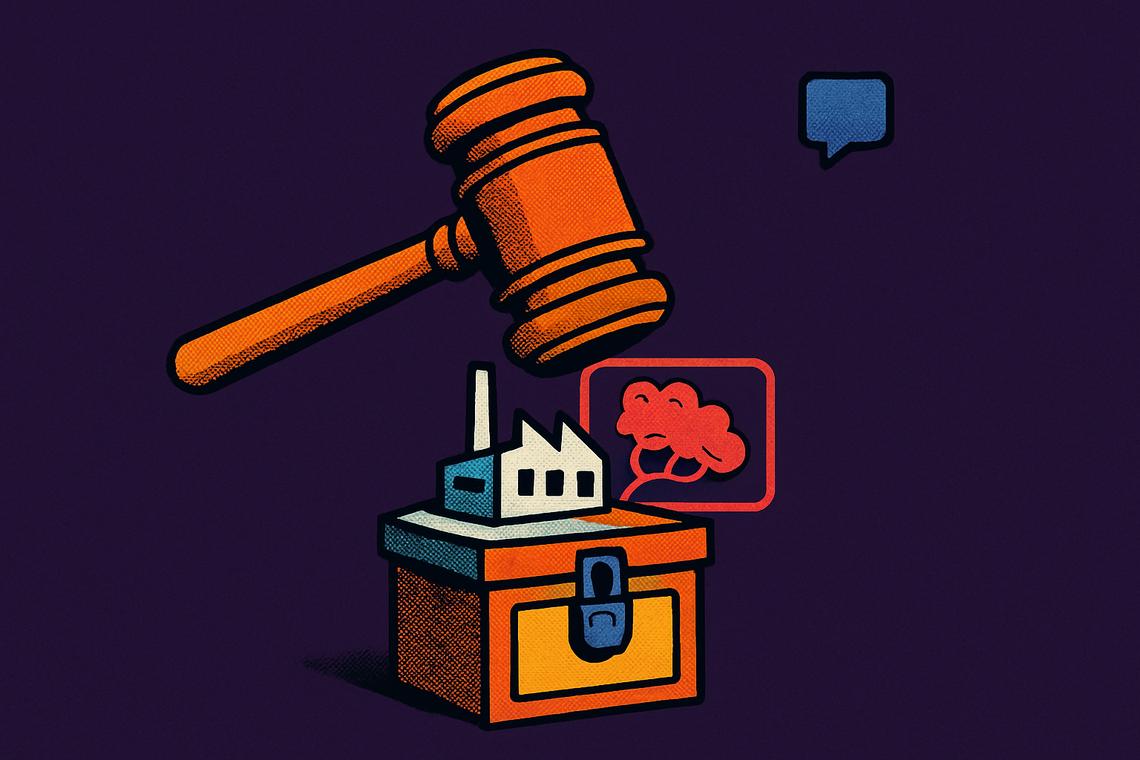
Considering whether AI chatbots might be legally declared a public nuisance. gettyIn today’s column, I examine a recently concluded New Mexico court case that declared Meta’s social media to be a legally prohibited public nuisance in that state. This was an unprecedented ruling. It is the first instance of successfully bringing a public nuisance charge against social media, and it has now opened the floodgates for other states to pursue the same legal line of attack against social media firms. That alone is newsworthy.Here’s the added twist. It is entirely conceivable that this crucial ruling could provide fodder to apply the same overarching public nuisance label to modern-day AI chatbots. Yes, for those who believe AI makers have allowed their generative AI and large language models (LLMs) to go too far, including excessive sycophancy and the AI offering ad hoc mental health guidance that might send people over the bend, the specter of public nuisance as a new legal hammer has arisen. In a series of posts, I will take a close look at how the legal charge of public nuisance could be the next big means of forcing AI makers to improve AI safety and adopt a more mindful approach to devising and fielding their AI wares.Let’s talk about it. This analysis of AI breakthroughs is part of my ongoing Forbes column coverage on the latest in AI, including identifying and explaining various impactful AI complexities (see the link here). The Pace Of AI AdvancesI’m sure that you already know that the pace of AI advancements is frenetic. Almost every day there is a new announcement about some resoundingly breathtaking AI innovation. Whereas this used to be a once-a-year kind of pronouncement, we have shifted to daily occurrences. Anyone who does doomscrolling on their smartphone can observe AI breakthrough announcements that arrive on a nearly hourly or minute-by-minute basis.The ordinary reaction would be that this is an exciting time to be alive. We are all in the front row when it comes to AI advancing and changing our lives. Imagine that fifty years ago the world at large could only dream of such an amazing pace. And, perhaps fifty years from now, in the future, the whole kit-and-caboodle will have slowed down after we’ve already exhausted all feasible AI innovations (well, some believe there will be even more, due to AI generating discoveries on behalf of humans).Here’s the problem at hand. The pace of technological advancement is outdoing the pace of figuring out how to handle the ramifications of this newest AI. Policies about guiding AI development and controlling its downsides are slowly being churned out. Laws that protect the public from runaway AI are only now being crafted and potentially put in place. The issue is that the AI tech advances are happening at lightning speed, and we are collectively far beyond the end of our skis. For my detailed coverage of this head-scratching conundrum, see the link here.Legal Angles To PursueThe question arises as to what legal angles can be pursued to try to ensure that AI makers incorporate AI safety integrally into their efforts. Rather than AI safety being a low priority or something that just happens to get lip service, there seemingly should be a viable legal means to put their feet to the fire. Force the AI makers to put AI safety at the top of their list of things to be taken seriously and pursued vigorously.A novel legal perspective is to consider that AI makers could be in trouble for allowing their AI chatbots to be a kind of public nuisance. I know that might sound a bit like an overstretch. We tend to think of public nuisances from an entirely different viewpoint. For example, when a factory in a town is caught polluting the local waters, that’s a circumstance where the charge of public nuisance is usually legally applied. Is an AI chatbot akin to a factory that is polluting the local waters?Some would say that it is. The logical argument is that an AI chatbot that is available in a jurisdiction is potentially polluting the minds of those who interact with the AI. Furthermore, there is a cascading effect. The people who have their minds polluted by AI will interact with and impact other people in that same jurisdiction. Thus, the AI started a mind-damaging snowball that has ramifications as it rolls down the societal hill.If this seems far-fetched as a legal tactic, well, we now have the application of the legal charge of public nuisance having been successfully won in a recent court case in New Mexico, though admittedly that case was focused on social media and not AI chatbots. One ardent belief is that AI chatbots are a mere baby step away from the realm of social media. Ergo, the social media instance of public nuisance provides great fodder for a potential legal pursuit of AI makers when it comes to their acts of an alleged public nuisance nature.Public Nuisance Legal AspectsLet’s first identify what the legal underpinnings are when it comes to saying that something or someone is a public nuisance.The conventional legal characterization of a public nuisance is that any conduct which materially interferes with the rights of the public can be construed as potential harm to the public and can receive legal redress. Each of the U.S. states defines the legal meaning of “public nuisance” in varying ways. For example, the California Penal Code indicates that a public nuisance is “anything which is injurious to health, or is indecent, or offensive to the senses, or an obstruction to the free use of property, by an entire community or neighborhood, or by any considerable number of persons” and so on.A notable element of public nuisance is that it must have a bearing on the public, which contrasts with a situation where a nuisance only bears on a private situation. If a factory was polluting and the pollution only impacted neighboring private land, and had zero spillovers into the public spaces, you would be hard pressed to apply the public nuisance label. Another vital factor is that some form of harm must be involved. Just because a matter extends into the public space is not sufficient to reach a conclusion that it is a public nuisance. What is the harm of the matter? Who is harmed? To what degree is the harm occurring or has occurred? If there is no identifiable harm, the nuisance portion of the equation won’t be satisfied.Legal Scholars Address Public NuisanceA scholarly look at the legal basis of “public nuisances” is skillfully undertaken in an article published in the Yale Law Review entitled “The Perils and Promise of Public Nuisance” by Leslie Kendrick, January 31, 2023, and makes these crucial points (excerpts):“Public nuisance has influenced American tort litigation and exerted an undeniable regulatory impact.”“In the past decades, this common-law oddity has generated thousands of lawsuits in which state officials have sued private companies for the negative impact of their products or activities on public health and welfare.”“Twenty-five years ago, it provided architecture for the lawsuits that impelled the tobacco industry to historic settlements of $246 billion with all fifty states.”“One striking feature of public nuisance is that it permits state officials to sue parens patriae -- literally as ‘parent of the nation,’ on behalf of the people of a jurisdiction – for an infringement on public rights by a private actor.”“It has also spurred hundreds of mostly unsuccessful actions across the nation involving, among other things, handguns, lead contamination, water pollution, and predatory lending.”You can plainly see from those key points that the legal use of public nuisance has been well-documented and often applied. The most notable instances are when public nuisance has been used against entire sectors, such as the big tobacco companies. Do not assume that the public nuisance route is an easy one. Legally, there is often an uphill battle when it comes to making public nuisance charges that will land successfully. Courts and juries are not a pushover when it comes to claims of public nuisance. The legal threshold is typically a relatively high one.Ruling On The Public Nuisance ChargeIn the social media court case of State of New Mexico v. Meta Platforms Inc., and per the document “Findings of Fact, Conclusions of Law, and Judgment, Order, and Decree of the Court”, filed August 6, 2026, these key points were made (excerpts):“Meta’s platforms create a public nuisance because their purpose and effect is to optimize engagement, including in ways that are detrimental to teenagers’ health and safety, and in ways that affect public resources.”“The Court considers Meta’s platforms to be analogous to a factory, the advertising and other content displayed on those platforms to be what is produced by the factory, and the psychological harm to and sexual exploitation of children to be the pollution that must be abated.” “Meta is liable for abating the public nuisance even though social, environmental, and other factors also injure New Mexico teenagers’ mental health.”“The Court orders Meta to pay and deposit a total of $567,000,000.00 into an abatement fund.”Per those notable points, the judge decided that Meta’s social media had indeed been a public nuisance. An abatement fund is to be established to the tune of nearly $600 million. Some would angrily say that the abatement amount is minuscule and won’t move the needle for a large firm such as Meta. Others insist that it is a reasonable amount and a good start toward holding social media companies accountable.We don’t know if the ruling will survive appeal. Meta already indicated they plan to appeal the ruling. It could be that the appeals court will later decide that the public nuisance portion of the case was somehow flawed and ought to be tossed out. The bottom line is that though this is a new precedent, there is no way of knowing whether the precedent will have a lasting role or be overturned and fall by the wayside. Time will tell.AI Chatbots As Public NuisanceThis brings us to the juncture of pondering whether the public nuisance characterization can be applied to the acts of AI makers and their AI chatbots. The belief is that if social media is construed as a public nuisance, we can readily take the logical step toward claiming that AI chatbots are also a public nuisance.Recall that a public nuisance must have impacted the public and must have done so in some harmful manner. The New Mexico case argued that social media was in fact used by the public, and that the usage included harms to the public. There is little doubt that AI chatbots are being used by the public; that’s for sure. But are AI chatbots also imparting harm?Some would vehemently say that AI is causing harm. I’ve previously covered the many concerns of AI chatbots mentally harming people in a wide variety of ways; see my analyses at the link here. One issue is that AI makers tune their AI chatbots to be sycophantic, fawning over users and misleading them into believing they are fantastic in whatever they think and want to do. This can lead to dire consequences. There are also issues with AI providing ad hoc mental health guidance, doing so without any formal certification or similar protections about the quality of such advice. And there is apprehension about the rise of so-called AI psychosis, whereby people come under the wicked spell of AI; see my discussion at the link here.The central ingredients of a public nuisance charge seem to be in play.The World AheadAll in all, AI makers are potentially vulnerable to accusations of being a public nuisance when it comes to what their generative AI and LLMs are doing. Pressure from the public could spur states to go down that path. Policymakers and lawmakers might urge their state agencies to pursue that angle. AI makers will need to get their ducks in a row, anticipating beforehand whether they are walking in the direction of a public nuisance charge, and be preparing to defend themselves accordingly.Florida has opted to pursue a public nuisance charge against OpenAI and Sam Altman, and I will soon be posting an analysis of those efforts. Stay tuned. I expect that other states are going to likewise file lawsuits against AI makers based on public nuisance, though many states might wait to first see what happens with the Florida case. The Florida case could be a bellwether that opens the floodgates or causes states to think twice about leaning into the public nuisance charge against AI makers, depending on the outcome of the case.A final thought for now. The famous Roman playwright Plautus made this pointed remark: “No guest is so welcome in a friend's house that they will not become a nuisance after three days.” AI has many positive qualities but also has many downsides. As a guest in the house of the public at large, it could be argued that AI has veered into being a public nuisance. This doesn’t mean that AI is to be summarily rejected and expunged. It just means that as a dutiful house guest, AI needs to be shaped by AI makers to be a prim and proper member of the public sphere. The law might make that so.
Judge Declares Meta’s Social Media Is A ‘Public Nuisance’ Which Spells Legal Trouble For AI Chatbots Too
New Mexico court case decided Meta's social media is a legal public nuisance. Might this same tag be applied to AI makers and their AI chatbots? An AI Insider analysis.
TL;DRAI
New Mexico court labels Meta a public nuisance—first legal action of this type against social media. AI makers now face identical exposure: regulators can claim unsafe chatbots harm public interests, converting AI safety from voluntary practice to legally enforced standard.
2,215 words~10 min read