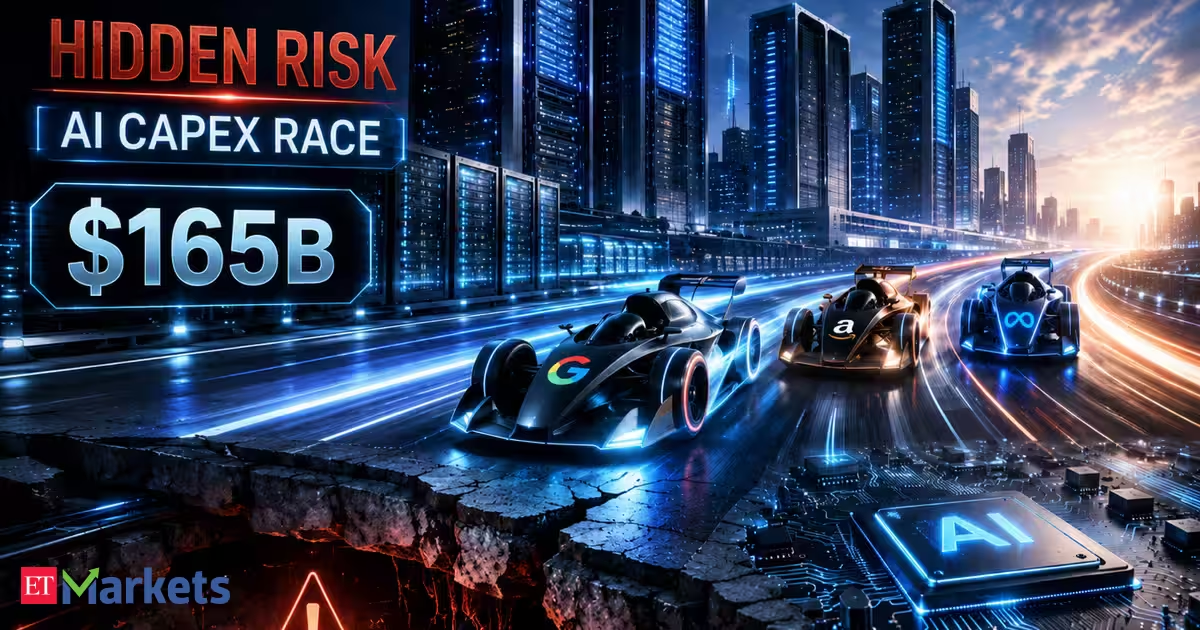
Big Tech’s artificial intelligence investment race is driving a cash flow squeeze at the heart of the US stock market. Microsoft, Amazon, Alphabet and Meta Platforms spent a combined $165 billion on capital expenditure in the second quarter, while generating just $7 billion in free cash flow, according to a report by Jefferies’ Global Head of Equity Strategy Christopher Wood.Consensus forecasts cited by Wood show the four hyperscalers’ aggregate free cash flow falling to negative $12 billion in the third quarter. That would mark a dramatic reversal from the $60 billion generated in the final three months of 2025.“The free cash flow generation of the S&P500 in aggregate has begun to deteriorate,” Wood wrote in his GREED & fear report, attributing the decline primarily to the “continuing capex binge by the four hyperscalers.”The quartet accounts for 17.7% of the S&P 500, making the erosion in their cash generation a broader market issue. The index’s free cash flow yield has fallen to 2.65% from 4.76% in October 2022, though it remains above the recent low of 2.50% reached in October 2025.Big Tech’s combined capital expenditure has more than doubled from $72 billion in the first quarter of 2025. The spending surge is unfolding as Microsoft, Amazon, Alphabet and Meta compete to build the computing infrastructure required for AI models and services.The more concealed risk lies in who is underpinning the expected returns from that investment.OpenAI and Anthropic, the two leading frontier AI laboratories, account for an estimated 45% to 50% of Amazon’s contracted revenue backlog, about 40% of Google’s and 30% to 40% of Microsoft’s, according to estimates from Jefferies’ US technology analysts cited in the report.That concentration is significant because the AI laboratories are cash burning customers, Wood wrote, potentially making them riskier counterparties than traditional corporate cloud clients.The exposure is already material in current revenue. OpenAI and Anthropic accounted for roughly 45% of Google Cloud Platform revenue in the second quarter and about 25% of Microsoft Azure revenue, according to Jefferies’ estimates. Their contribution to Amazon Web Services was lower at roughly 6%, but Jefferies expects that share to rise two to three times to between 12% and 18% in the third quarter.The dependence on AI customers contrasts with their still modest contribution to the hyperscalers’ overall cloud businesses. Wood estimates that AI-related services generate only about 15% of their cloud revenue, with traditional cloud services supplying the remaining 85%.Amazon CEO Andy Jassy said AWS operated at a $169 billion annualised revenue run rate in the second quarter, while its AI business exceeded a $25 billion annualised run rate. That implies AI represented about 15% of AWS revenue.Microsoft disclosed $24.1 billion of revenue from commercial arrangements with OpenAI, including revenue-sharing payments, in the fiscal year ended June 30. Azure revenue exceeded $100 billion for the first time during the period.Microsoft CEO Satya Nadella said in April that the company’s AI business had surpassed a $37 billion annual revenue run rate, an increase of 123% from a year earlier. Based on the data cited by Wood, OpenAI accounted for about 24% of Azure revenue and roughly 70% of Microsoft’s AI business.The investment case remains supported by rapid cloud growth. Aggregate cloud revenue at Microsoft, Google and Amazon climbed 38% from a year earlier to $126 billion in the second quarter.Their contracted revenue backlog also reached $2.34 trillion, rising 186%, or $1.52 trillion, over four quarters. The backlog stood at $816 billion at the end of the second quarter of 2025.Investors are betting that this growth will generate an adequate return on the soaring expenditure as the hyperscalers “turn into data factories,” Wood wrote. The expanding role of cash-burning AI laboratories in that backlog, however, complicates the quality and visibility of those prospective returns.For now, the AI spending cycle continues to deliver exceptional earnings growth elsewhere in the supply chain. Wood described the “AI capex arms race” as extremely earnings-accretive because the “picks and shovels plays book their profits upfront,” while the hyperscalers recognise the cost of their investment over time through depreciation.The four companies’ combined depreciation and amortisation expense was $44.5 billion in the second quarter, up 24% from a year earlier. That was far below their quarterly capital expenditure.Jefferies estimates annualised earnings growth of 48% for its S&P 500 AI basket over 2026 and 2027, led by memory and packaging companies, computing businesses and AI server suppliers. That compares with estimated growth of 23% for the S&P 500 and 12% for the index excluding AI stocks.Also read: FIIs dumped nearly Rs 1 lakh crore worth of these 10 stocks but 8 defied the selloffThe wider earnings backdrop is also robust. S&P 500 earnings rose 40.6% from a year earlier in the second quarter, the fastest post-global-financial-crisis growth excluding the Covid period. Consensus forecasts point to growth of 28.6% in the third quarter, up from the 16.1% projected last October.Wood’s analysis shifts the focus from how much Big Tech is spending to whether its increasingly concentrated group of AI customers can ultimately deliver sufficient cash returns on that investment.(Disclaimer: Recommendations, suggestions, views and opinions given by the experts are their own. These do not represent the views of Economic Times)
Jefferies’ Chris Wood spots a hidden risk in Big Tech’s $165 billion AI capex race
Big Techs AI capex surge is putting pressure on free cash flow, with Microsoft, Amazon, Alphabet and Meta spending $165 billion in Q2 against just $7 billion in free cash flow. Jefferies Chris Wood warns that growing reliance on cash-burning AI firms OpenAI and Anthropic could pose a hidden risk.
TL;DRAI
Big Tech's $165B AI capex generated $7B free cash flow in Q2, falling to -$12B forecast; OpenAI/Anthropic represent 40-50% of backlog but burn cash. Tech managers face concentration risk: hyperscalers' capex ROI hinges on unprofitable AI labs becoming sustainable.
860 words~4 min read