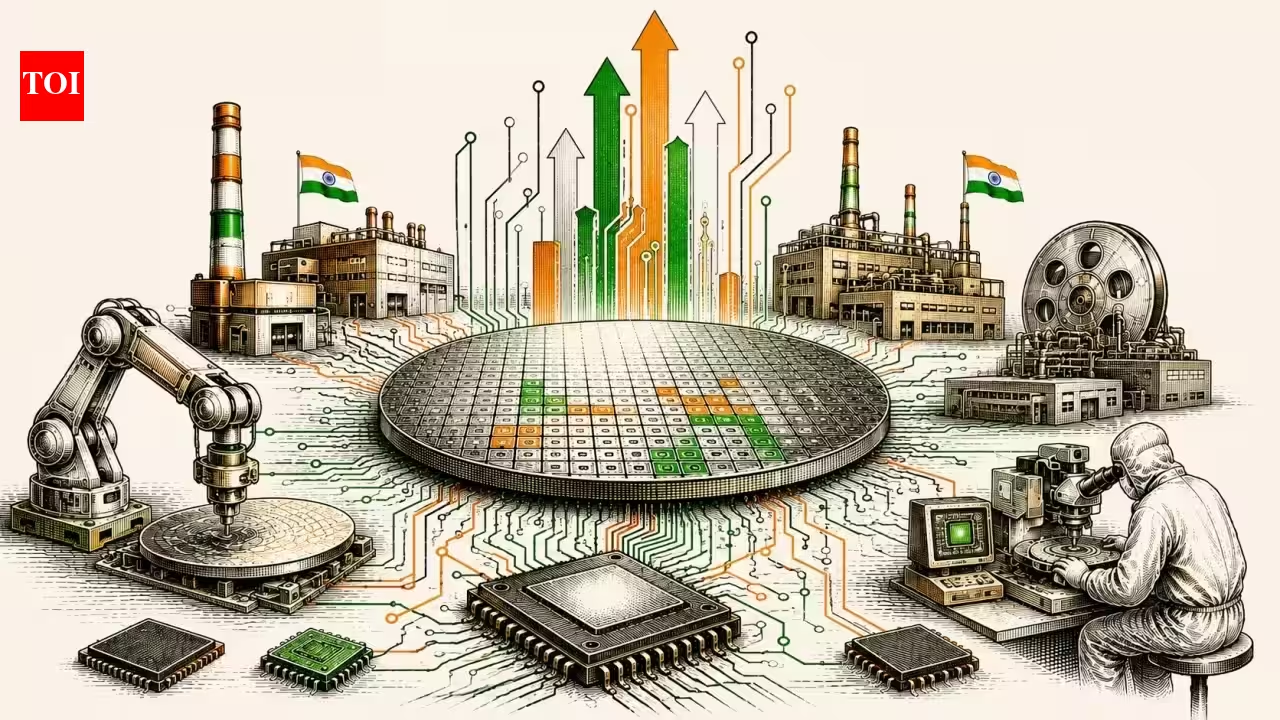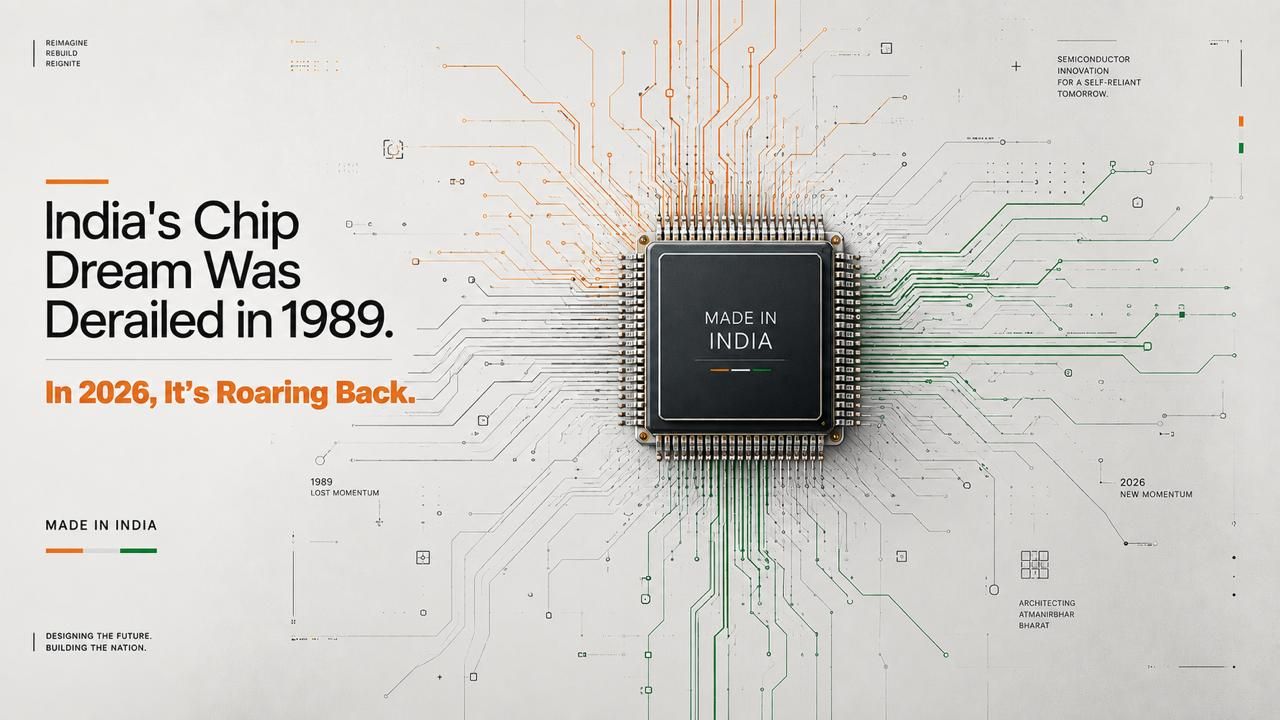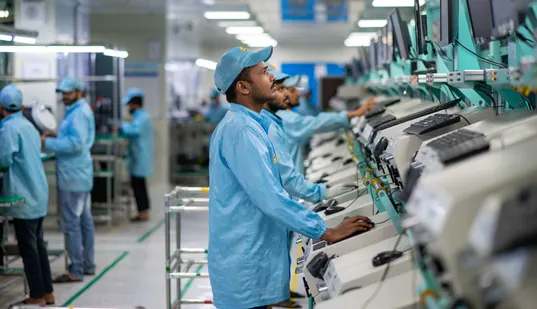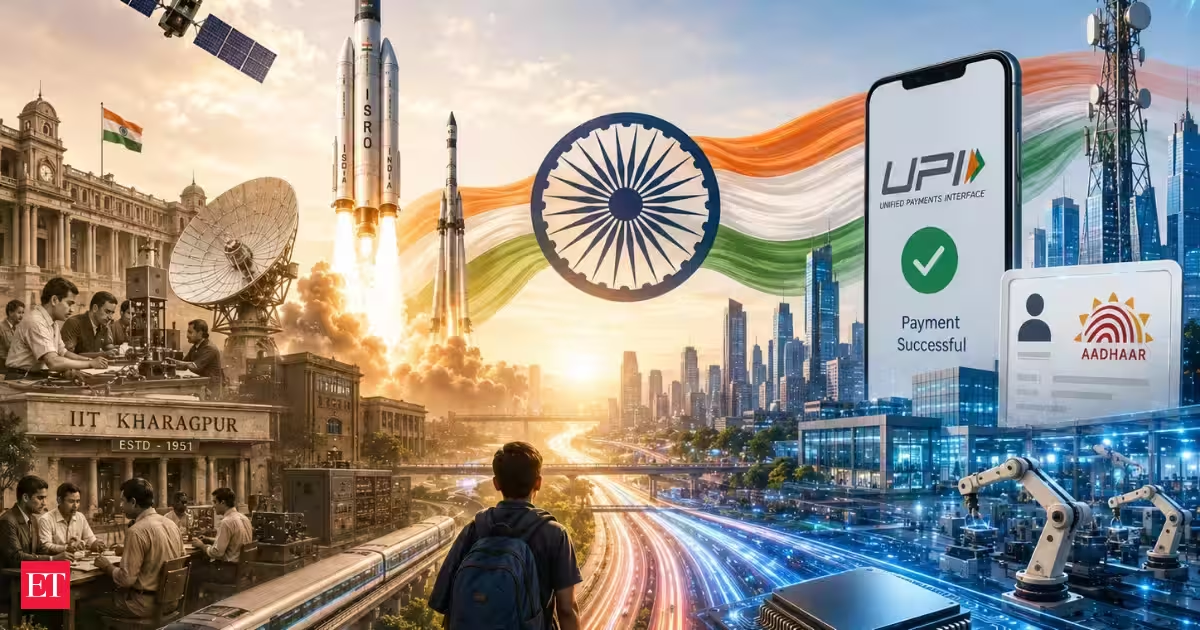
Over the 79 years of India’s technological journey since Independence, the country has transformed from an importer of ideas into a global technology powerhouse. As India celebrates its 80th Independence Day, the next chapter of that journey could be its most ambitious yet.In 1905, the Swadeshi movement laid the foundations of economic self-reliance by urging Indians to reject foreign cloth and build indigenous industry.Also Read: Independence Day 2026: A 1968 gold ban that turned every Indian household into an underground vaultNearly eight decades after Independence, that pursuit of self-reliance has taken forms the country's founding leaders could barely have imagined.India now has more than 1.09 billion internet subscribers and 1.06 billion broadband subscribers, according to the Telecom Regulatory Authority of India (TRAI). Its technology industry is expected to cross $315 billion in revenue in FY26, according to NASSCOM.The vocabulary has changed — from steel plants to semiconductor fabs, from software code to GPUs. But the ambition has remained remarkably consistent.From building capability to scaling itIn the years after Independence, India was trying to build a modern economy from scratch.The First Five-Year Plan, launched in 1951, focused on agriculture, irrigation and reconstruction, even as the young republic built the scientific institutions that would underpin its industrial ambitions. IIT Kharagpur began its academic programme that year. The Atomic Energy Commission had been established in 1948, followed by the Department of Atomic Energy in 1954 and DRDO in 1958.These institutions were not designed to produce technology companies; they were designed to create scientific and technical capability.That capability gradually translated into achievements in space, telecom and computing. ISRO was established in 1969, Aryabhata was launched in 1975 and C-DOT was created in 1984 to develop indigenous telecom technologies.India’s push for computing self-reliance followed a similar path. After the US denied India access to an advanced supercomputer, the government established C-DAC in 1988, which went on to develop the PARAM series of supercomputers.(AI-generated image)Economic liberalisation in 1991 changed the trajectory. For four decades, India had focused on building capability. Now it could commercialise it.Also Read: India won political freedom in 1947. Financial freedom is the next frontierTelecom opened to private participation. The internet arrived. Global companies discovered India's growing pool of English-speaking engineers.TCS, Infosys, Wipro and HCL expanded rapidly. Bengaluru, Hyderabad and Pune became global technology centres. Y2K and business-process outsourcing cemented India's reputation as the world's back office.What began as a small export industry has become a $315-billion technology sector, according to NASSCOM, with direct employment approaching 6 million.But the IT revolution was still largely linear. India produced talent. That talent produced software. The software was exported.Then the smartphone arrived, linking software, connectivity and consumers.When technology became a webThe spread of affordable smartphones and cheap mobile data changed not just how Indians accessed technology, but what technology could be built for them.Aadhaar created a digital identity layer. Jan Dhan bank accounts expanded access to formal finance. Mobile connectivity linked the two. UPI then created a real-time payments layer.Together, these became the foundation of India's Digital Public Infrastructure (DPI).(AI-generated image) The scale today is staggering. UPI processed 23.66 billion transactions worth Rs 29.88 lakh crore in July 2026 alone, according to the National Payments Corporation of India (NPCI).The significance of UPI is that a common digital rail allows banks, fintech companies, merchants and consumers to build on top of the same infrastructure.The technology stack feeds itself.Connectivity feeds DPI. DPI feeds fintech. Fintech creates data. Data and cloud feed AI. AI creates demand for computing. Computing creates demand for semiconductors. Semiconductors create demand for electronics manufacturing. Manufacturing creates exports. Policy is increasingly designed to connect these pieces.From digital India to manufacturing IndiaIndia's technology ambitions are no longer confined to software. The same country that spent decades exporting code is now trying to become a manufacturing and export hub for the physical technologies that power the digital economy.The Production Linked Incentive, or PLI, schemes are central to that shift.(AI-generated image)The government says its 14 PLI schemes had attracted more than Rs 2.40 lakh crore in investment and generated more than 14.15 lakh direct and indirect jobs by March 2026, while driving more than Rs 15.2 lakh crore in exports.Also Read: Independence Day 2026: The hidden role of food in India's fight against British ruleElectronics is one of the clearest examples. Under the large-scale electronics manufacturing PLI scheme, cumulative investment had crossed Rs 20,600 crore, production Rs 11.62 lakh crore and exports Rs 6.53 lakh crore by March 2026, according to the Ministry of Electronics & Information Technology (MeitY).The semiconductor momentThe semiconductor push is an attempt to move deeper into the technology stack. In July 2026, the Union Cabinet approved Semicon 2.0 with a Rs 1,27,500-crore outlay to strengthen India's semiconductor design and manufacturing ecosystem.(AI-generated image)The ambition is significant because chips sit underneath almost every technology India is now trying to build — smartphones, telecom equipment, automobiles, defence systems, data centres and artificial intelligence.The IndiaAI Mission is moving in parallel. Approved with an outlay of Rs 10,371.92 crore over five years, its compute programme had onboarded more than 38,000 GPUs by early 2026, according to the Ministry of Electronics & Information Technology (MeitY).(AI-generated image)This is where India's technology journey has become a web rather than a line. The semiconductor mission supports electronics. Electronics supports telecom. Telecom supports digital public infrastructure. DPI supports fintech and digital commerce.Those systems generate data and demand for computing. AI increases demand for GPUs and semiconductors. And the entire ecosystem creates demand for engineers, research, manufacturing and capital.The next technology testThe transformation is also visible in India's Global Capability Centres (GCCs). These were once primarily back-office operations. Increasingly, they are becoming global engineering and research centres.Government data showed India had more than 1,700 GCCs employing 1.9 million professionals and generating $64.6 billion in revenue in 2024, with the centres expanding into areas including AI, cybersecurity, cloud computing and semiconductors.India's role in global technology is changing again. First, India supplied labour. Then it supplied software. Increasingly, it supplies engineering, research, products and manufacturing. But becoming a technology power will require more than scale.India's R&D spending rose from around Rs 60,200 crore in 2010-11 to Rs 1.27 lakh crore in 2020-21, but remained just 0.64% of GDP, according to the Department of Science and Technology.The software revolution rewarded India's ability to produce engineers at competitive cost.The AI and semiconductor revolutions will reward ecosystems — universities, research institutions, private capital, manufacturing capacity, intellectual property, computing infrastructure and specialised talent working together.A new meaning of SwadeshiEvery generation has redefined what technological self-reliance means. For the freedom movement, Swadeshi was about producing what India consumed.For the generation after Independence, it meant building laboratories, engineering colleges and scientific institutions.For the software generation, it meant proving that Indian talent could compete with the world. For today's India, it means something broader.It means building the digital rails used by hundreds of millions of people. It means manufacturing smartphones and electronics for the world. It means building semiconductor capacity, AI compute and research ecosystems. It means moving from services to products, from implementation to intellectual property and from assembling technology to developing what lies inside it.The tools have changed dramatically over 79 years. The aspiration has not.From Swadeshi to satellites, from software exports to UPI, from 4G and 5G to AI and semiconductors, India's technological journey has always been driven by the same idea: political independence is strengthened when it is matched by technological capability.The first era taught India how to build. The second taught it how to scale.The new era is about something more ambitious — building an ecosystem that allows India not just to use the technologies of the future, but to make, own and export them.
Independence Day 2026: The 79-year journey of a nation from charkha to chips
Independence Day: Story of India's technological rise now focuses on indigenous manufacturing and ambitious future goals. Digital public infrastructure and affordable smartphones fueled this significant technological evolution. Production linked incentive schemes drive electronics and semiconductor manufacturing growth. India aims to build, own, and export future technologies.
1,276 words~6 min read