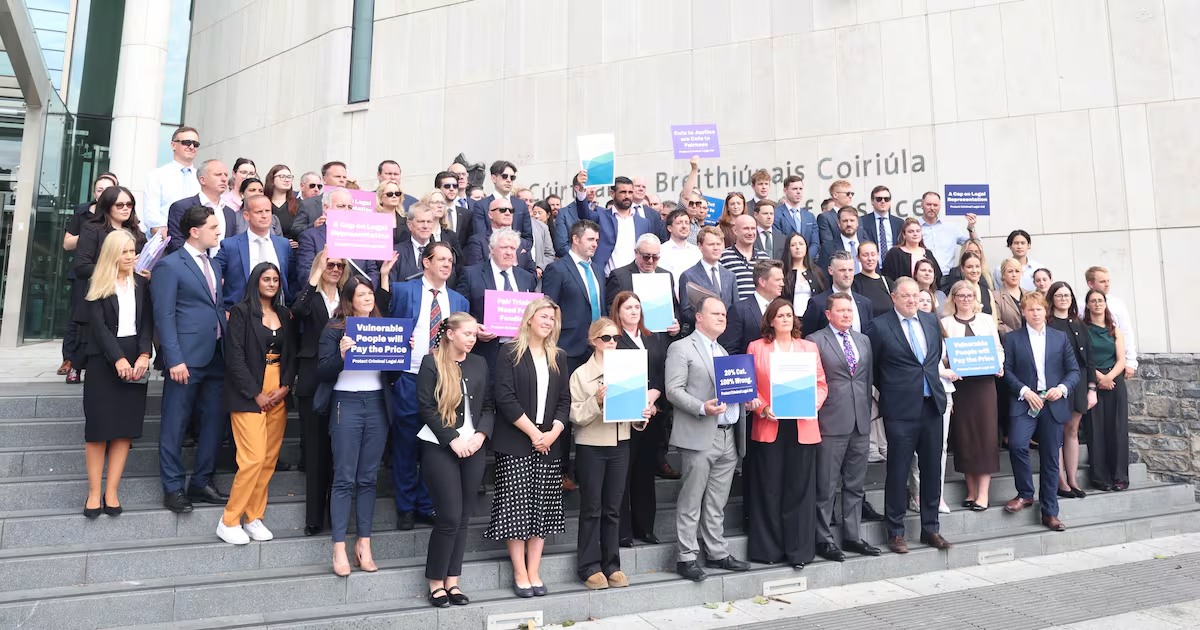
The Law Society of Ireland has proposed compromise measures aimed at resolving the dispute between solicitors and the Government over criminal legal aid payments.The organisation has suggested a cap on the number of legal aid certificates granted to one defendant in a court on a single day – a measure aimed at easing Government concerns over multiple legal aid payments for defendants charged with several offences.The Law Society has also proposed that long-running cases would see a second legal aid certificate issued when cases exceed 10 court appearances. The proposals were set out in a letter from Law Society president Rosemarie Loftus to Minister for Justice Jim O’Callaghan at the end of July.The row between solicitors and the Government – which has resulted in work stoppages in the criminal courts as solicitors opposed the new system – arose over the introduction of a flat fee payment at the beginning of July. There was a meeting between O’Callaghan and Law Society representatives on July 27th. The following day O’Callaghan wrote to the Law Society and announced he was sticking with the flat fee payment of €520, irrespective of how many appearances solicitors make to represent a client in District Court cases.In a bid to break the deadlock he agreed to pay two-thirds of the fee at the start of a case and the remaining one-third at the conclusion of the case or 12 months later, whichever comes first.[ Jim O’Callaghan vs the solicitors: Minister under siege as criminal legal aid dispute escalatesOpens in new window ]Loftus wrote to O’Callaghan on July 31st and said that “several positive developments are welcome”.However, she added: “the feedback we have received from criminal law solicitors nationwide is that these changes do not, of themselves, address significant practical concerns”.Loftus wrote that the Law Society believed two issues “remain critical” – these were “separate cases with distinct facts” and “cases of extended duration”. On the first issue she wrote that “criminal practitioners understand the concern you have identified regarding the previous operation of the scheme, wherein numerous certificates could arise from what is, in substance, a single set of circumstances.”However, she argued O’Callaghan’s proposal “moves too far in the opposite direction”.She gave an example of a defendant being charged with three separate types of offences in three different locations that could be brought against the one defendant on the one day. “Under the current Scheme these cases would result in just one Legal Aid Certificate ... whereas three Legal Aid Certificates would issue if these three cases commenced on separate dates,” she wrote. “The workload involved in both scenarios is the same” and “does not diminish or disappear merely because the cases happen to be listed before the same judge on the same day.”She wrote “a possible compromise is that legal aid certificates should only be issued for separate and distinct cases committed on separate dates and placing a cap of five on the number of certificates that can be granted to one defendant in one court on one day”.On cases of extended duration, Loftus said there are categories of cases where the length of proceedings due to the number of court appearances are “considerably longer” and they are typically those involving children, people with mental health issues and those remanded in custody by judges.“Under the new Scheme a solicitor who represents someone in court for a non-complex matter will be paid the same as someone who represents a troubled child in a complex case involving 20+ court appearances.”Loftus suggested that as an interim measure, pending the completion of a review O’Callaghan has announced, “that a practical and proportionate solution would be to issue a further legal aid certificate where a case exceeds 10 court appearances.” “The two adjustments outlined above would alleviate the principal remaining concerns regarding the operation of the scheme,” she told O’Callaghan. A Department of Justice statement said the contents of the correspondence are “under consideration”. “The Minister is committed to improving efficiencies for court users, legal practitioners and the Irish public. The new District Court Criminal Legal Aid Scheme provides for those efficiencies.”A Law Society spokeswoman said: “As outlined in the letter, we are available to engage and meet with the Minister and his officials at any time.”
Law society proposed compromises aimed at resolving dispute over criminal legal aid payments
Letter sent to Jim O’Callaghan setting out measures that could end row ‘under consideration’ by Department of Justice
706 words~3 min read