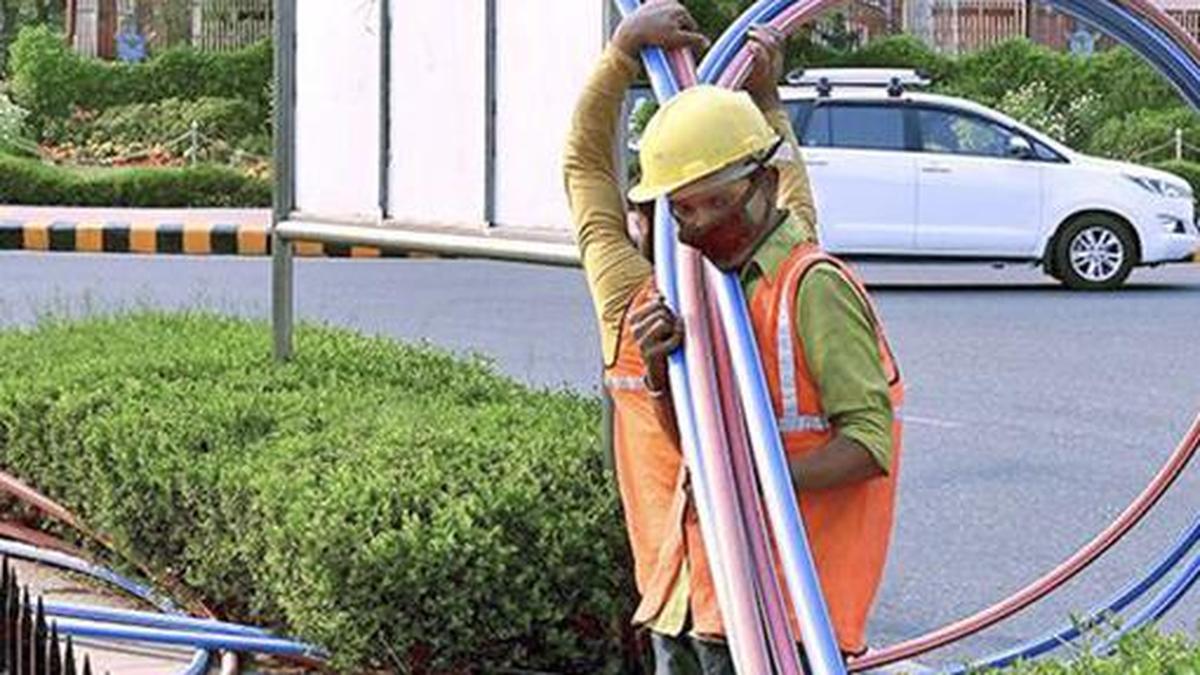
The BharatNet project was conceived in October 2011 and has been executed through a special purpose vehicle, Bharat Broadband Network Ltd
| Photo Credit:
The government's rural high-speed broadband project BharatNet fell short of its broader objective to bridge the digital divide, mainly due to deficiencies in planning and execution, the Comptroller and Auditor General of India said on Thursday.In an official statement on ‘Performance Audit on BharatNet’ of its second phase tabled in Parliament on August 12, the Comptroller and Auditor General of India (CAG) said the network infrastructure has been largely deployed, covering over 96.70 per cent (November 2025) of targeted GPs. However, the same could not be translated into efficient operation, utilisation and revenue generation."Audit concludes that while BharatNet has achieved substantial infrastructural success, it has fallen short of its broader objective of bridging the digital divide," the CAG said.The BharatNet project was conceived in October 2011 and has been executed through a special purpose vehicle, Bharat Broadband Network Ltd (BBNL), incorporated in 2012.As of November 2025, an expenditure of ₹39,888 crore has been incurred against an approved budget of ₹42,068 crore, comprising ₹11,148 crore in Phase-I and ₹30,920 crore in Phase-II."We found deficiencies in the project's planning and implementation. Though Phase-II was planned in 20 states (21 Circles) through three implementation models – Central Public Sector Undertaking (CPSU)-led model, state-led model and private-led model, it could be implemented in 13 states (14 Circles) only," the auditor said.As of November 2025, only 33.20 per cent of service-ready GPs were operational, it added."The main cause of downtime was fibre faults or cuts, accounting for approximately 48 per cent of non-operational cases. Moreover, the Mean Time to Restore (MTTR) for fibre faults stood at an average of 17 days, reflecting delayed maintenance response," the CAG said.The auditor said that only six states (seven circles) achieved 100 per cent service-ready status, with delays ranging from two to six years across all the implementation models as of November 2025."The delayed roll-out deferred the availability of broadband connectivity in rural areas envisaged to enable access to services, such as education, healthcare, business, entertainment, and e-governance to the rural population, thereby undermining the objective of early socio-economic transformation," the CAG said.The auditor found that the inability to integrate fibre fault localisation systems hampered maintenance. The operational status of BharatNet remains a challenge across states, except in Gujarat and Punjab, where the operational GPs were above 90 per cent.CAG said the project was conceived to be self-sustaining, but high maintenance costs vis-a-vis paltry revenue have cut short that expectation."Financial oversight emerged as a concern," it added.The auditor found that the milestone-based payment model was weakest under the CPSU-led model, contributing to lower service delivery, while the private-led model demonstrated stronger financial discipline and better service delivery."We also noted that BSNL under the CPSU-led model diverted funds of ₹2,001.43 crore from the project for other purposes, which has since been recouped and submission of Utilisation Certificates is now required under the Amended BharatNet Program (ABP)," the CAG said.Published on August 14, 2026