Over the past two years, Pakistan-UAE trade relationship was seen tested and, in the end, strengthened. The numbers alone tell a story of long-term resilience, a pace that reflected genuine momentum, not a one-off surge. As the UAE is Pakistan’s third-largest trading partner, both maintain a vital economic cooperation across trade, logistics, ports, energy, banking, manufacturing and digital economy. According to the State Bank of Pakistan, the total merchandise bilateral trade crossed $10.5 billion during FY 2025-2026, with our exports to the UAE topping over $2.1 billion. Food and agricultural products, textiles and apparel, chemicals, plastics and other manufactured goods continue to anchor what we sell here from our export basket.During pre-conflict period (Jul-Mar) 2025-26, the exports of Pakistan to the UAE showed an upward trend with an increase of 18 per cent to $1.65 billion. Then came the regional supply chain disruptions. The closure of Strait of Hormuz, suspension of operations by shipping lines, unavailability of vessels, air space disturbance and an overall regional situation slowed down the pace of exports. I will not pretend these were minor setbacks. For exporters who had built their year around predictable schedules for shipments, this was a real shock.Transforming crisis to advantageWhat we witnessed instead, was laudable. The UAE transformed the crisis into a strategic advantage where the overall supply chains adapted and emerged as more resilient. Since the UAE redirected trade through alternative ports like Khorfakkan and Fujairah and overland corridors via Oman and other regional countries to bypass high-risk maritime choke points, DP World and AD Ports Group kept their terminals running and also introduced alternative feeder services and real-time digital cargo tracking to maintain market continuity. On our side, some maritime traffic shifted toward Pakistan’s own transshipment terminals as an alternative when the traditional hubs came under strain. None of this happened by accident. It was the result of both governments and the private sector refusing to let maritime disruptions overcome.While focussing on enhanced regional connectivity and trade facilitation in the wake of recent marine troubles, Pakistan’s government showed utmost commitment to sustain its exports to the Middle East through targeted initiatives for substantial outcomes. The Mission in coordination with the Ministry of Commerce, Trade Development of Pakistan (TDAP), UAE authorities and other trade bodies held webinars, virtual business-to-business (B2B) meetings and awareness sessions on regulatory compliance, use of alternative routes, real-time information on food demand and handling of freight costs.Exploring new partnershipsCapitalising on the UAE’s location as a global hub with its robust business ecosystem, the dynamic participation of Pakistani exporters under TDAP in Dubai’s exhibitions including Gulfood, Arab Health, Gitex Global, Beauty World, Middle East Energy, ISM, The Big 5, InterSec, Gulfood Manufacturing, and Automechanika remained remarkable, which provided great opportunities to explore new partnerships and expand exports through various successful B2B engagements. This was made possible with the support of different UAE based Trade Missions, Chambers, Pakistani and other multinational Business Councils in the UAE.As the UAE has come a long way in diversifying its non-oil sectors, it rests on regional technology and innovation by making huge investments in artificial intelligence (AI), smart infrastructure, and digital governance. Pakistani IT companies also support this vision by scaling cross-border partnerships, raising IT exports to the UAE, and supplying specialized talent in AI, fintech, and cyber security.During the world’s largest tech event like Gitex Global, the Pakistan pavilion featured over 24 leading Pakistani IT companies, with a total of over 100 companies and 1,000+ C-level delegates and 50 leading start-ups highlighting one of Pakistan’s largest national representations. Pakistan’s IT exports to the UAE soared to a record-breaking $376 million in FY 2024–25, underscoring the strength of its rising footprint in global technology trade.Positioning Pakistan as a dependable and close-proximity agricultural supplier, over 140 Pakistani companies — of which 67 were facilitated by TDAP — achieved record participation to showcase agro-food products at Gulfood 2026 in Dubai. Similarly, Pakistan’s notable presence of over 40 companies in a mega event like the World Health Exhibition (WHX) 2026 underlined the country’s capabilities in a diverse range of innovative products aligned with global healthcare, surgical and pharmaceutical standards.It is equally important to point to the human resource dimension of this economic relationship. Remittances from the UAE to Pakistan rose 13 per cent to $8.8 billion this year, sent home by the 2.2 million Pakistanis living in the UAE. The Mission continues to work with banks and exchange companies to encourage the use of legal channels and to utilize instruments like the Pakistan Roshan Digital Account, because these flows matter as much to Pakistan’s economy as any trade figures.None of this is to suggest the work is done. The investment cooperation especially under G2G framework in areas of port infrastructure, special zones, banking, logistics, information technology and mining remains a real work in progress.The Mission maintains a close liaison with the Ministry of Investment in the UAE and Special Investment Facilitation Council (SIFC) in Pakistan to expand investments and continuing joint efforts to further strengthen this partnership.If this year taught us anything, it is that the Pakistan-UAE relationship does not simply survive disruption, it rather adapts, secures and often grows stronger for having been tested.
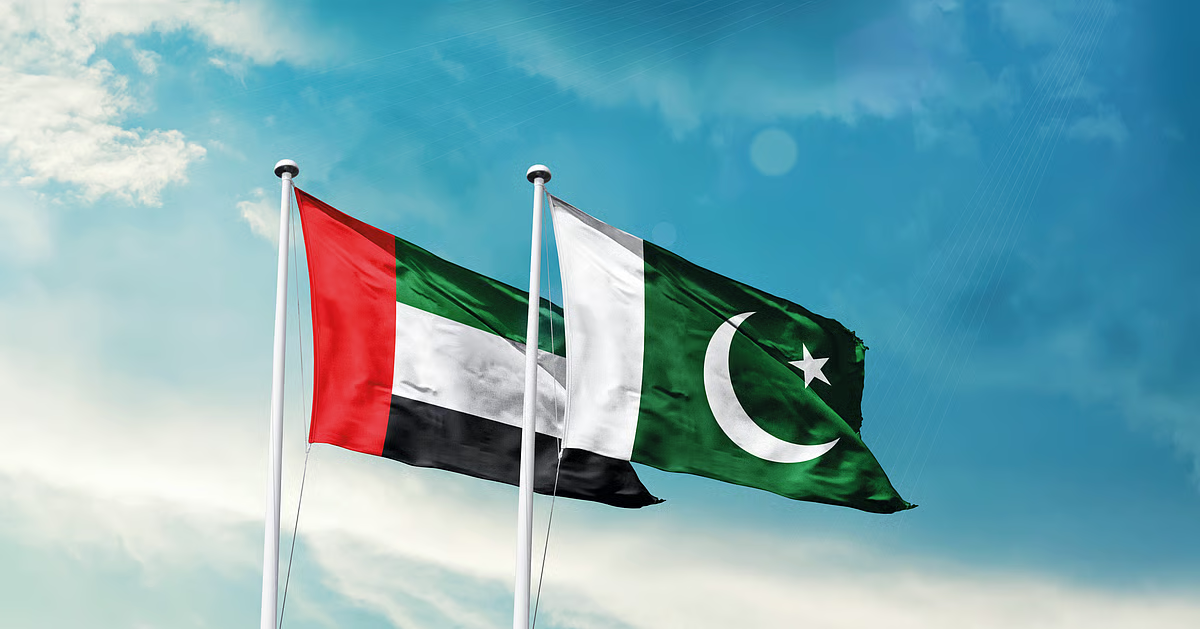
Pakistan-UAE bilateral trade remains strong, resilient
Navigating maritime disruptions and securing supply chains
861 words~4 min read