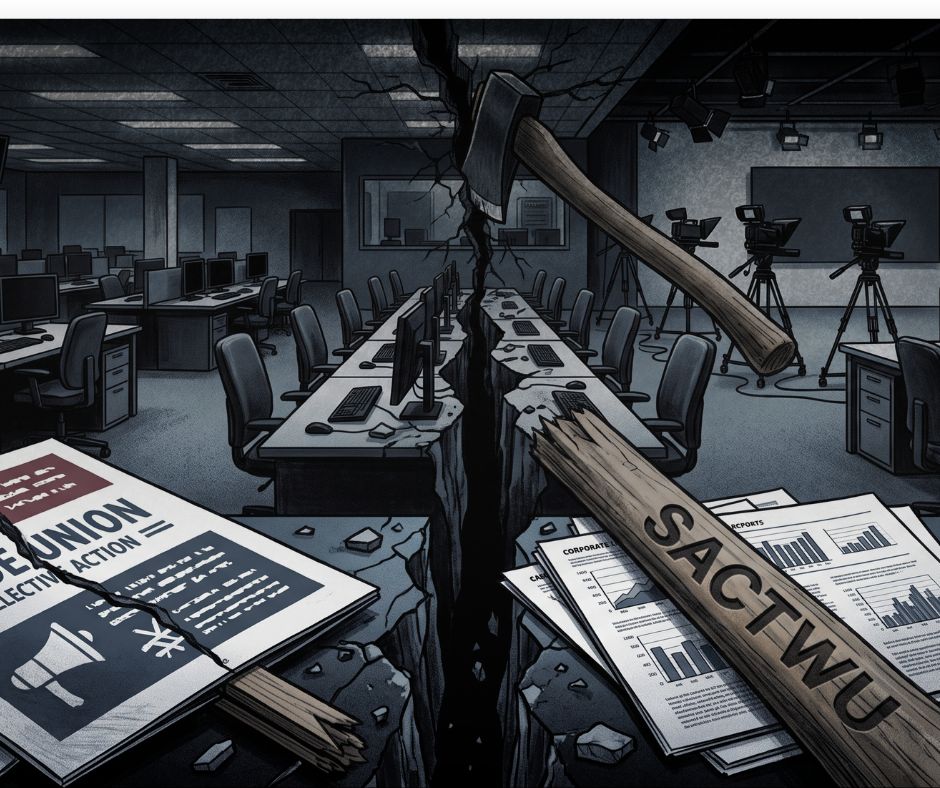
It has been a bitterly painful 30 days for South African media.The announcement that eNCA plans to cut roughly half its workforce came on the heels of news that Media24, the country’s biggest publisher, is embarking on a major restructuring that will see cuts in its lifestyle, sports and business sections.These announcements speak to the extraordinary precarity of South African journalism. The industry faces both an existential crisis and, uncomfortably, a crisis of relevance.The latest Reuters Institute Digital News Report says South Africans are increasingly consuming news through social media and video platforms, while news influencers and content creators are becoming increasingly popular at the expense of traditional news organisations. Trust in South African news has also fallen sharply, from 61% in 2022 to 50% in 2026.An excellent and sober analysis by Daily Maverick CEO Styli Charalambous after the latest retrenchment news argued that continuous staff cuts and strategic shifts will not alone fix what is fundamentally a broken market. They make a case for policy intervention and more enterprise-inclined thinking rather than simply a collection of struggling newsrooms.The point is that serious, urgent change is required — because we are already seeing warning signs of what the industry could look like if nothing is done.Recently, The South African, a relatively prominent newsroom, advertised freelance opportunities where payment would be determined by the traffic a piece generated. This pretty much makes the algorithm the newsroom’s editor.The South African's job posting on LinkedIn. (Screenshot) Outrage, controversy and highly emotive subjects are easy ways of attracting an audience. The subjects most likely to generate traffic are generally questionable in terms of news value. But this is also the logic the industry criticises Big Tech platforms for.‘Newsfluencers’ This brings us to the rise of content creators and news influencers. Their ability to be more conversational and accessible allows them to speak directly to audiences in formats and language that people actually want, and in a sense, they are making up for a gap left by traditional media.However, the same issue that exists with churn exists here. Whatever is likely to trend, or is already trending, is generally prioritised. Content creators also build substantial audiences by piggy-backing on original reporting produced by news organisations.Original, on-the-ground reporting is expensive, but the distribution and commentary around it can require just a person and a cellphone. That unbalanced equation means newsrooms are not receiving fair financial return for their work.AI will inevitably be used for some production responsibilities, particularly routine and entry-level work like turning press releases into basic stories and transcribing. This may be helpful, but here’s the contradiction: South African media organisations complained to the Competition Commission that Big Tech has extracted enormous value from journalism without fair compensation. Yet now they are embracing AI systems developed by those same technology companies, mainly because it may streamline processes and save costs.Funding incentivesDonor and grant funding has provided an important lifeline for journalism, particularly niche reporting. However, the lack of a commercial burden to maintain healthy numbers means these newsrooms can afford to produce journalism that performs poorly in terms of reach. Journalism ultimately exists to inform the public. If stories are read primarily by other journalists, academics, funders and award judges, then something has gone wrong. This kind of ecosystem risks news stories mainly targeting elites and not the wider public.The more journalism becomes donor or project-based, the greater the incentive will be to frame applications for funding around what funders want to hear. That does not mean the underlying journalism will be bad or that the issues being funded are unimportant. It does, however, create a potential conflict. Journalism ultimately exists to inform the public. If stories are read primarily by other journalists, academics, funders and award judges, then something has gone wrong. This kind of ecosystem risks news stories mainly targeting elites and not the wider public.If a newsroom’s survival depends on convincing funders that it serves far-flung, under-reported communities, issues of inequality or certain causes, there will certainly be instances of lip service.Those warning of Big Tech’s corrosive impacts on the media and the public sphere were right. Traditional media organisations have to accept that distribution has changed permanently, so the solution can’t be to pine for older times. The solution is also not to drive towards every incentive Big Tech platforms have created.While part of the solution surely lies in producing journalism that is original, trustworthy and impactful so audiences understand why it is important, that does not necessarily lead to stability. A new direction and way of thinking is required, and it will probably require a variety of heads coming together.And as for those cynical of mainstream media who feel vindicated by its decimation, they should think again. Much of the information they consume from their favourite storyteller, commentator or alternative voice still originates with a journalist who went out and reported it. The horrible mainstream media, for all its faults, has almost certainly contributed far more than many would care to acknowledge. If we lose it, we may appreciate what it was doing for us only after it is gone.• Pillay is a Business Day web producer.
KERUSHUN PILLAY | SA media’s existential crisis
Newsrooms grapple with smaller audiences, staff cuts and the lure of Big Tech solutions
858 words~4 min read