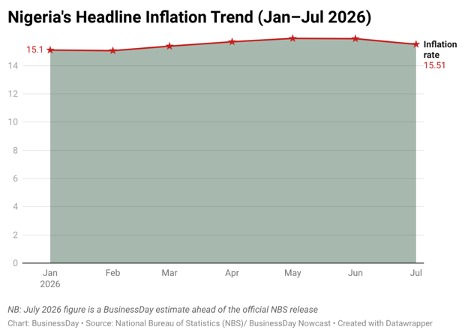
BusinessDay’s inflation economists project that Nigeria’s headline inflation will ease to 15.51 percent in July, dropping from the 15.91 percent recorded in June, signifying a moderation of price pressure.
If validated by the National Bureau of Statistics (NBS), this 0.4 percentage point difference will extend the steady disinflationary trend that followed the agency’s 2025 rebasing exercise. The pace of disinflation, however, remains dependent on exchange-rate stability, food supply conditions and global commodity prices.
This forecast was generated using an Autoregressive Integrated Moving Average with Exogenous Variables (ARIMAX) model. The model estimates monthly inflation by combining lagged inflation movements with changes in the official exchange rate, business activity measured by the Stanbic IBTC/S&P Global Purchasing Managers’ Index (PMI), the inflation rebasing dummy and an autoregressive component that captures inflation persistence.
Business activity is included because stronger demand and improving business conditions often influence firms’ pricing decisions, making the PMI a useful leading indicator of inflation.
The model uses all available information up to June 2026 to estimate July inflation ahead of the NBS’s official release.