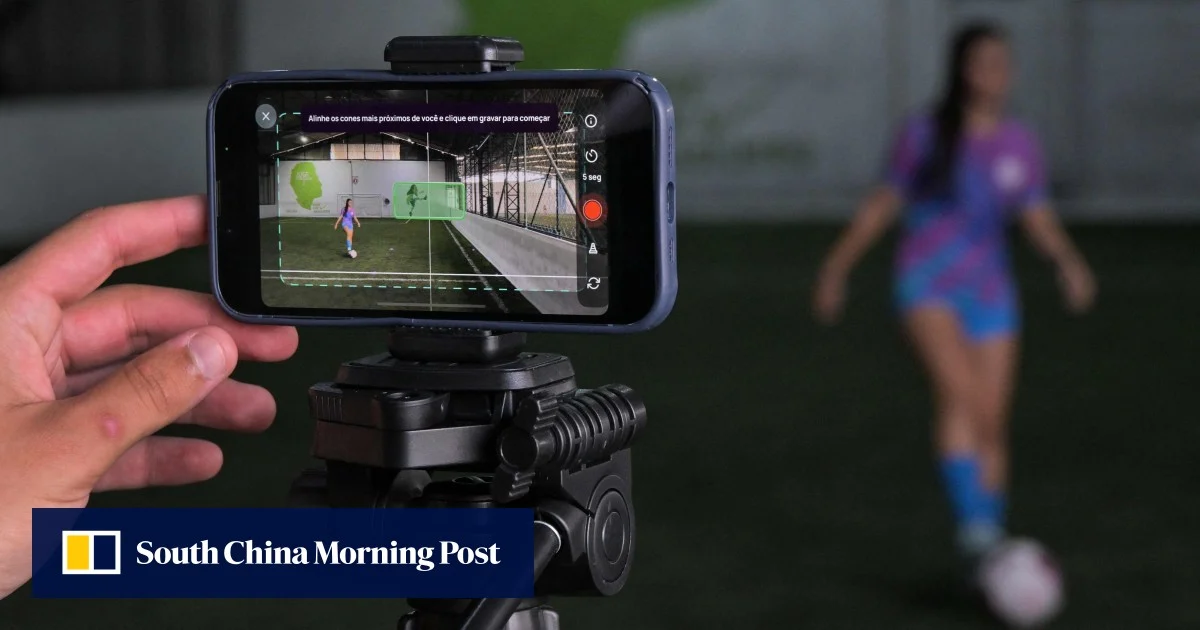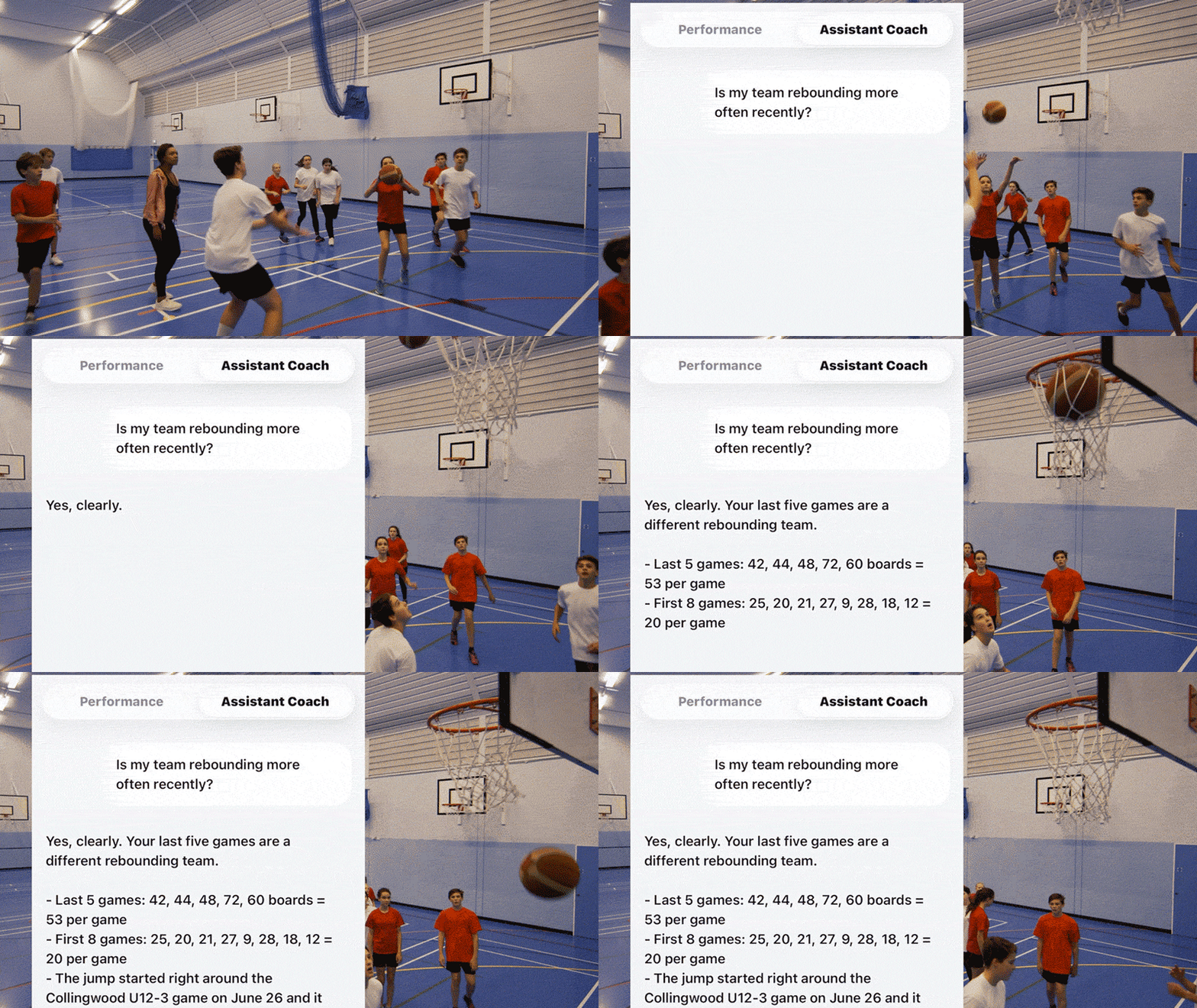
August 14, 2026 — 11:43amDuring the dog days of Melbourne’s COVID-19 lockdowns, Sam Hung and his teenage friends would head to a local basketball court and shoot hoops to pass the time.Hung was a high school student back then, but already a budding technological guru.Collingwood junior basketballers are using stat-tracking app Superstat to get better.Jason SouthWith so much time on his hands, he decided to build a basic app that produced shot charts from those street-ball games. Little did he know that experience would be helpful several years later, when he joined forces with Kai Bloomfield and Cordelia King to co-found Superstat.They created a stat-tracking app that uses artificial intelligence computer vision to deliver amateur sports teams – starting with basketball – the kind of performance data previously available only to elite athletes.Computer vision is an AI subfield that equips machines with the ability to process, analyse and interpret visual inputs such as images and videos, then extract meaningful information.Superstat just scored $3.5 million in seed funding from venture capital firm Blackbird and some private investors, and the team is relocating to Austin, Texas, in September to dive deeper into the United States market – a sports mecca that already is strongly featured among their membership – where they plan to expand to American football, baseball, soccer and volleyball.Closer to home, Australian football and netball are on the company’s hit list, too.“Our mission is to provide pro-level stats for everyone,” Bloomfield told this masthead.NBA-level stats for amateursThe Melbourne entrepreneurs first worked together on a different app, TrainStop, a sports recruiting matchmaker that was once described as football’s answer to Tinder.The app proved popular with grassroots clubs, but a problem soon surfaced: would-be recruits were “catfishing” them, embellishing their output to try to earn a quick buck.Superstat co-founders Sam Hung, Cordelia King and Kai Bloomfield use AI technology to deliver professional-level statistics for amateur athletes.Eddie JimBloomfield, an ex-Oakleigh Chargers development coach in the under-18 Talent League who was working at St Kilda as a football analyst at the time, realised there was a missing link – and it owed to a lack of data.He was manually “cutting” footage for the Saints, an onerous task mirrored at amateur level, where coaches and fellow volunteers were more time poor and unable to gather the same level of information.Hence, some mischievous TrainStop members saw an opportunity to use that data deficit to their advantage.That was when Bloomfield and co. started wondering about the possibility of using AI to track statistics and plug that gap in grassroots sport. Superstat effectively became the app designed to solve that problem.The company’s early days last year were devoted to football before they found out about Hung’s basketball app from the pandemic.That was enough for them to pivot to basketball – but it wasn’t until they started attending tournaments and speaking to people involved that they realised the opportunity at hand.The trio recalled a photo they took from the annual Adelaide Easter Classic, where there were four mobile phones positioned on tripods around a court recording a single junior basketball match.Bloomfield, King and Hung plan to expand to many more sports beyond basketball.Eddie JimCoaches previously spent hours going through vision to manually track statistics, which were often inaccurate because of human error. Those same coaches can now upload footage to Superstat, input basic details such as player numbers, names and jersey colours for AI tagging purposes – and the app does the rest.At the end of the process, users receive an NBA-like box score, including points, rebounds, assists, turnovers, and field goal and free throw attempts, as well as individual minutes played and plus/minus totals for each athlete.An example of from Superstat’s AI coaching tool. SuperstatSuperstat also generates team and individual shot charts, and individual player highlights (and lowlights) for coaches to analyse, or parents to send to grandparents. An AI assistant coach offers suggestions on what to focus on at training, too, and answers questions on game trends.The real-life coach could ask something like: “What are my team’s strengths?“. Or, “Has my team’s free throw shooting improved?” or “Where do we need to get better?”The AI assistant coach will then provide an answer, within seconds, from the game data that is uploaded.Using AI technology in this way is a significant step for amateur and junior sport.Similar basketball analytics and video platforms, such as the US-based Hoopalytics, use AI only for offerings like player evaluations and scouting reports, while still paying human analysts to track the actual statistics.“We thought that a big issue might be that no-one films the games – but everyone does,” Bloomfield said.Superstat hopes to help teams discover the next Josh Giddey.Justin McManus“We want [our app] to kind of be like Strava, with what they’ve done for running and cycling. I’ll use Strava, and it’ll tell me what my next run should be. I feel like an Olympian when I go for my 5km run at my six-minute [per kilometre] pace because I get my VO2 max, my cadence and more.“We want that for player development, and to be able to help players and tell them, ‘Here’s what you’re good at, here’s what you can work on, here’s what to do at training this week’.”Among Superstat’s almost 6000 active monthly users is Joe Barker, who coaches one of Collingwood’s under-12 representative teams in the Victorian Junior Basketball League.“What I really like is that it highlights the ‘unsung’ parts of the game that don’t always get recognised – things like rebounds, assists, defensive effort and doing the little things that help the team,” Barker said.“It gives every player a chance to see where they’re contributing, while also giving me useful information to shape training and help the kids improve week to week.”Going beyond the box scoreKing loves that their app could play a role in recruiting decisions shifting from subjective to objective decisions based on detailed game data.It is part of the vision for the Superstat crew. They have already held discussions with US colleges such as Arizona State, who employ an Australian among their scouting staff.An example of the data generated by the Superstat app. Adobe Stock/suppliedLike most sporting organisations, Arizona State have a budget that restricts their recruiting pool to areas they can send scouts to – but Superstat’s AI modelling could change the game in that sense.“The recruitment system in the US is still quite archaic,” King said.“A lot of it is literally sending YouTube highlights to colleges, and you’ve got to be amazing in the first 30 seconds [to attract attention]. You send a cold email, or DM [direct message], and hopefully, someone sees it. Anything we can do to improve that visibility is a bonus.”Two of Australia’s preeminent experts in AI and sport, Dr Machar Reid and Dr Sam Robertson, don’t believe recruiters have anything to worry about in the foreseeable future.Robertson, who consults for elite sporting organisations and clubs in the US, Europe and Australia on innovation, said AI tagging, which Superstat uses, and its efficiency benefits were this technology’s best use so far.Could AI help sports recruiters better identify the best young talents, such as Richmond’s Sam Lalor?Getty ImagesHowever, Robertson was not convinced, at least yet, that AI could positively impact the talent identification process.Reid, Tennis Australia’s director of innovation, was more optimistic, but agreed with Robertson that using AI to help unearth future stars was “infinitely more complex than just tagging a game”.“The application of AI to talent ID is likely easier and more effective in sports like swimming, tennis, and maybe even golf. So the individual pursuits,” Reid said.“You have a single competitor, perhaps a single technical action to analyse ... there are fewer variables that exist outside your control. From a modelling point of view, the exercise is simpler.“That doesn’t mean it will solve all your dilemmas … but team sports will take a while longer, if indeed they ever get there. You’re always going to, I think, have the human there and that element of heuristics that are important.”That reality has not stopped Superstat’s founders from thinking big.They hope to take advantage of AI’s rapidly increasing sophistication to one day be able to analyse and measure an athlete’s performance more closely to offer even greater insights.“What we’re looking to build isn’t just a system that’s good on a box score level, but more of a visual level,” chief technology officer Hung said.“We want to be able to identify, ‘If this person’s this tall, and he’s playing in this age group, he should be doing better, or moving this way to perform even better, or help the team in this way’. That’s another layer of data that we’re trying to get to.”Come back next weekend for the second part of this masthead’s series on how AI is changing sport.News, results and expert analysis from the weekend of sport sent every Monday. Sign up for our Sport newsletter.From our partners
‘Has my team’s shooting improved?’ How AI is professionalising junior sport
Grassroots coaches can generate player highlights (and lowlights) to analyse and sent to parents or grandparents. It’s tipped to transform local sport.
TL;DRAI
Superstat raised $3.5M (Blackbird) for its AI computer vision app delivering pro-level stats to amateur basketball teams. Solves manual video editing for coaches and democratizes analytics; SaaS expanding US market (football, baseball, soccer, volleyball).
1,482 words~7 min read