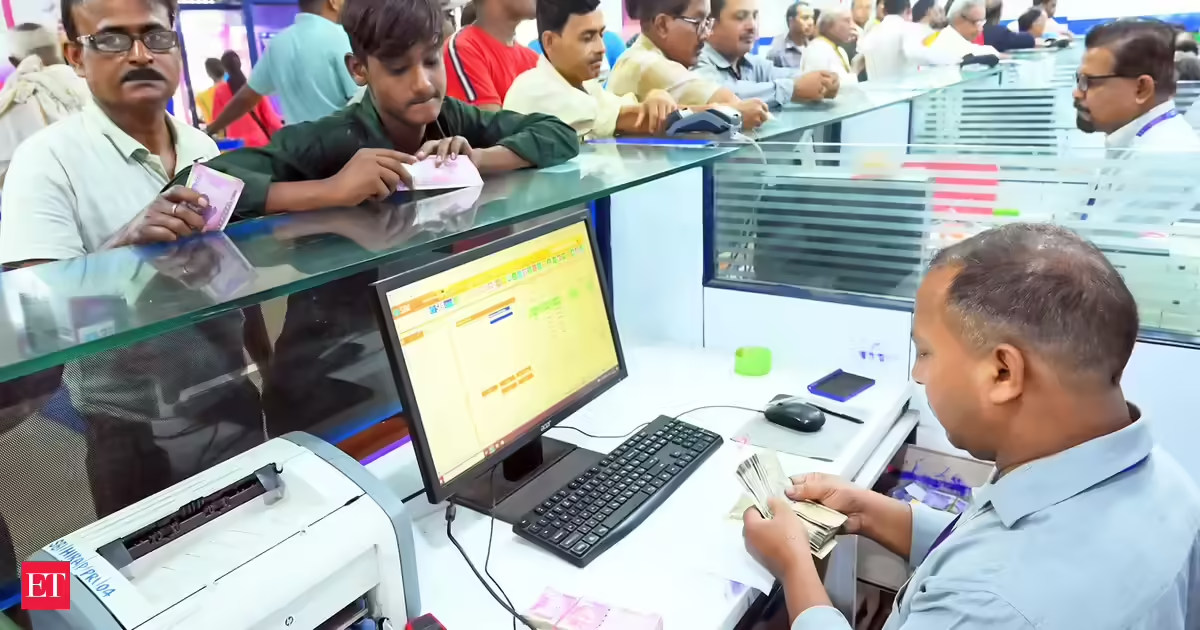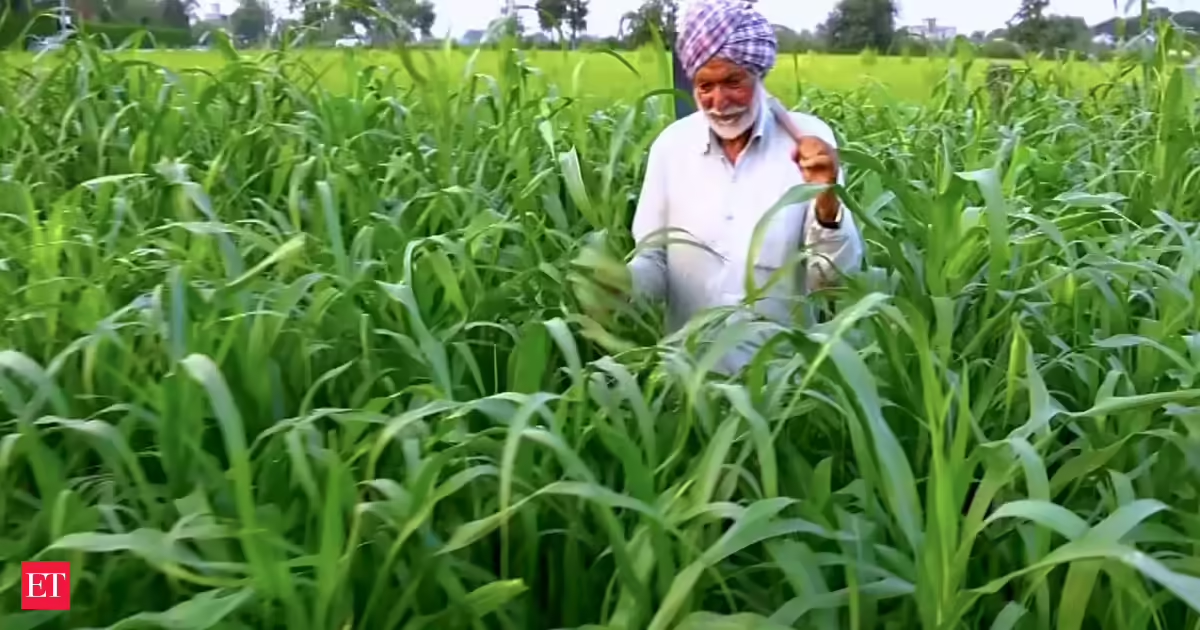
More than seventy-five years ago, the landmark All India Rural Credit Survey observed that rural credit was “not of the right quantity, not of the right type, did not serve the right purpose and often failed to go to the right people.”Independent India responded with exceptional institutional imagination. New institutions, innovative policies and successive financial inclusion initiatives steadily expanded formal finance to millions of rural households. Judged by access alone, this remains one of independent India’s enduring development achievements.Yet, Rural Credit Market Conditions in India Survey (June 2026) contains a finding that deserves reflection. Among rural households that had borrowed, nearly 57 per cent reported that their incomes had not increased. This single statistic raises a quiet question.Has the next challenge in rural credit shifted from expanding access to improving outcomes?Building institutionsEvery generation builds institutions to answer the questions of its time. As society changes, those institutions continue to perform the roles for which they were designed. Over time, however, society begins asking different questions. That is often when the need for institutional evolution becomes visible and progress begins.Rural India has changed. It is more aspirational and economically more complex than the rural economy for which many of our institutions were originally designed. The economic well-being of rural households is now shaped by many interacting factors. Credit remains indispensable, but it is only one part of the ecosystem.A small farm today is rarely just a small farm. The modern rural household is no longer sustained by a single stream of income, but by a portfolio of livelihoods, and income streams. A household may cultivate crops, keep a few dairy animals, earn wages outside agriculture, receive remittances from a family member, receive Direct Benefit Transfers, while aspiring to build a small enterprise of its own. For many households, this diversification reflects economic necessity as much as opportunity.Some months ago, a farmer made an observation that has stayed with me. “The bank gives me credit based on my acreage and the crop I grow,” he said. “But I have other needs.”The rural household has become an integrated economic unit. Our institutions, however, continue to engage with different parts of that household economy through specialised functions.Our principal agricultural credit instruments have served agriculture well. They were designed to finance cultivation, not the increasingly diversified economic life of rural households. There is nothing inadequate about these institutions; they have remained true to the purpose for which they were created.Changing rural economyRural life, however, has quietly evolved beyond the world in which many of them were conceived. Banks, quite naturally, judge success by the reach and quality of credit. Rural households, however, appear to judge the situation differently. Their question is simpler: Has life become better after the loan?For decades, public policy rightly concentrated on expanding institutional credit. That effort transformed rural finance. Yet the survey shows that nearly half of rural households report no debt at all, and most say that this was by choice.The more important question, however, is not why some households avoid credit, but why credit does not do more for those who do borrow. Sixteen per cent of outstanding rural debt still flows through non-institutional sources, reminding us that access, while transformed, is not yet complete.Banks mobilise savings, assess creditworthiness, manage risk and allocate capital. They are financial institutions—not enterprise mentors, market advisers, technical specialists or livelihood planners.The effectiveness of rural credit depends equally on complementary institutions. Enabling beneficiary identification, updating land records, facilitating the creation of charge, completing statutory formalities and supporting outreach often fall within the responsibilities of State governments. When these functions do not move in step, banks alone cannot complete the task.The challenge, therefore, is not one of banking alone. It is one of institutional evolution.Banks finance.Extension systems build knowledge.Community institutions mobilise people.Markets reward enterprise.Each performs an essential and complementary role.India’s first rural credit revolution answered one of the country’s most important development questions: How do we take banking to every village?The next may begin with a quieter one.Once credit reaches a rural household, who walks with that household until opportunity becomes enterprise, and enterprise becomes prosperity?The writer is is former Deputy Managing Director, NABARD. Views are personal.Published on August 14, 2026
Rural credit needs to be reimagined
Our agricultural credit instruments were designed for cultivation, not for today’s varied economic life of rural households
696 words~3 min read