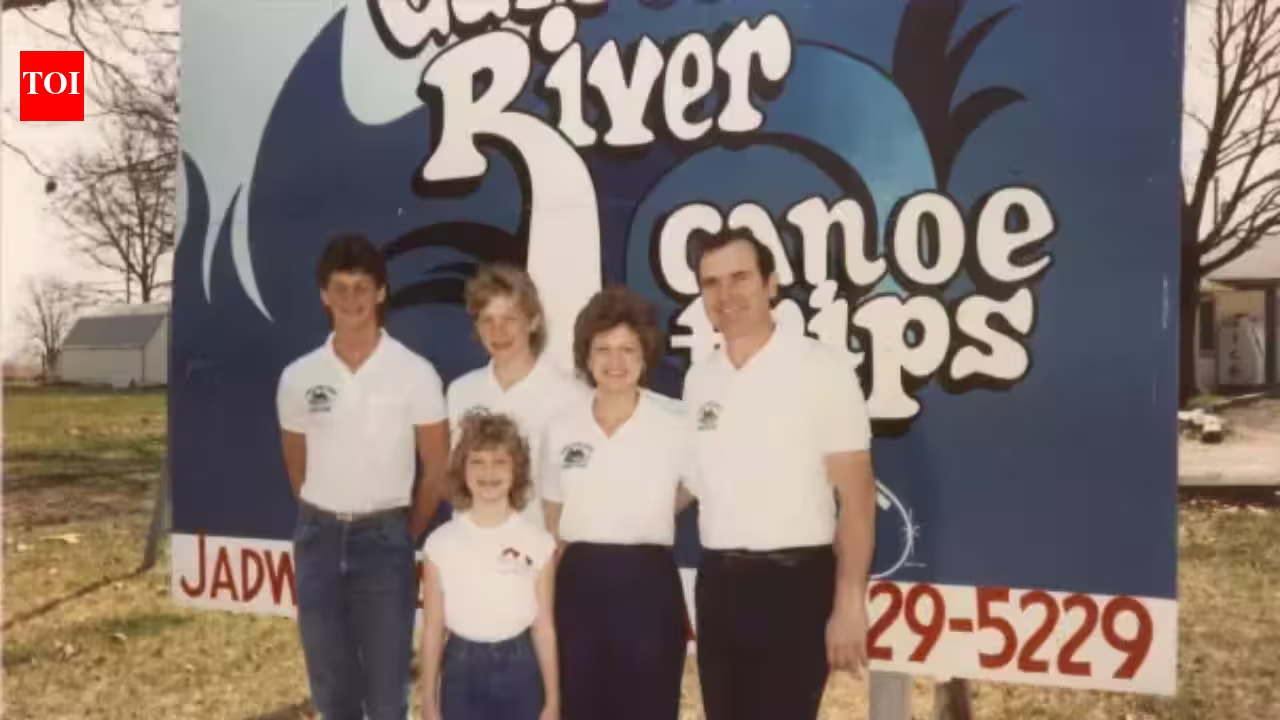
The Blackwell family, with Amanda in the front and, standing behind her from left to right, Brad, Scott, Shelia and Darrel.In 1970, a Missouri farming family found itself at the centre of a legal battle with the federal government after officials sought to acquire nearly 600 acres of its land for the creation of a new national park.The Blackwell family farm, known as the “Blackwell Tract”, sat across from Pulltite along the Current River in northern Shannon County. According to an article published by the National Park Service’s Ozark National Scenic Riverways, the government initially offered the family $73,000 for the property. After the case went to federal court, the Blackwells ultimately received $214,000 for nearly 600 acres.The story is closely tied to Darrel Blackwell, who went on to have a unique relationship with the National Park Service. He worked as a seasonal park ranger during the early years of Ozark National Scenic Riverways, while his father was simultaneously fighting the agency in court over the family’s farm. Years later, Darrel became a concessioner for the park through Jadwin Canoe Rental.The Blackwell family’s farm along Current RiverDarrel grew up in Rector, Missouri, with his father Wayne, mother Iceline and brother Charlie. Wayne was a farmer who managed two properties - one in Rector and another along the Current River across from what is now Pulltite.Wayne purchased the Current River farm in the mid-1930s. In 1937, he and Roy Weise built a road down to Pulltite to improve access to the property. The route of that early road is now largely followed by Highway EE.The family’s farming operation centred primarily on cattle, although crops were also grown for a time in the bottom fields along the river.As the farm expanded, Wayne acquired two additional tracts of land. The family also employed caretakers who lived permanently on the property and helped manage the growing agricultural operation.From a family farm to a national parkThe Blackwell farm eventually became one of the properties acquired by the federal government during the establishment of Ozark National Scenic Riverways.The park, which protects portions of the Current and Jacks Fork rivers in Missouri, was created to preserve the rivers and the surrounding natural and cultural resources.Darrel recalled that his father did not initially receive an offer for the property.“When the government came to buy my dad’s place, they didn’t offer him anything for it,” Darrel said, according to the National Park Service account. “They told him they were going to use the power of eminent domain to condemn the property and they would have to go to court.”Wayne accepted that the government had the legal authority to pursue eminent domain but wanted the family to receive what he considered a fair price for the land.The $73,000 offer that became $214,000The legal dispute came to a head in 1970, when the acquisition was finalized.Darrel recalled that his father hired Dorman Steelman, another Current River resident, but because the attorney could not practice in federal court, the family brought in another lawyer from Cape Girardeau.“The government originally offered us $73,000 for the farm,” Darrel recalled.The case then went before a federal court to determine the value of the property.One unusual moment during the proceedings involved Darrel’s mother, Iceline. According to Darrel, she carried candy in her purse and was caught handing some to members of the jury during a recess.“Mom always had a purse with some candy in it,” Darrel recalled. “During a recess from the proceedings, she was caught handing out candy to members of the jury members.”The judge intervened and told her she could not do so, although Darrel said it was clear she meant no harm.After the proceedings, the family received $214,000 for “right at 600 acres” - substantially more than the government’s initial $73,000 offer.Darrel worked for the National Park Service while his father fought itPerhaps the most unusual part of Darrel’s story is that he was working for the very agency his father was battling in court.Darrel served as a seasonal park ranger from 1969 to 1972, during the same period his father was fighting the National Park Service over the family farm.He said his father did not object to him working for the agency.Darrel remembered his years as a ranger fondly, describing the job as one where every day brought something different. Rangers patrolled the river by canoe and horseback, looked after campgrounds, assisted visitors and provided information.He also recalled that public safety and helping visitors were central to the job, with law enforcement considered a secondary responsibility.Darrel witnessed the dedication of Ozark National Scenic RiverwaysDarrel was also among the park employees present for the dedication ceremony for Ozark National Scenic Riverways in 1972 at Big Spring.Tricia Nixon, daughter of then-President Richard Nixon, attended the ceremony.Darrel recalled being assigned to escort her toward the spring and keep photographers from getting too close.He remembered the moment vividly, particularly her appearance and the hectic atmosphere surrounding the event.His experience meant that Darrel had been connected to Ozark National Scenic Riverways from several different perspectives — as the son of a landowner whose property was acquired for the park, as a park ranger and eventually as a business operator serving visitors to the Riverways.From farming and teaching to canoe rentalsAfter leaving the park service, Darrel increasingly turned his attention to tourism and outdoor recreation.In the fall of 1972, he partnered with Jack Peters and John Hambacker to purchase Camp Zoe, a youth camp located at the site of what is now Echo Bluff State Park.A few months later, in January 1973, Darrel purchased Jadwin Canoe Rental from Clinton and Sue Jadwin.The canoe rental business eventually became the centre of his professional life.Darrel initially operated from a farmhouse at the junction of Highway K and Highway ZZ. In 1977, he purchased the building where Jadwin Canoe Rental currently operates, which had previously served as a local grocery store.His early transportation methods were equally unconventional. The business initially used Suburbans to transport visitors, but Darrel recalled that customers were sometimes taken to the river in the back of a stock truck.He later expanded the operation, including purchasing a 1967 Chevrolet 48-passenger bus in 1975.A life intertwined with the RiverwaysDarrel eventually spent decades running Jadwin Canoe Rental, building a life and business around the visitors coming to the Ozarks.He said the most important part of the business was not the equipment itself but the way customers were treated.“If you don’t provide a quality service for visitors the first time, they won’t ever come back,” Darrel said. “The only thing that separates one from another is how you treat your customers and how you take care of your customers.”For him, the canoe rental business became much more than a job. He said it allowed him to make a living with the help of his wife, who worked as a schoolteacher, while remaining connected to the people and landscape he had known throughout his life.“I’ve enjoyed it,” Darrel said. “I have a great wife, I have three wonderful kids, and I have three beautiful grandkids.”A rare connection to Ozark National Scenic RiverwaysThe National Park Service describes Darrel Blackwell as a one-of-a-kind figure because of his three distinct connections to Ozark National Scenic Riverways.He worked as a park ranger during the park’s early years, his family’s farm was acquired through eminent domain during the park’s creation, and he later became a National Park Service concessioner through Jadwin Canoe Rental.Those experiences placed Darrel on both sides of the park’s early history - first as part of a family whose land was taken for its creation, then as an employee of the agency responsible for managing it, and finally as a business owner whose livelihood depended on the visitors drawn to the Riverways.
In 1970, a Missouri family fought the government over nearly 600 acres wanted for a national park; an initial $73,000 offer became a $214,000 court payout
In 1970, a Missouri farming family found itself at the centre of a legal battle with the federal government after officials sought to acquire nearly 600 acres of its land for the creation of a new national park.
1,288 words~6 min read