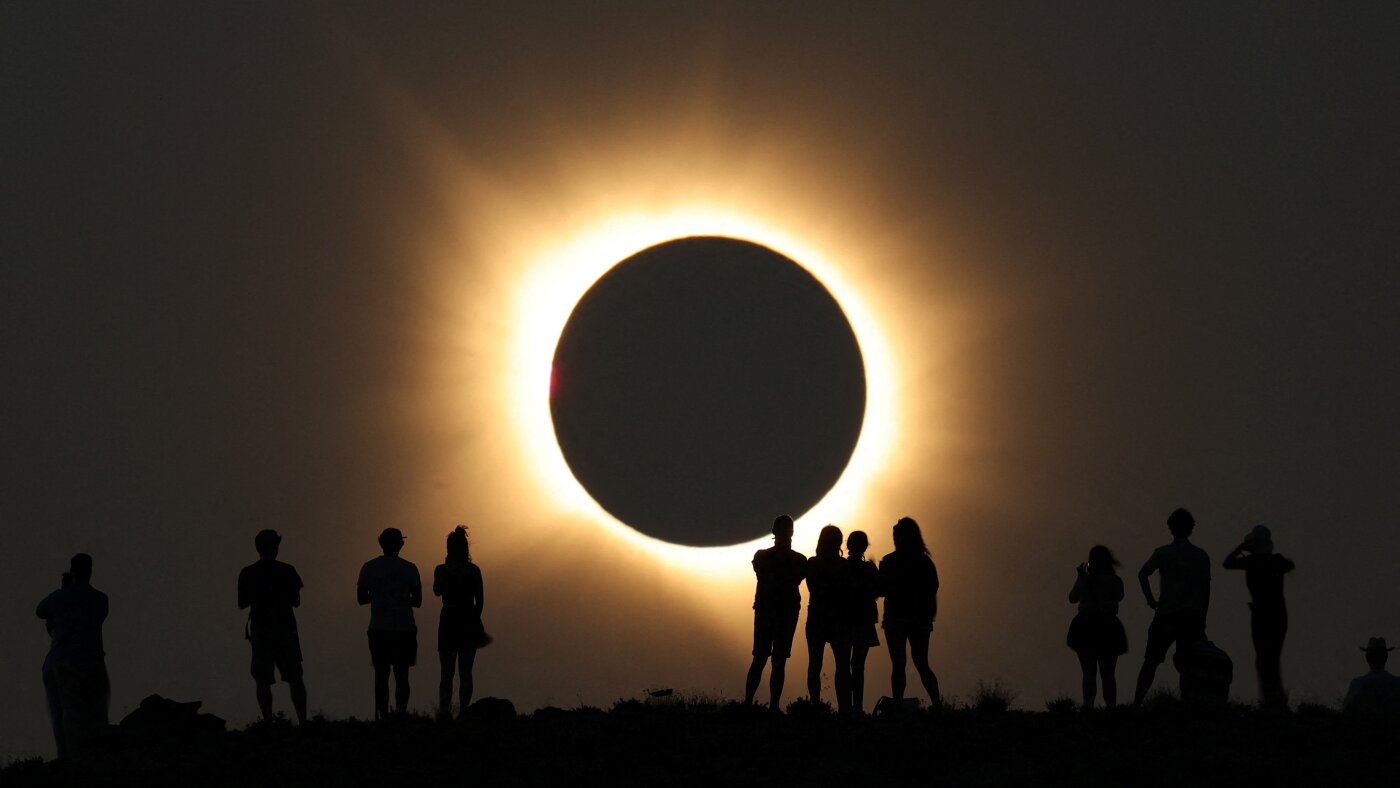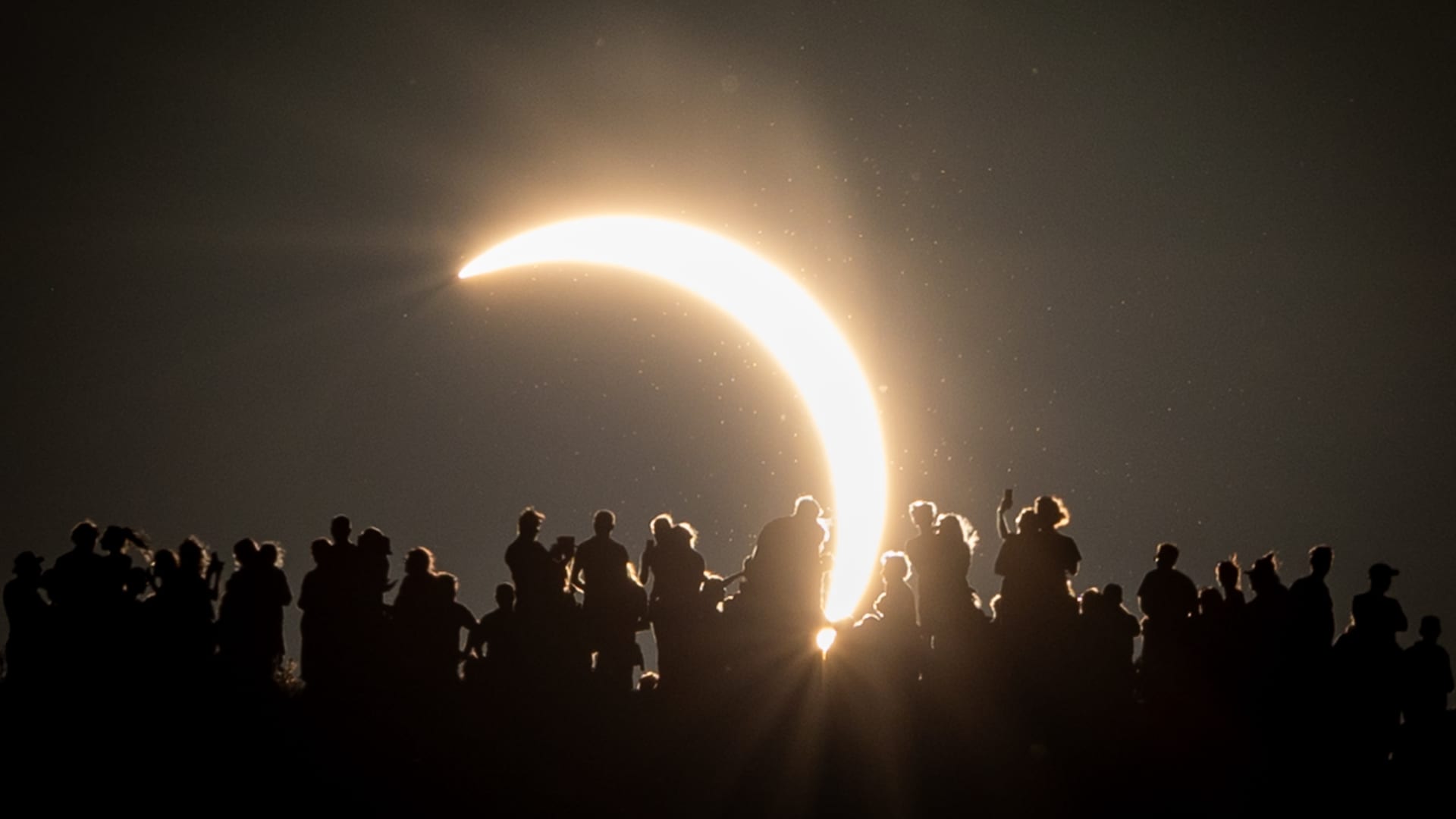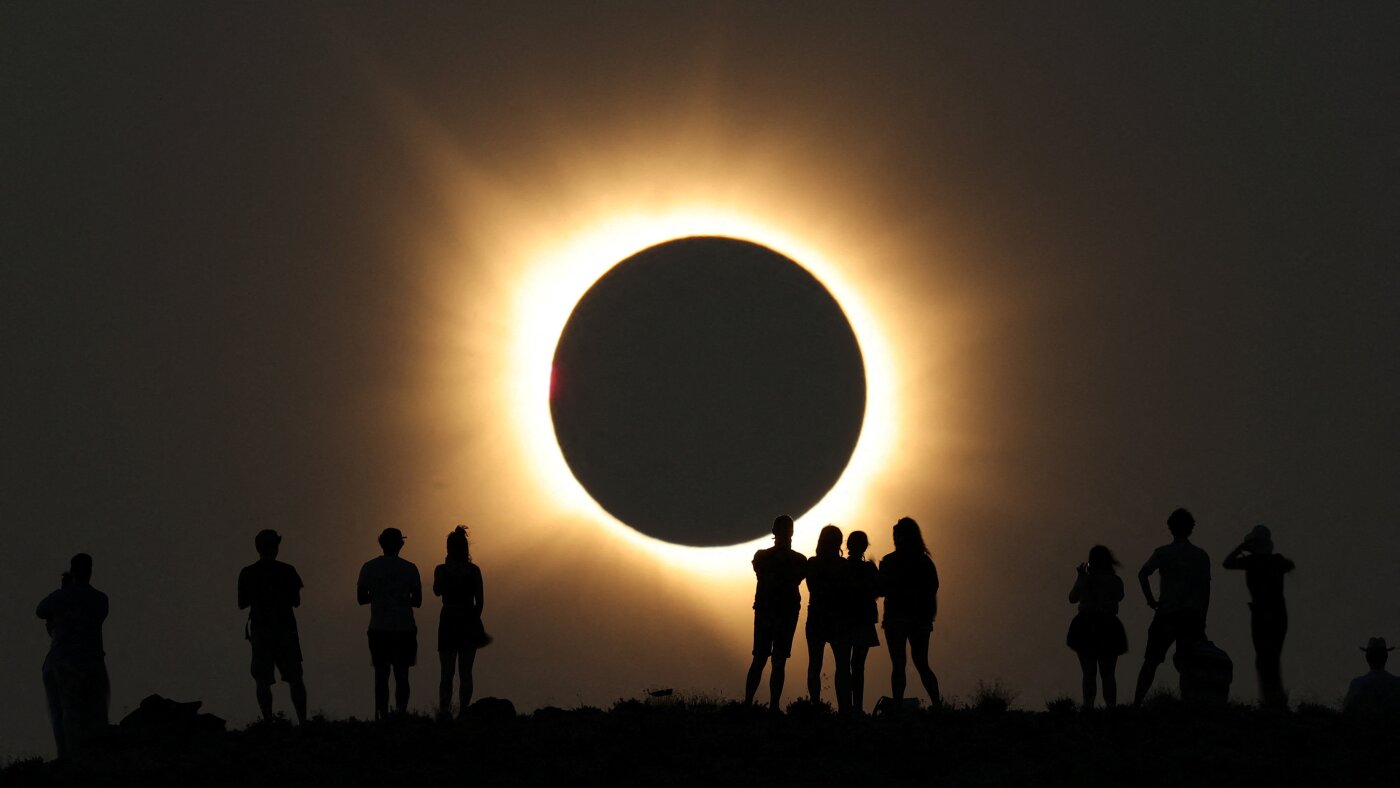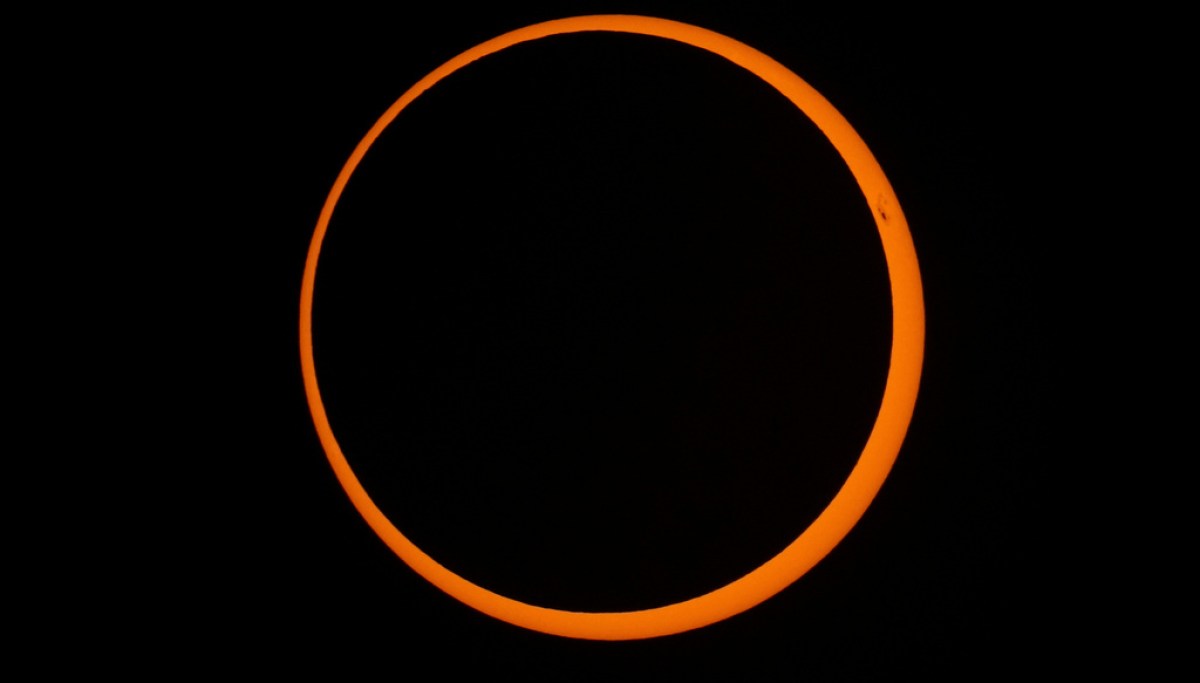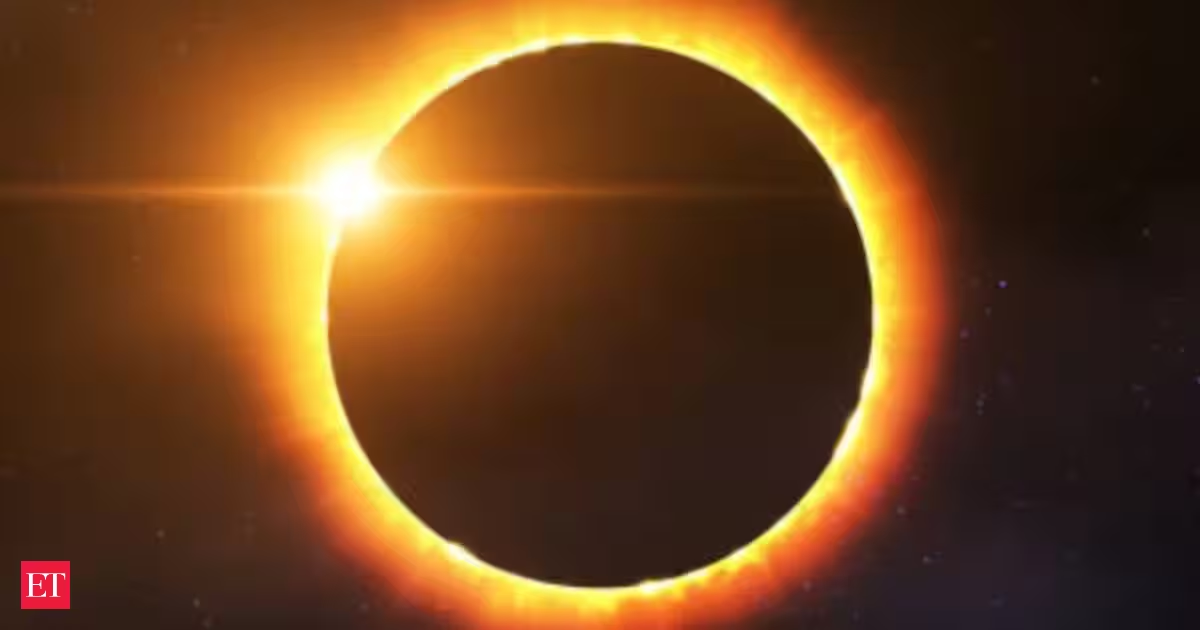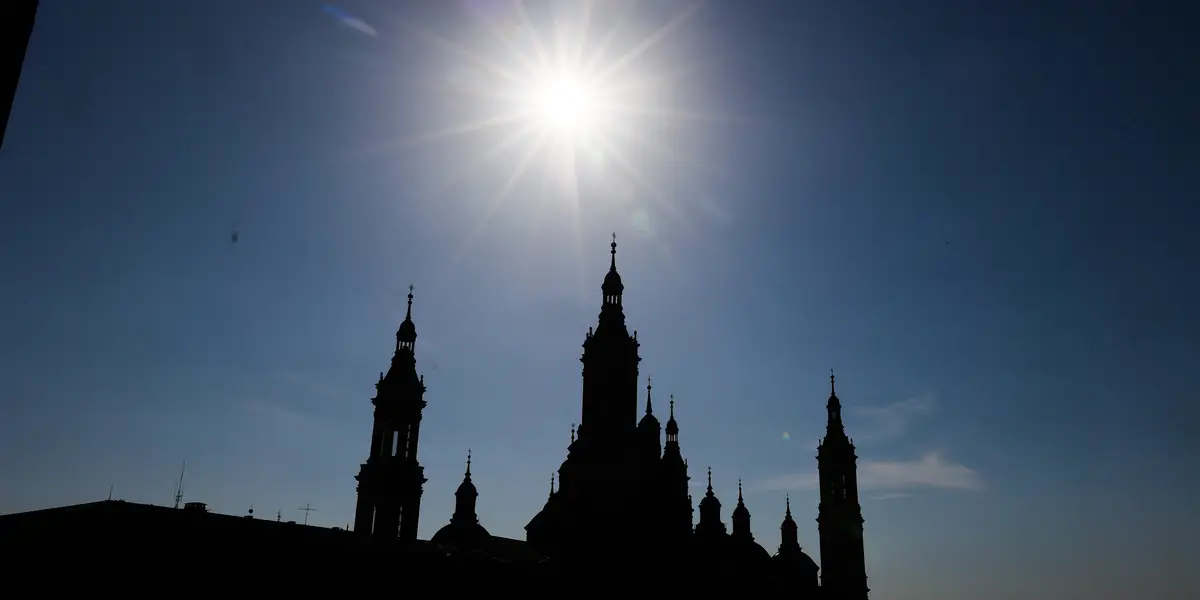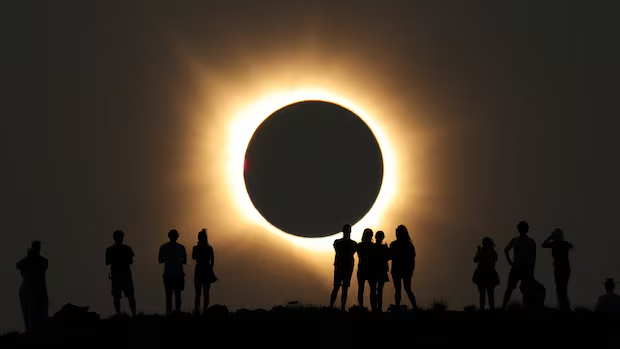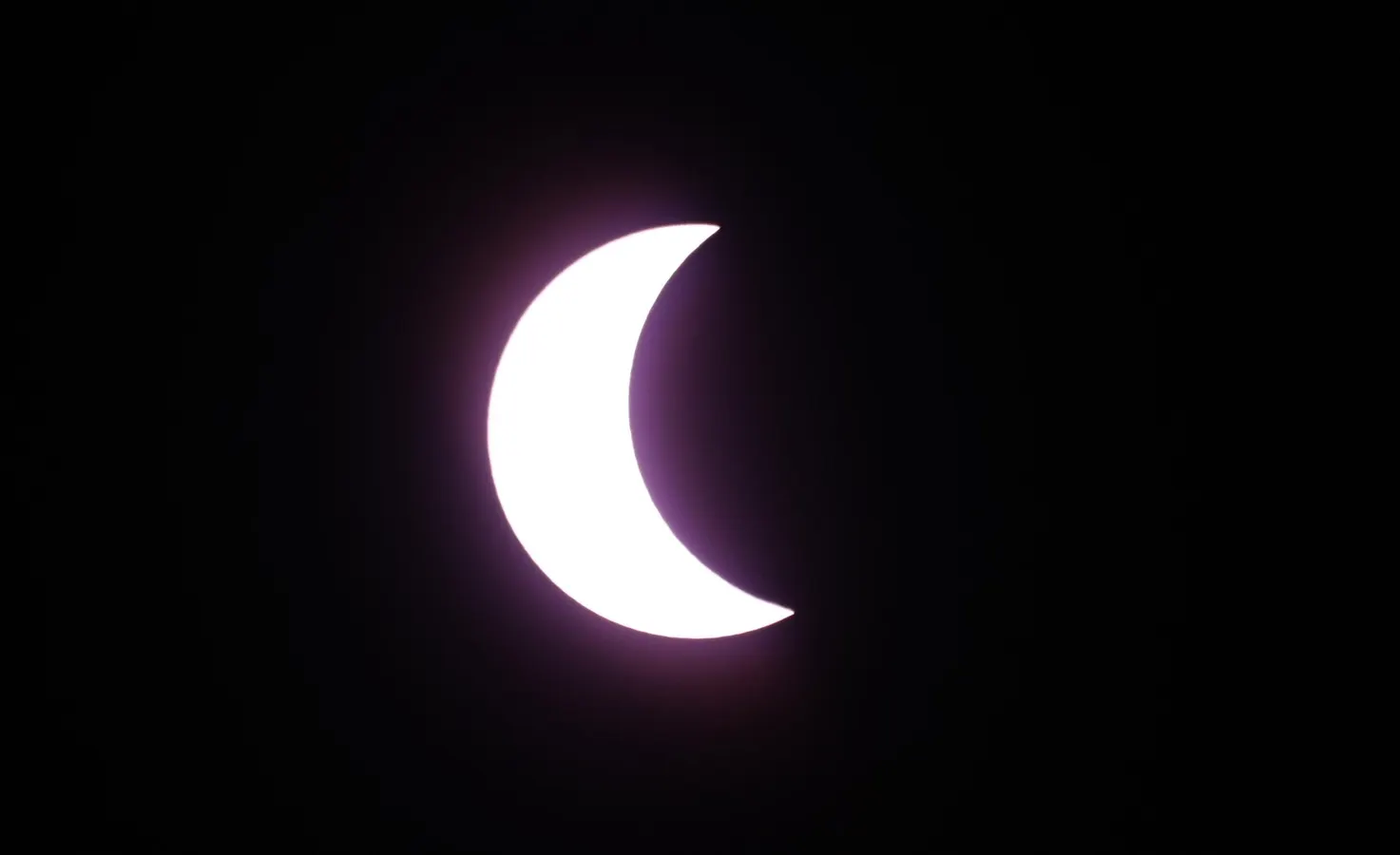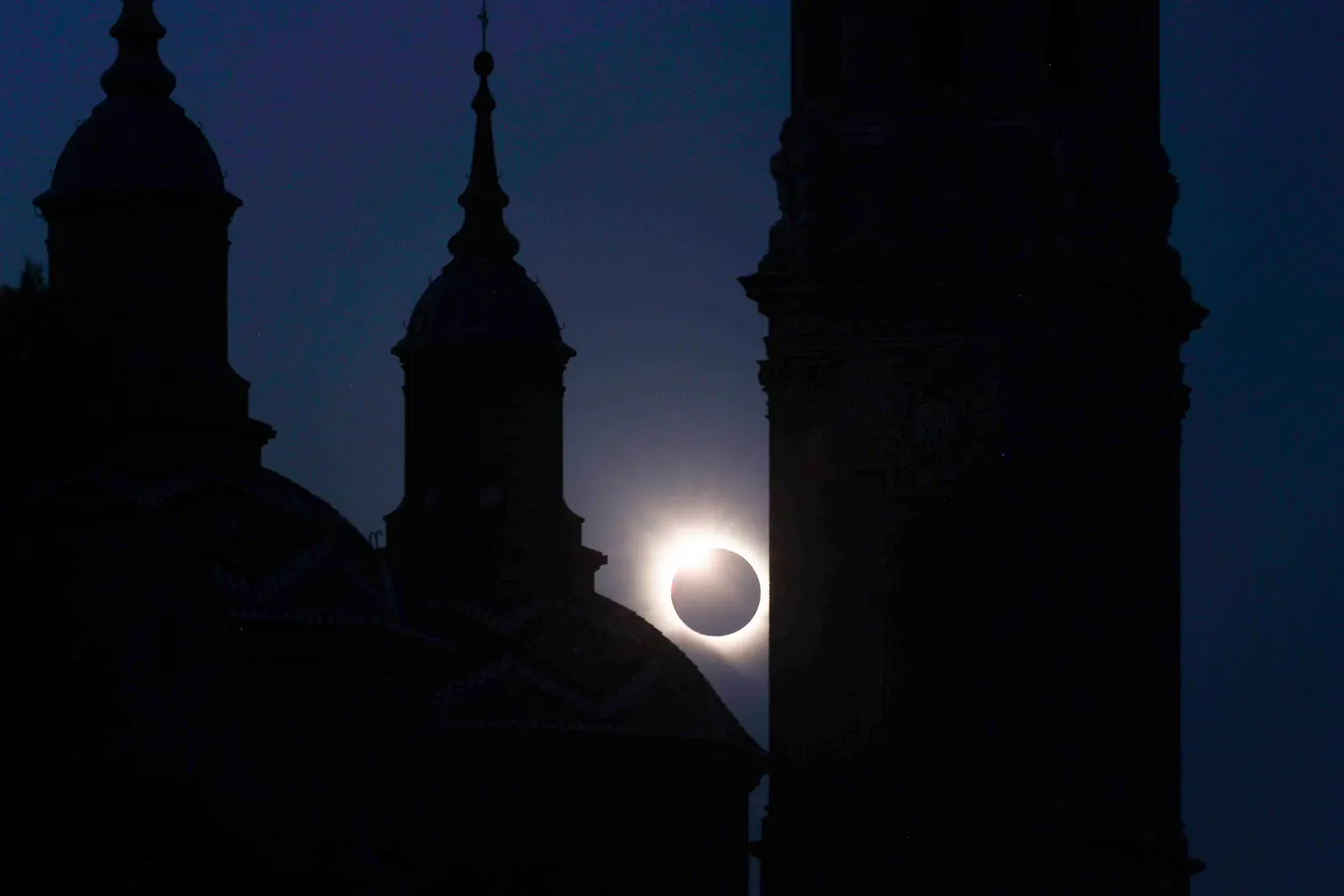
ToplineA total solar eclipse — the astronomical highlight of summer — swept across eastern Greenland, western Iceland and northern Spain on Wednesday, Aug. 12, briefly turning daylight into darkness. Those with a narrow path of totality just 180 miles (290 kilometers) saw the sun’s spectacular corona with the naked eye, while millions more people across Europe, Canada and parts of the U.S. saw a partial solar eclipse. It came just hours before the peak of the annual Perseid meteor shower. A view of the sun with the Catedral-Basilica de Nuestra Senora del Pilar during total solar eclipse in Zaragoza, Spain on August 12, 2026. (Photo by Jakub Porzycki/NurPhoto via Getty Images)NurPhoto via Getty ImagesKey FactsAbout 15 million people witnessed Wednesday’s eclipse of the sun, according to Timeanddate.com. Totality crossed Greenland, Iceland and northern Spain, while a partial eclipse was visible across much of Europe, Canada and the northeastern U.S.The total eclipse produced dramatically different views depending on location. Greenland’s Scoresby Sund offered Arctic landscapes, Iceland combined volcanic landscapes with those of its capital city, Reykjavík, while Spain experienced a rare total eclipse just before sunset from Galicia in the northwest to the Balearic Islands in the Mediterranean.Photographers captured the sun’s delicate corona, the iconic “diamond-ring effect,” and pinkish prominences along the edge of the moon’s silhouette.Though observers inside the path of totality — the moon’s dark central shadow — were able to remove eclipse glasses for the short totality phase, they had to keep them on for the preceding and following partial phases. Outside the path, the entire event had to be viewed with eclipse glasses.Today’s eclipse marks the beginning of an extraordinary few years for eclipse chasers. Total solar eclipses will cross Spain and North Africa on Aug. 2, 2027, and Australia and New Zealand on July 2, 2028.LEON CASTILE AND LEON, SPAIN - AUGUST 12: View of the total solar eclipse of 2026, on 12 August, 2026 on 12 August 2026, on 12 August, 2026 in Leon, on 12 August, 2026 Castile and Leon, Spain. This is the first total solar eclipse visible from the Iberian Peninsula in over a century. The path of totality crosses Spain from west to east and passes through numerous provincial capitals, from where the first event in the so-called ‘trio of eclipses’ will be visible, as on 2 August 2027, another total eclipse will cross Spain, and on 26 January 2028, an annular eclipse will take place. (Photo By Fernando Otero/Europa Press via Getty Images)Europa Press via Getty ImagesA Solar Eclipse Crossed The North AtlanticThis eclipse had some unusual geometry. As always, It began at sunrise, but this time close to midnight over remote areas of the Russian Arctic. The moon’s shadow then crested at about 88 degrees north — just a few hundred miles from the North Pole — before traveling south to cross Greenland’s vast ice-covered terrain and the fjords of Scoresby Sund. It then reached western Iceland, including the Snæfellsnes and Reykjanes peninsulas and the capital city, Reykjavik, before crossing the North Atlantic Ocean, reaching northern Spain. It ended over the Mediterranean just before sunset.AUGSBURG, GERMANY - AUGUST 12: The moon passes in front of the sun shortly before sunset during a partial solar eclipse on August 12, 2026 in Augsburg, Germany. The total solar eclipse marks a historic astronomical event as the first total solar eclipse visible from mainland Europe since 1999. This rare celestial spectacle sweeps a narrow path of totality across the Arctic, Greenland, Iceland, northern Spain, and a small section of Portugal, while delivering a dramatic partial eclipse to the rest of Western Europe (Photo by Marcus Hartmann/Getty Images)Getty ImagesGreenland Sees Totality Over Ice And FjordsThose standing inside the path of totality saw the moon completely cover the sun, exposing the faint solar corona and transforming the surrounding landscape. Some of the day’s most dramatic images came from Greenland, where the eclipsed sun hung above mountains, glaciers and deep Arctic fjords. Expedition ships inside the path of totality in Scoresby Sund — the world’s largest fjord — offered photographers unusually wild foregrounds.AREVALO, SPAIN - AUGUST 12: A solar corona with flares is seen during the total solar eclipse at Eclipsados Avila on August 12, 2026 in Arevalo, Spain. It was the first time a total solar eclipse, when the sun is blocked by the moon's orbit, could be viewed from Spain since 1905. (Photo by Luciano Lima/Getty Images)Getty ImagesIceland’s Eclipse Reveals The Solar CoronaThe eclipse reached Iceland during the late afternoon, with totality visible from parts of the country’s western coastline. The sun remained more than 20 degrees above the horizon in the best locations, giving photographers a clear view of the eclipsed sun above Iceland’s volcanic terrain. Images from the Snæfellsnes Peninsula showed totality above mountains, lava fields and the Atlantic Ocean.VALENCIA VALENCIAN COMMUNITY, SPAIN - AUGUST 12: A group of people on a boat during the total solar eclipse of 2026, on 12 August, 2026 on 12 August 2026, on 12 August, 2026 in Valencia, on 12 August, 2026 the Valencian Community, Spain. This is the first total solar eclipse visible from the Iberian Peninsula in over a century. The path of totality crosses Spain from west to east and passes through numerous provincial capitals, from where the first event in the so-called ‘trio of eclipses’ will be visible, as on 2 August 2027, another total eclipse will cross Spain, and on 26 January 2028, an annular eclipse will take place. (Photo By Jorge Gil/Europa Press via Getty Images)Europa Press via Getty ImagesSpain Watches Totality Close To SunsetIn Spain, the eclipse occurred much closer to sunset — just before the moon’s shadow skipped off Earth — placing the darkened sun low above the northwestern horizon. Totality crossed parts of Galicia, Asturias, Castile and León, Aragón, Catalonia and the Balearic Islands. Images showed the eclipsed sun suspended above cities, coastlines, vineyards, church towers and distant mountain ridges. The low sun appeared to exaggerate the diamond-ring effect, which occurred immediately before and after totality as the final point of direct sunlight shone through a valley along the moon’s edge.GUADALAJARA CASTILE-LA MANCHA, SPAIN - AUGUST 12: View of the total solar eclipse of 2026, on 12 August, 2026 on 12 August 2026, on 12 August, 2026 in Guadalajara, on 12 August, 2026 Castilla-La Mancha, Spain. This is the first total solar eclipse visible from the Iberian Peninsula in over a century. The path of totality crosses Spain from west to east, passing through numerous provincial capitals, from where the first event in the so-called ‘trio of eclipses’ will be visible, as on 2 August 2027, another total eclipse will cross Spain, and on 26 January 2028, an annular eclipse will take place. (Photo By Rafael Martin/Europa Press via Getty Images)Europa Press via Getty ImagesSolar Corona Extends Into SpaceDuring totality, the sun’s corona — its superheated outer atmosphere — was imaged extending far beyond the moon’s silhouette, while bright pink prominences were visible along the edge of the sun. The corona appeared structured rather than perfectly circular, with streamers extending outward into space. Those features were shaped by the sun’s magnetic field, which directs electrically charged plasma through the solar atmosphere.A total solar eclipse is seen from Castronuevo de los Arcos, Zamora, northwest Spain, on August 12, 2026. (Photo by Manuel Balles/NurPhoto via Getty Images)NurPhoto via Getty ImagesEurope Sees a Deep Partial EclipseOutside the path of totality, a much larger region saw the moon cover only part of the sun. Across the U.K. and much of western Europe, observers watched a deep partial eclipse during the early evening. More than 95% of the sun was covered from many parts of Britain, with the deepest views in the southwest. From many locations in Italy and Austria, a deeply eclipsed sunset was the main attraction.North America’s Partial EclipseA partial eclipse was also visible across Canada and parts of the northern U.S. The effect was greatest in far northern Nunavut, but from Atlantic Canada, much of the sun was blocked by the moon at the peak of the event. Unlike during totality, viewers had to keep certified eclipse glasses or properly filtered equipment in place throughout the event because part of the sun’s intensely bright surface always remained visible.Night Sky Show ContinuesThe end of the eclipse did not mark the end of the day’s celestial events. Just hours later, the Perseid meteor shower approached its annual peak under exceptionally dark conditions created by the new moon. Observers who remained beneath clear skies had the chance to see dozens of meteors streaking across the night sky, particularly from dark rural locations.What’s Next For Eclipse ChasersThe next total solar eclipse will occur on Aug. 2, 2027, when the moon’s shadow again crosses southern Spain before sweeping across North Africa and the Middle East. Near Luxor, Egypt, totality will last up to 6 minutes 22 seconds — the longest total solar eclipse visible from land between 1991 and 2114. Australia and New Zealand follow on July 22, 2028.When Is The Next Eclipse In The U.S.?Total solar eclipses occur somewhere on Earth roughly every 16 months, but each follows a different path. The next U.S. total solar eclipse arrives March 30, 2033, in Alaska, offering a rare Arctic spectacle with potential northern lights. The next total solar eclipse in the contiguous U.S. arrives on Aug. 22, 2044, when the moon’s shadow crosses Montana and the Dakotas after passing through Canada.Further readingForbesYour Ultimate Guide To Stargazing And Astronomy In 2026By Jamie CarterForbes7 Spectacular Stargazing Events To See This SummerBy Jamie CarterForbesThe Perseid Meteor Shower Begins Today: When To WatchBy Jamie Carter
In Photos: Total Eclipse Dazzles Europe As U.S. Gets Partial
Millions just watched a total solar eclipse sweep across Greenland, Iceland and Spain, while the rest of Europe and North America witnessed a dramatic partial eclipse.
1,596 words~7 min read