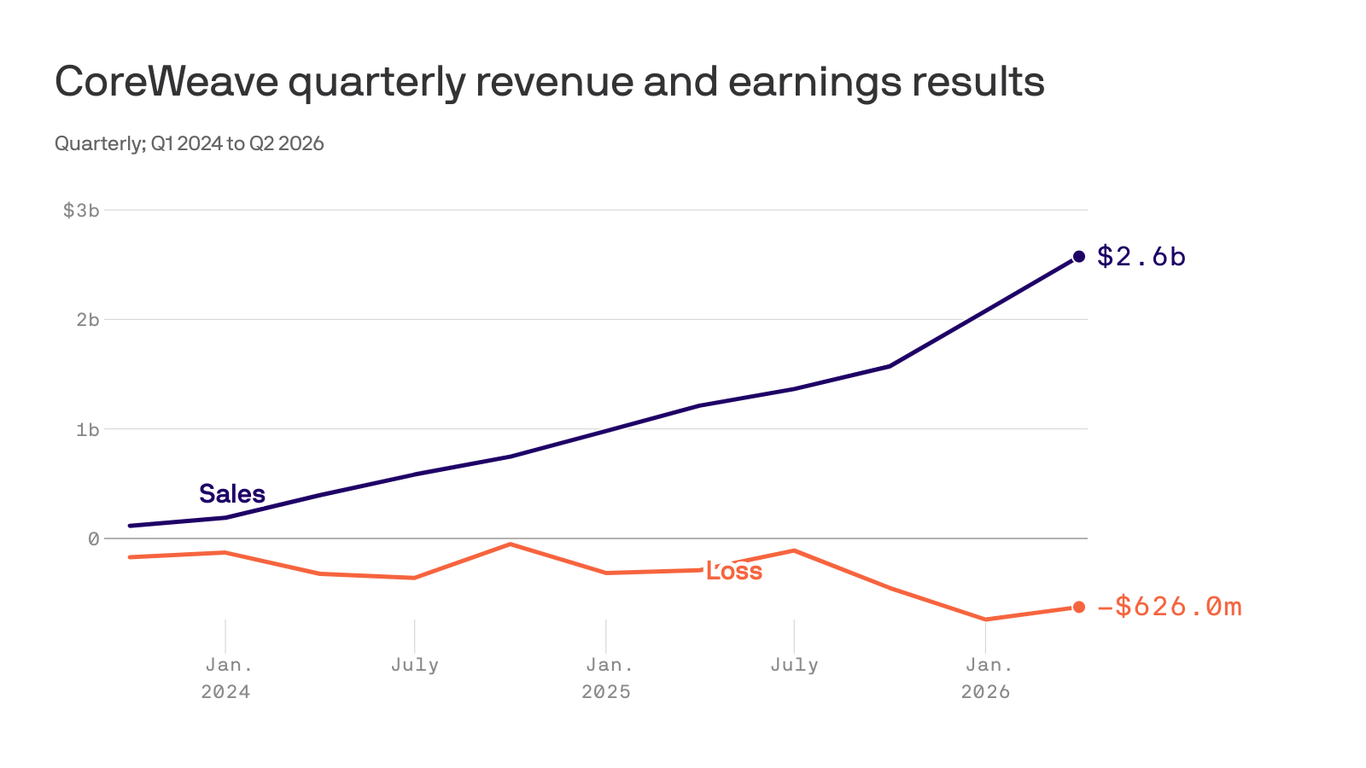
Data: FactSet; Note: Loss data is produced in accordance with GAAP; Chart: Matt Phillips/AxiosCoreWeave's losses doubled, its spending soared and it devoured almost $6 billion more in cash than it generated last quarter. Investors loved it. Why it matters: Some see CoreWeave, a so-called neocloud that builds data centers and sells AI computing power, as the canary in the coal mine of the AI trade. After the report, that canary was tweeting and flying high. The latest: Shares of the neocloud soared 19% after it reported second-quarter results the previous evening.CoreWeave's numbers were broadly consistent with what we've been hearing from hyperscalers and others.Sales and backlog showed rising demand for AI compute, as revenue more than doubled, to $2.58 billion. Remaining performance obligations, a measure of sales backlog, jumped 245% to $103.7 billion. Yes, but: The company's losses are getting deeper for every dollar of sales it collects. Its adjusted net loss worsened to $567 million from $130 million during the same quarter last year. (According to stricter GAAP accounting rules, the loss was worse, $626 million.) CoreWeave's adjusted net loss margin — or how much it loses for every dollar of sales, excluding certain items — declined to -22% from -11%. And the company's free cash flow, considered one of the highest-quality earnings indicators, was negative $5.74 billion, a sharp deterioration from negative $2.70 billion the previous year, according to FactSet.Data: FactSet; Chart: Matt Phillips/AxiosWhat they're saying: Bulls are keeping the faith, while skeptics are, um, skeptical. "Overall, results/guide reflect a robust demand/constrained supply backdrop that should continue to drive revenue growth/margin expansion momentum," wrote Evercore ISI analyst Amit Daryanani. "While guidance went up on every line," wrote Madison Rezaei, an analyst with Bernstein Research. "Capex went up higher than all of them." "We're still not fans of the model," she later added. Between the lines: While some deference to the market's reaction may be due, that should likely come with a few grains of salt as well. We're not the only ones who've noticed the company's problems with profitability. And as a result, a large short position has grown in the stock.The most recent data showed more than 20% of CoreWeave's float in the hands of short sellers. Since shorts have to buy the stock to exit, or cover, their trades, a move higher in a heavily shorted stock like CoreWeave can create a mad rush to exit positions, generating something known as a squeeze. That could be part of what's happened with the stock Wednesday. The bottom line: If one wants a clean read on CoreWeave, it could be illustrative to take a look at what insiders have been doing recently with their holdings. As the chart below shows, what they definitely haven't been doing is buying — at least in the aggregate — and that's pretty interesting in itself. Data: FactSet; Chart: Matt Phillips/Axios
Understanding the surge in CoreWeave's stock
The data center company's losses doubled and its spending soared. Investors loved it.
TL;DRAI
CoreWeave doubled revenue to $2.58B with $103.7B backlog (+245%), signaling strong enterprise demand for AI compute amid constrained supply. Adjusted net loss margin deteriorated to -22% and free cash flow hit -$5.74B, revealing the profitability gap beneath bookings euphoria.
478 words~2 min read