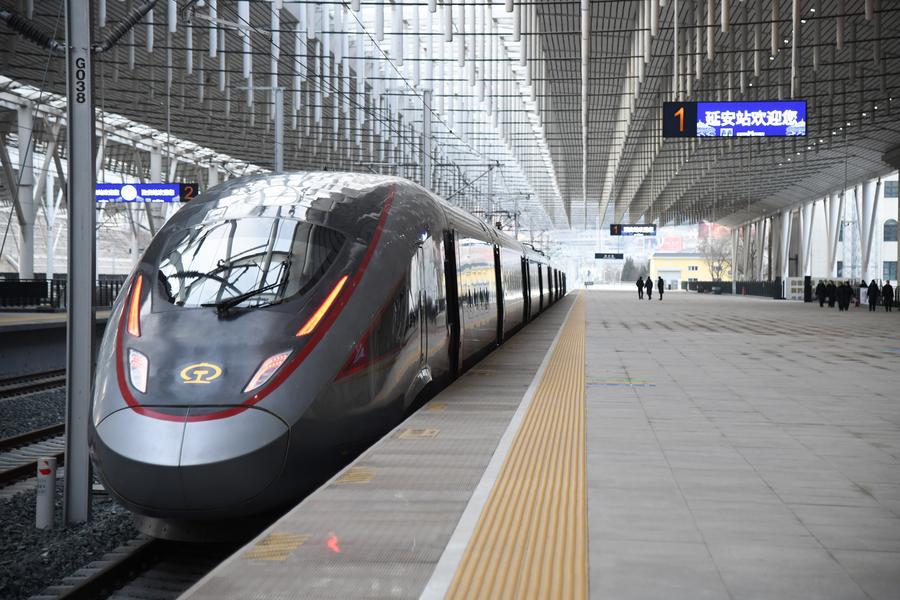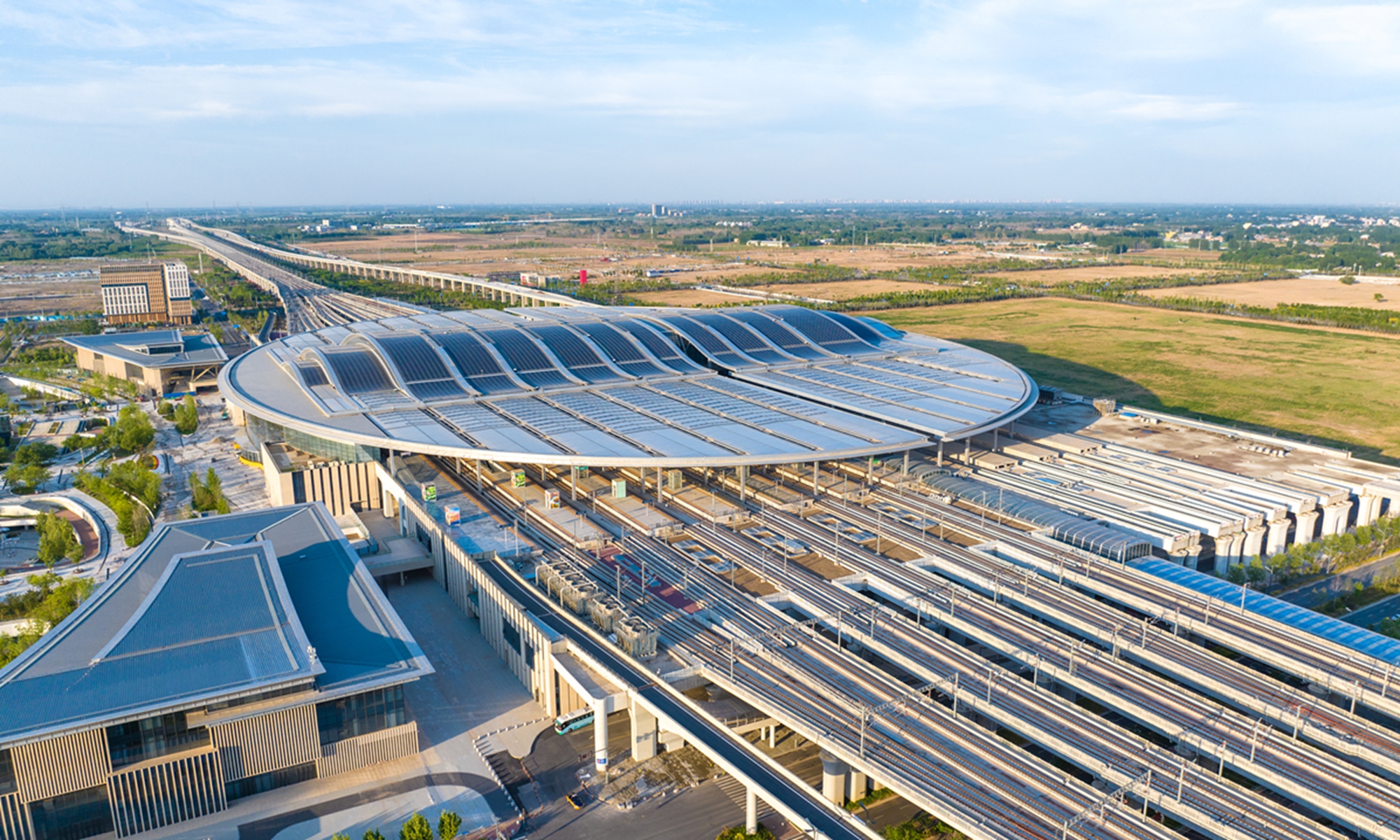
A view of Xiong'an Railway Station in Xiong'an New Area, North China's Hebei Province Photo: VCGEditor's Note:Since 2012, China has witnessed an extraordinary economic transition, with historic achievements in all aspects of the economy. Such an unparalleled feat does not just happen by accident, especially during a tumultuous period in the global geo-economic landscape and a tough phase in China's economic transformation and upgrading process. It was Xi Jinping Thought on Socialism with Chinese Characteristics for a New Era that guided the country in overcoming various risks and challenges, and in keeping the China economic miracle alive.As China embarked on the quest to become a great modern socialist country amid global changes unseen in a century, Xi's economic thought has been and will continue to be the guiding principle for development in China for years to come. Furthermore, China's development carries immense significance for the world at large. What is Xi's economic thought? What does it mean for China and the world?To answer these questions, the Global Times has launched this special coverage on the Chinese leader's major economic speeches and policies, and how they are put into practice to boost development in China and around the world.When Francesco Faiola first arrived in China, he had no long-term plans. Yet he stayed - because, as he puts it, "China made me feel like I belong to a scientific community that's now helping set global directions." A decade later, the stem cell toxicologist leads a lab in Beijing and has taken a front row seat to China's rising technological innovation. And it's not just him - his family back home has also caught the wave."My parents are old and live in a small Italian town. They don't speak English, they don't understand molecular biology, and they can't read a scientific paper. But over the past few years, they've called me more than once, excited, telling me about a Chinese airplane, a humanoid robot, or some AI breakthrough they saw on Italy's main TV news or in the newspapers," Faiola, a researcher at the Chinese Academy of Sciences, told the Global Times in a recent interview.Faiola's story is just one illustration of how China's technology-driven industrial transformation is drawing growing global attention.For years, China's growth narrative was defined by scale - the world's largest manufacturing base and one of its biggest consumer markets. But now, a structural shift is underway. New and emerging technologies are no longer playing a supporting role; they are becoming genuine drivers of growth, turning scale into speed and capability.Following footprintsAs China released economic data for the first half of 2026 in mid-July, there are many analyses of the performance of the world's second-largest economy. What's the best way to view the actual state of the Chinese economy? The inspection tours of the top leader offer the best clues.In February, when visiting a national information technology innovation park in Beijing, Xi Jinping, general secretary of the Communist Party of China (CPC) Central Committee, stressed self-reliance and strength in science and technology, hailing it as the "key" in building China into a great modern socialist country.In March, Xi, also Chinese president and chairman of the Central Military Commission, called for efforts to build the Xiong'an New Area in North China's Hebei Province into an innovation hub in the new era and a model of promoting high-quality development.In June, during an inspection trip to the city of Dezhou, East China's Shandong Province, he called for solid measures to advance the modernization of agriculture and rural areas.In July, he called for advancing high-quality urban renewal during an inspection trip to Shanghai.From sci-tech self-reliance and strength to innovation, from modernization of agriculture and rural areas to high-quality urban renewal, the focuses of the inspection tours also highlighted various aspects of China's economic performance in the first half of 2026 as well as its future growth path: innovation-driven high-quality development, emergence of new growth points and vast potential for growth.Innovation-driven growthFrom the beginning of 2026, the recovery of the world economy has remained under sustained pressure amid increasingly turbulent and unstable international landscape. Meanwhile, China's economy has braved the storm and forged ahead with unyielding momentum, demonstrating a resilient, steady and upward trajectory since the start of the 15th Five-Year Plan period (2026-30).New growth engines, including advanced manufacturing, the digital economy and modern services, accounted for more than 40 percent of China's economic growth in the first half of the year, according to the National Bureau of Statistics.During the period, the country's value-added output of high-tech manufacturing climbed 13.3 percent, while value-added of the manufacturing sector accounting for 26.2 percent year-on-year, up 0.4 percentage points compared with three years ago, underscoring the dynamic, innovation-driven and high-quality development of the Chinese economy.When attending a symposium on strengthening basic research in Shanghai in April, Xi urged greater efforts and more concrete measures to strengthen basic research, enhance China's capacity for original innovation and further solidify the foundation for building the country's strength in science and technology.At a meeting on July 8 in Beijing that brought together the national science and technology award conference, the general assemblies of the members of the Chinese Academy of Sciences and the Chinese Academy of Engineering, and the 11th national congress of the China Association for Science and Technology, he stressed that "We must seize the historic opportunity, rise to the challenges of the times, accelerate efforts to achieve high-level self-reliance and strength in science and technology, and make steady progress toward the 2035 goal of becoming a leading country in science and technology."A series of technological breakthroughs has highlighted the momentum behind China's innovation-driven industries, including the T1200 ultra-high-strength carbon fiber achieving the world's first ton-scale mass production, a humanoid robot shattering the human half-marathon record in April, the Kimi K3 open-source large model unlocking new frontiers of cognitive computing.In the much-anticipated "city of the future," Mech-Mind stands as a microcosm of this ascent. Specializing in physical AI, its "eye-brain-hand" solution has migrated from lab prototypes to automotive lines, logistics hubs and service sectors across nearly 50 countries."China possesses the world's most complex manufacturing scenarios and the largest pool of application data, hence the richest experience in intelligent manufacturing," Shao Tianlan, founder and CEO of Mech-Mind, told the Global Times. This global footprint is no isolated incident; it is the crystallization of unparalleled industrial advantages nurtured under a policy ecosystem that prioritizes scenario-based innovation."China's march toward an innovation-driven, higher-quality economy is gathering real pace, as industrial transformation is now visible, tangible and making solid progress," Cao Heping, professor at the School of Economics of Peking University, told the Global Times.
Xiconomics in Practice: Charting China’s growth path in H1 through Xi’s footprints
When Francesco Faiola first arrived in China, he had no long-term plans. Yet he stayed - because, as he puts it,
2,234 words~10 min read