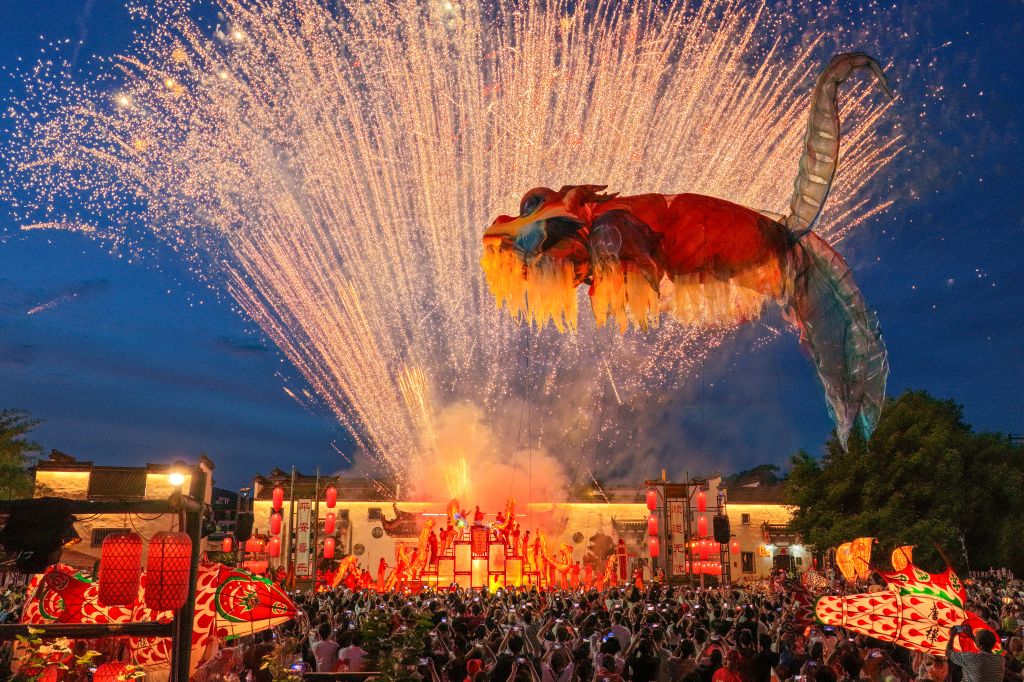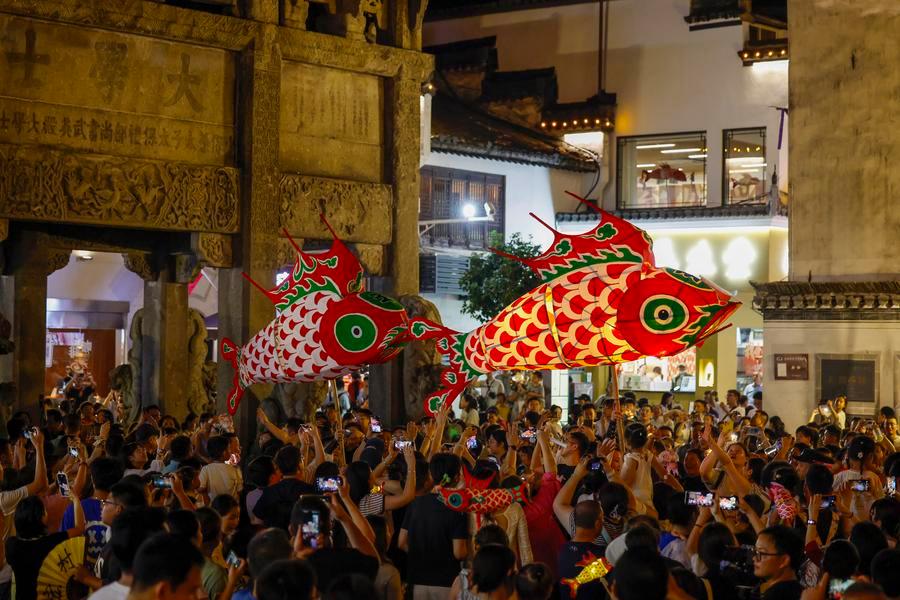
The fish lantern parade in the Millennium City Park Photo: Courtesy of the Millennium City ParkFireworks bloomed in golden-red sparks across the night sky, the hems of Hanfu skirts swaying gently in the glow of the lanterns, while the steam from soup dumplings mingled with the bustling sounds of the marketplace. Several foreign tourists held up their phones to capture the atmosphere. This was an ordinary day in Kaifeng, Central China's Henan Province, yet every corner brimmed with the lively atmosphere of Song-era life and an open, welcoming warmth.This city, once known as Bianliang, the capital of the Northern Song Dynasty a thousand years ago, was already a thriving metropolis that broke the boundaries of traditional wards and markets and opened gates to promote maritime foreign trade.Today, it continues to carry forward the unique charm of Song culture and an atmosphere of openness and inclusiveness, drawing an increasing number of international visitors — people who are not merely passing through, but many who have chosen to work and live here.Among them is Xiao Feifei, a performer from Ghana who has been working in Kaifeng for more than a year."When I first arrived in Kaifeng, there weren't many foreign visitors in the scenic areas. Now I meet new visitors almost every day — some are European tourists who decided to come on the spur of the moment thanks to convenient visa policies, others are families who specifically bring their children to experience Song culture," he said.The figures confirm this change: in the first half of 2026, the number of inbound tourists to Kaifeng grew by approximately 130 percent year-on-year, with source markets expanding beyond the traditional Hong Kong, Macao, and Taiwan regions to include multiple countries in Southeast Asia, Europe, and North America.Why are more and more foreigners willing to come to Kaifeng — and even stay? When Global Times reporters walked through the city, the answers gradually became clear.'A home to stay'Xiao Feifei's story with the city begins in 2025. He arrived in Kaifeng and worked as an acrobat and performer in the Wansuishan Martial Arts City, a Disney-style theme park that features many scenes and plays inspired by "Outlaws of the Marsh." At first he viewed it as just a job — finish each performance to earn a living. But as time passed, he found himself increasingly unable to leave."The most unforgettable moment for me was one day after a performance, just as I was about to rest, a security guard wheeled over a boy who was my fan. Unable to speak, he simply stretched out his arms with all his strength, asking for a hug. I bent down and gently held him. In that instant, a tenderness I had never felt before welled up inside me," Xiao Feifei told the Global Times. "There are also the children who call me 'big bro.' They post videos online looking for me and specially come to play with me. These moments make me feel that I am not merely working — I am truly bringing joy to others," he noted.It was this sense of purpose, of being accepted and warmly embraced that made Xiao Feifei decide to stay. "I feel the inclusiveness and care of the people here every day. This is how I understand Chinese culture," he said. "Kaifeng has become my second home."Xiao Feifei is not alone. The scenic area now has more than 200 foreign performers and staff. Zhao Kuan, general manager of Wansuishan Martial Arts City, explained that while the park is rooted in traditional Chinese wuxia culture -- a genre of Chinese fiction or cinema featuring the adventures of martial artists in ancient China, it also incorporates elements from foreign martial traditions, such as Zorro-style figures. "This allows overseas visitors to find a sense of familiarity while experiencing something uniquely Chinese," Zhao said. "It reflects the open and inclusive spirit of Song culture itself."Currently, more than 3,000 performances of various sizes themed around wuxia culture — including live-action martial arts dramas and character model shows — are staged every day.Immersive experienceMartin, a computer technology teacher from Eindhoven in the Netherlands, is visiting China for the first time. This two-week trip has taken him through several cities, and the Millennium City Park, a Song Dynasty-themed park in Kaifeng marks one of his final stops before heading home."The moment you step into the park, you are immediately immersed. The colors, the lights, the performances — everything is perfectly coordinated. Even though I don't understand the dialogue, I can clearly feel the historical atmosphere of the ancient Song Dynasty and its everyday street life. It's not simply about performance tricks; it's telling a real story that makes you feel as if you've traveled back in time," Martin told the Global Times.Millennium City Park is modeled on the renowned painting the Qingming Festival by the Riverside, recreating the street scenes, everyday life, and live performances of the Song Dynasty. Centered on Hanfu styling and makeup, intangible cultural heritage handicrafts, park-wide NPC interactions, and large-scale live shows, the scenic area transforms Song Dynasty rituals, folk customs, aesthetics, and the spirit of family and nation into living scenes that visitors can wear, make, watch, and interact with, an employee from the park told the Global Times.Foreign tourists need no direct historical knowledge or language skills to appreciate the elegance and vibrant street life of the Song people through costume, hands-on crafts, performances, and interactions, he noted.
How Kaifeng is winning foreign hearts with Song culture and open inclusiveness
Fireworks bloomed in golden-red sparks across the night sky, the hems of Hanfu skirts swaying gently in the glow of the lanterns, while the steam from soup dumplings mingled with the bustling sounds of the marketplace. Several foreign tourists held up their phones to capture the atmosphere. This was an ordinary day in Kaifeng, Central China's Henan Province, yet every corner brimmed with the lively atmosphere of Song-era life and an open, welcoming warmth.
1,714 words~8 min read