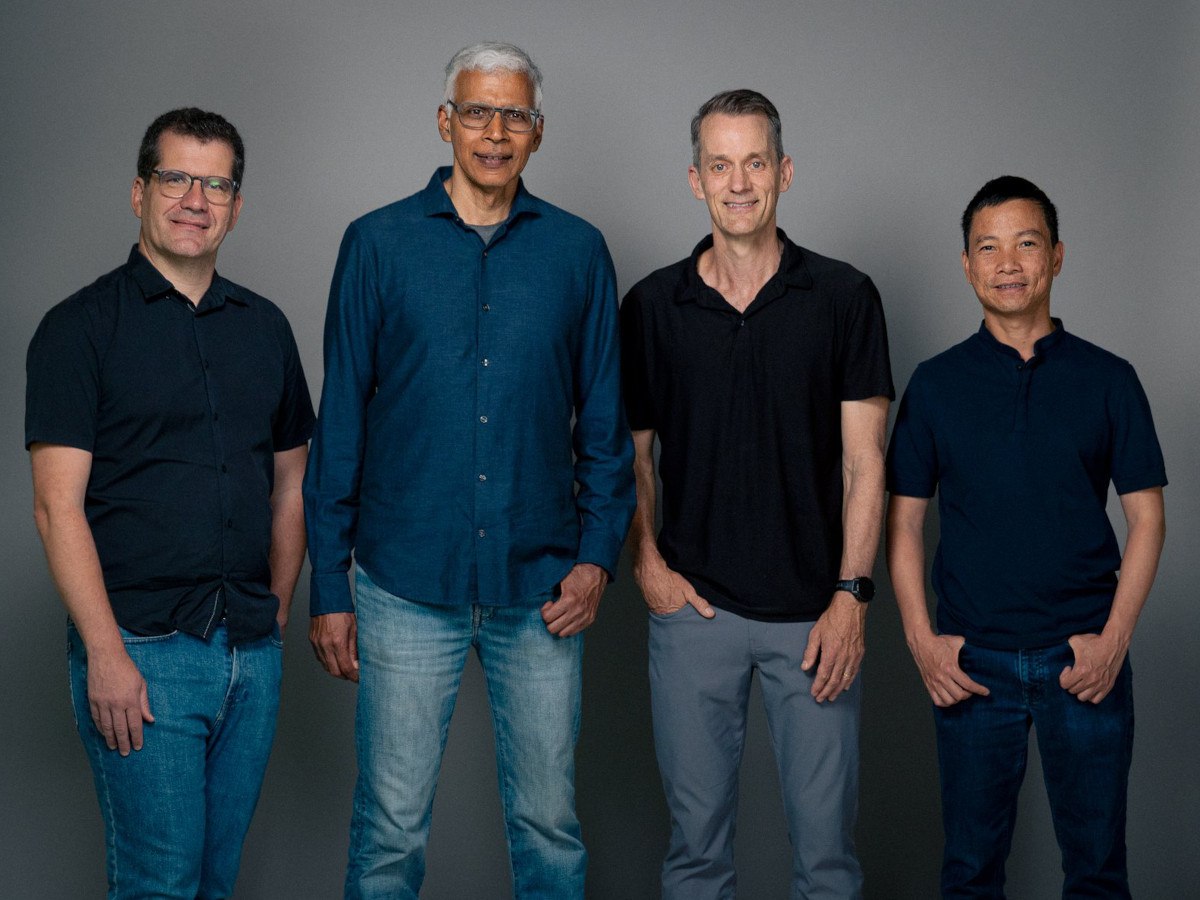
Link CopyTwitterLinkedinWhatsappJeff Dean’s Next Move: Google AI Veteran Targets $10 Billion Startup ValuationGoogle AI leader Jeff Dean has departed after 27 years to co-found Discovery Loop. This new venture aims to accelerate scientific breakthroughs using automated machine learning. The startup is reportedly in discussions to raise approximately one billion dollars. Dean's departure highlights the trend of elite researchers forming specialized AI startups. Discovery Loop's success could redefine AI's value beyond information generation.Google’s most remarkable engineer and one of its key AI pioneers, Jeff Dean, will channel his decades of experience of large-scale computing and AI into the world of startups.After an impressive 27-year tenure, Dean announced today that he’ll be leaving Google, not only in body, but in spirit as he starts out as co-founder of the new public benefit corporation Discovery Loop, that aims to use automated ML, large scale experiments and AI based scientific workflow, aiming to accelerate the progress in science and engineering. Other founding members include fellow Google veterans and scientists including Sanjay Ghemawat, Quoc Le, and Oriol Vinyals.About The AuthorHey there, i am a technology enthusiast with a deep passion for gadgets, consumer electronics, emerging technologies, and the fast-paced world of digital innovation. Constantly exploring the latest tech trends, product launches, and industry developments, I enjoy translating complex technological advancements into engaging and accessible stories for readers. My interests span smartphones, wearables, artificial intelligence, smart devices, and the broader technology ecosystem. As I begin my journey as a Tech Journalist at Gadgets Now, I am excited to contribute to a platform that informs millions of readers, combining my passion for technology with storytelling to deliver insightful, accurate, and timely tech coverage.The business has garnered exceptional investment interest as sources close to the venture revealed that Discovery Loop had entered talks of raising approximately $1 billion at a valuation of ~$10 billion; Dean or the company have not confirmed those numbers, and a representative for Dean had no comment about the fundraising talks.Discovery Loop's Bet: AI That Runs Experiments, Not Just Answers QuestionsDiscovery Loop's central idea is different from the dominant consumer-AI model.Rather than building another general-purpose chatbot designed primarily to generate text, images or code, the company aims to develop AI systems that can participate in the process of scientific and engineering discovery.Its stated mission is to automate machine learning, science and engineering in order to accelerate discovery and progress. The company says its systems will tackle difficult problems by coordinating large numbers of experiments in parallel.The distinction is important. Discovery Loop is describing a system in which AI could help formulate hypotheses, determine which experiments should be run, analyze the resulting data and use those results to decide what to test next.The goal is therefore not simply to make AI better at answering questions. It is to create an increasingly automated feedback loop between hypothesis, experiment, result and new hypothesis.More articles by AuthorTrending StoriesThe company says it aims eventually to conduct thousands of experiments in parallel. That should be understood as an ambitious objective rather than evidence that Discovery Loop already operates a fully autonomous system performing thousands of real-world scientific experiments.The underlying concept, however, is not science fiction. Researchers have spent years developing automated experimentation, active learning and AI-assisted scientific-discovery systems. Recent work has demonstrated increasingly sophisticated systems capable of proposing research ideas, writing experimental code, executing experiments and analyzing their results.Discovery Loop's larger bet is that these techniques can be scaled dramatically and applied to a much broader range of scientific and engineering problems.A Founding Team With Unusual Technical DepthDiscovery Loop's street-credability begins with its founders.Dean's experience started when he joined Google in 1999. He became one of Google's most senior engineers, building some of Google's fundamental distributed systems such as MapReduce, contributing significantly to Google's large-scale computing infrastructure and in founding Google Brain, perhaps Google's most significant AI research group.Sanjay Ghemawat, joining in 1999 as well, is Dean's collaborator and co-inventor of MapReduce and its many underlying distributed system ideas. Their work helped establish the architecture underlying much of Google's ability to process enormous quantities of data across large clusters.Quoc Le has been a major figure in machine learning research, with work spanning neural networks, neural architecture search, language models and other areas of deep learning.Oriol Vinyals, meanwhile, has held senior research roles at Google DeepMind and contributed to major advances in deep learning, reinforcement learning and AI systems including AlphaStar.Collectively, the four founders represent several generations of Google's technological development: distributed computing, large-scale machine learning, deep learning, reinforcement learning and frontier AI.Their previous work is connected to technologies and research underlying major Google products and initiatives, including Search, advertising infrastructure and Gemini. Dean himself was also one of the leaders associated with Gemini's development.That background gives Discovery Loop something that is difficult for a conventional startup to manufacture: a founding team with decades of experience building computing systems at enormous scale.Alphabet Is Both a Former Employer and a PartnerPerhaps the most unusual aspect of Discovery Loop is its relationship with Alphabet.Alphabet is not simply watching Dean's startup from the outside. Google CEO Sundar Pichai has said that Alphabet will be a founding investor and cloud partner to Discovery Loop. Other reported investors include Radical Ventures, Khosla Ventures, Lightspeed, Kleiner Perkins and Doerr Capital.The financial terms of Discovery Loop's initial financing have not been fully disclosed, although reporting indicates that it was in the hundreds of millions of dollars.That should be distinguished from the separately reported discussions around a potential $1 billion financing at approximately a $10 billion valuation.The relationship with Alphabet makes Discovery Loop different from a straightforward Google competitor.Dean is leaving Google, but his new company will still have access to Google's broader ecosystem through investment and cloud infrastructure. In effect, Alphabet can maintain a relationship with technology and researchers that it no longer employs directly.That could become an increasingly important model in the AI industry: researchers leave large companies to gain greater independence, while those same companies remain connected to their former employees through investment, infrastructure and commercial partnerships.A Significant Change for GoogleNevertheless Dean's resignation is a huge event for Google.Dean started at Google during the company's infancy and dedicated nearly three decades to laying the foundation for Google's technical infrastructure and AI strategy. He was appointed Chief Scientist in 2023 on the formation of Google DeepMind, ranking him as one of Google's top scientific leaderships. This announcement comes during a wider reshuffling of Google's AI leadership.Demis Hassabis has moved into a wider scientific and strategic role as Chief Scientist of Alphabet and Chair of Google DeepMind, while Koray Kavukcuoglu has taken more of an operational leadership role in DeepMind.The changes are occurring as Google faces intense competition from OpenAI, Anthropic and other AI companies and continues to push Gemini as a central part of its strategy.It would be too early to conclude that Dean's departure demonstrates that Google can no longer retain elite researchers. Google still has enormous advantages in computing infrastructure, specialized hardware, data, distribution and research talent.But the move does demonstrate how attractive the independent-startup route has become for researchers with exceptional technical reputations.A researcher who once needed the resources of a technology giant can now potentially leave, raise hundreds of millions or even billions of dollars, and obtain large-scale computing through cloud partnerships.That changes the economics of frontier research.The Rise of the Big-Tech AI SpinoutThe arrival of Discovery Loop is happening in a larger movement by researchers from the world's top AI labs to start their own well-funded companies.One of the most high-profile is Ineffable Intelligence, a company founded by former DeepMind researcher David Silver. This startup successfully raised approximately $1.1B at a valuation of around $5.1B-showing how investors are eager to give extremely large sums of money to researchers with strong frontier-AI experience.Yet another example is Periodic Labs, a company founded by AI researchers with experience in OpenAI and Google, which raised $300M at a valuation of over $1.1B at a later round, and which will use AI and autonomous experimentation on scientific discovery.These companies are part of a larger shift in the AI economy.The scarce resource is no longer simply computing power. It is also the people capable of deciding what to build, what scientific problems are worth pursuing and how AI systems can be pushed beyond today's capabilities.For investors, researchers such as Dean, Silver and others offer a rare combination of scientific credibility, technical experience and the ability to recruit additional elite talent.For those researchers, the current funding environment provides something that was much harder to obtain a decade ago: the ability to build organizations around ambitious scientific ideas without remaining inside a technology giant.The Bigger PictureThe reported possibility of a $1 billion financing at a $10 billion valuation illustrates how dramatically investor expectations have changed around frontier AI talent.Discovery Loop has not yet demonstrated that it can transform scientific discovery at the scale envisioned by its founders. Its technology, commercial model and eventual scientific impact remain to be proven.But the company's formation is already significant.Four researchers with extraordinary experience at Google have chosen to build an independent organization around AI-driven scientific discovery. They have attracted major venture investors, while Alphabet itself has chosen to remain involved as a founding investor and cloud partner.That combination points to a changing Silicon Valley model.The largest technology companies still possess enormous advantages in infrastructure and research resources. But those advantages no longer necessarily require researchers to remain employees of those companies.Elite scientists can leave, raise enormous amounts of capital, rent or partner for computing infrastructure and build organizations around highly specialized visions.For Google, that creates both a challenge and an opportunity. It loses one of its most recognizable technical leaders, but through Alphabet's investment and cloud relationship, it can remain connected to whatever technology emerges from Dean's next chapter.For the wider AI industry, the significance may be even greater.The next generation of important AI companies may not be built primarily around another chatbot or consumer application. They may be built around researchers who use AI to accelerate the discovery of new materials, medicines, algorithms, engineering systems and scientific knowledge.If Discovery Loop succeeds, the most important output of AI may increasingly be measured not by how well a model answers a question, but by how quickly it can discover something nobody knew before. FAQsWhat is Discovery Loop and what is its main focus?Discovery Loop is a public-benefit corporation co-founded by Jeff Dean and others, focusing on leveraging automated machine learning and AI-driven scientific workflows to accelerate advancements in science and engineering.Who are the key founders of Discovery Loop?The founding team of Discovery Loop includes Jeff Dean, Sanjay Ghemawat, Quoc Le, and Oriol Vinyals, all of whom have extensive experience in large-scale computing and AI from their previous work at Google.How is Discovery Loop different from traditional AI companies?Unlike traditional AI companies that create general-purpose chatbots, Discovery Loop aims to develop AI systems that can actively participate in scientific and engineering discoveries by running experiments, analyzing data, and forming new hypotheses.What is the significance of Alphabet's involvement with Discovery Loop?Alphabet is both a founding investor and cloud partner of Discovery Loop, allowing the startup to access Google's infrastructure while maintaining a unique independence, which could create a new model for the AI industry.What challenges does Discovery Loop face in proving its technology?Discovery Loop's major challenge will be demonstrating its ability to transform scientific discovery at scale and validating its ambitious goal of automating the entire research process through AI.end of article
Jeff Dean’s Next Move: Google AI Veteran Targets $10 Billion Startup Valuation
Google AI leader Jeff Dean has departed after 27 years to co-found Discovery Loop. This new venture aims to accelerate scientific breakthroughs using automated machine learning. The startup is reportedly in discussions to raise approximately one billion dollars. Dean's departure highlights the trend of elite researchers forming specialized AI startups. Discovery Loop's success could redefine AI's value beyond information generation.
Jeff Dean leaves Google after 27 years to co-found Discovery Loop with other AI veterans, targeting $1 billion funding at $10 billion valuation to automate scientific discovery via machine learning. The move redefines AI's enterprise value from text generation to autonomous research systems, reshaping CTO spending priorities and R&D team capabilities.