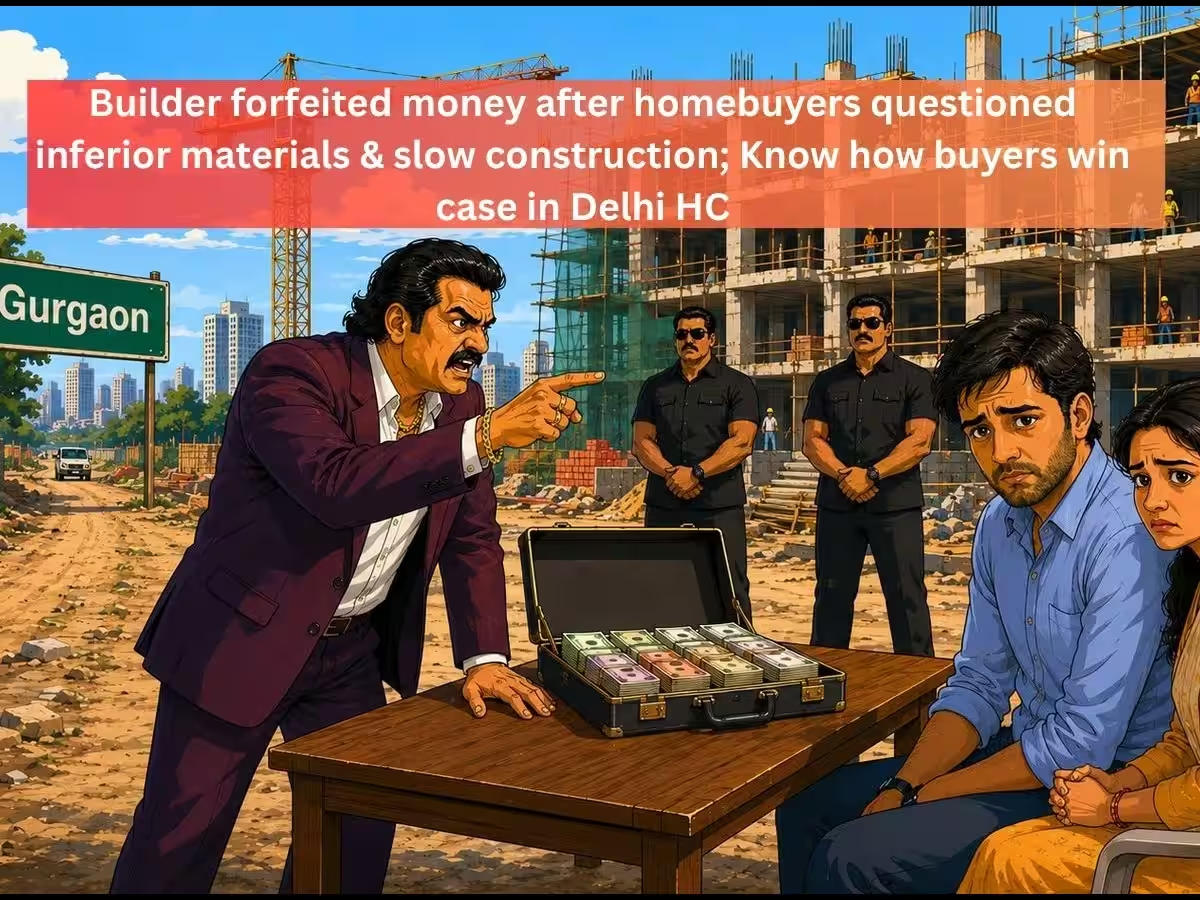
The Delhi High Court recently provided relief to a family of homebuyers (Mr and Mrs Maheshwari) from Safdarjang, by directing the builder to refund Rs 18 lakh along with 6% annual interest. This amount had been held back due to the cancellation of their allotment, which the builder coerced them into signing a full and final settlement for.To give you a quick overview of how this dispute came about, it all began on February 22, 2008, when the homebuyers showed interest in purchasing duplex independent villas from this builder’s new project in Village Ghasola Badshahpur, Gurgaon, Haryana.The homebuyers had paid Rs 10 lakh as a booking amount and subsequently signed an Agreement to Sell (ATS) on February 27, 2008 for Villa No. C-01, measuring approximately 510.39 sq. yds., with a super built-up area of about 4900 sq. ft., with a total price tag of Rs 2.5 crore.On March 22, 2008, the homebuyers paid Rs 25 lakh via cheque and again Rs 27 lakh was paid on June 30, 2008, via cheque, giving in total Rs 62 lakh to the builder.However, between September-October 2008 when the homebuyers went to the construction site, they found the construction to be slow and of inferior quality and so they raised objections and sought either compliance with specifications or a refund of their money. The builder, however, assured them that the construction will be completed in time and persuaded them to continue with the project.However, on March 12, 2009, the homebuyers informed the builder that they have lost the original allotment documents in transit and requested him to supply complete documents. The builder supplied some documents, but the schedule of construction and specifications were not provided despite repeated requests.Although the homebuyers had made payments that were commensurate with the construction progress, the absence of an available construction schedule meant the homebuyers could not determine the expected stage of completion, the actual work performed, or the specific due dates for installments.Despite this, the builder on March 9, 2009, unilaterally and arbitrarily cancelled their allotment alleging default in payment of installments and also forfeited the earnest money of Rs 62 lakh paid by the homebuyers, as Clause 4 of the Agreement to Sell (ATS) said that in the event of cancellation, the builder can forfeit 25% of the Villa’s composite price.In response to this forfeiture, the homebuyers on March 30, 2009, and April 15, 2009, asked the builder to withdraw the cancellation and provide the necessary documents.However, the builder failed to take any action or even reply, leaving their concerns completely unaddressed. After this, the homebuyers decided to take legal action against the builder for recovery of Rs 62 lakh paid by them.Just when the homebuyers were in the process of initiating litigation, Mr. Sharma, DGM (Sales & Marketing), contacted the homebuyers to propose a meeting on June 23, 2009, regarding the Agreement to Sell.The homebuyers attended the meeting, They kept minutes of the meeting and emailed it to Mr Sharma once the meeting ended. During this meeting, the homebuyers requested that the builder should rescind the cancellation and complete the villa.However, this proposal was rejected outright by the builder’s employee stating they were not in a position to reverse the cancellation decision. The homebuyers then requested a refund of Rs 62 lakh, along with interest, plus Rs 20 lakh, in damages, which was also turned down by the builder.In lieu of the original villa, Mr. Sharma offered to allot Villa No. B-69, located on 430 square yards with a super built-up area of 4,800 square feet, for a total price of Rs 2.11 crore. Under compelling circumstances and due to coercive bargaining, the homebuyers were left with no option but to accept this one-sided proposal.Also read: Homebuyer booked flat for Rs 18 lakh in 2010, later finds builder sold the flats to third party: Mumbai man wins full refund with interest, penalty on developerMr. Sharma thereafter, summoned the Accounts Manager, Mr. Shaily and informed him of the understanding, and requested that the details be recorded via email.The following day, Mr. Sharma provided the application Form in duplicate, for the allotment of Villa No. B-69. The homebuyers signed the forms and completed all necessary procedures in the presence of Mr. Sharma, handing over one copy, while retaining the second.On June 24, 2009, Mr Shaily emailed the requisite papers to the homebuyers and Mr Sharma further confirmed this via telephone that the detailed agreement and other formalities would be finalised by June 27, 2009, in line with the understanding reached by them on June 23, 2009, which had been confirmed by the minutes of the meeting, emailed by the homebuyers.However, on June 27, 2026, when Mr Sharma requested to meet the homebuyers, they discovered that the builder was again unilaterally and arbitrarily changing the villa.Mr. Sharma said there was no room for further discussion. He then insisted that the homebuyers settle the entire claim of Rs 62 lakh for Rs 44 lakh. He claimed that if the homebuyers agreed, the builder would assist with two plots in a different project in Surajkund, Faridabad, and provide free membership to an "International Standard Spa & Club" proposed for that development.The homebuyers allege that they were threatened that if they failed to agree to this new proposal, they would lose the entire Rs 62 lakh which was already paid under the first Agreement to Sell. Thus the homebuyers were coerced to accept the unilateral proposal and forced to sign the "Full and Final Settlement" offer along with other documents.After signing, the homebuyers were handed a cheque for Rs 44 lakh, against a total lawful claim of Rs 62 lakh. After this, on June 30, 2009, the homebuyers lodged a formal protest with the builder regarding the receipt of the payment and the builder’s failure to pay the outstanding balance of Rs 18 lakh. Subsequently, the homebuyers filed a court case also against the builder in 2016.The case went for trial and on September 30, 2019, the trial court ruled in the homebuyers’ favour and held that the builder failed to prove that proper demand notices for installment payments were ever served on the buyers. Also the buyers’ allegations that construction was slow and of inferior quality remained unrebutted.Therefore, the court held that the cancellation of the villa allotment by the builder was illegal. Moreover, the court held that the so-called full and final settlement under which the homebuyers accepted Rs 44 lakh was signed under undue influence and coercion because the builder was in a much stronger bargaining position.Feeling aggrieved, the builder filed an appeal in Delhi High Court. On May 18, 2026 the Delhi High Court upheld the trial court’s judgement under which the builder was ordered to refund Rs 18 lakh with interest.Also read: Homebuyer paid for a flat in a Delhi housing society in 2003, got delayed possession, sought compensation for delay; SC defends his rightWhy the homebuyers won this caseShashwat Anand, Advocate on Record (AOR), Supreme Court of India said to ET Wealth Online that there were three main reasons for the Delhi High Court's favorable ruling for the homebuyers.Firstly, there was a finding by the court that the cancellation of the villa allotment was an unlawful act. The payment obligations were construction-linked, and the builder failed to produce the construction schedule or establish that the relevant construction milestones had been achieved. It also failed to prove service of the demand notices in the contractually prescribed manner. The buyers therefore could not be treated as defaulters.Secondly, it was ruled by the high court that the payment of Rs 44 lakh being a full and final settlement did not put an end to the claim of the other amount of Rs 18 lakh. This is due to the coercion and undue influence as found from the facts of the case, including that the developer possessed Rs 62 lakh and could forfeit that amount.Thirdly, it is clear that the Delhi High Court held through Section 74 of the Contract Act that the forfeiture of Rs 18 lakh cannot stand since the builder did not prove any loss. The forfeiture is hence deemed unlawful and the buyers are entitled to refund of the same with interest.Also read: Booked flat for Rs 24 lakh in 2010, paid Rs 40 lakh over time, still no possession in 2026; homebuyers awarded full refund and Rs 2.5 lakh compensation eachDelhi High Court order and discussionJustice Neena Bansal Krishna of the Delhi High Court said that it is well-settled that a plea of full and final settlement must be founded on free consent. Where the acceptance of a lesser amount occurs under protest or coercive circumstances, it does not constitute a binding accord and satisfaction and, consequently, does not extinguish the original claim, reported LiveLaw.The Delhi High Court said that the homebuyers were in a vulnerable position and were left with no viable alternative but to accept whatever amount was offered.The high court said that the District Judge (trial court) had correctly observed that the homebuyers, when pitted against a large builder with superior bargaining power, were effectively coerced into accepting Rs 44 lakh offered by the builder.The Delhi High Court also observed that the builder had failed to show any evidence that they have served the homebuyers with demand notices and that the builder failed to show the actual construction progress which justified the payment demands made by it.Agreeing with the trial court, it held that the cancellation was illegal, arbitrary, and unjustified, reported LiveLaw.Lastly, the high court also held that the builder failed to give any evidence showing that it has suffered any actual loss justifying the Rs 18 lakh money it forfeited. The court thus dismissed the appeal but refused to grant any other relief like the Rs 20 lakh for damages which the homebuyers wanted. Since the high court upheld the trial court’s order, now the builder has to refund the Rs 18 lakh with 6% per annum interest, from the date of the institution of the case till its actual realization.
Builder forfeited homebuyers' earnest money after they questioned poor construction quality; HC orders Rs 18 lakh refund with 6% interest - The Economic Times
Builder forfeited earnest money paid by homebuyers after they questioned inferior materials and slow construction; HC orders Rs 18 lakh refund with 6% interest
1,671 words~8 min read