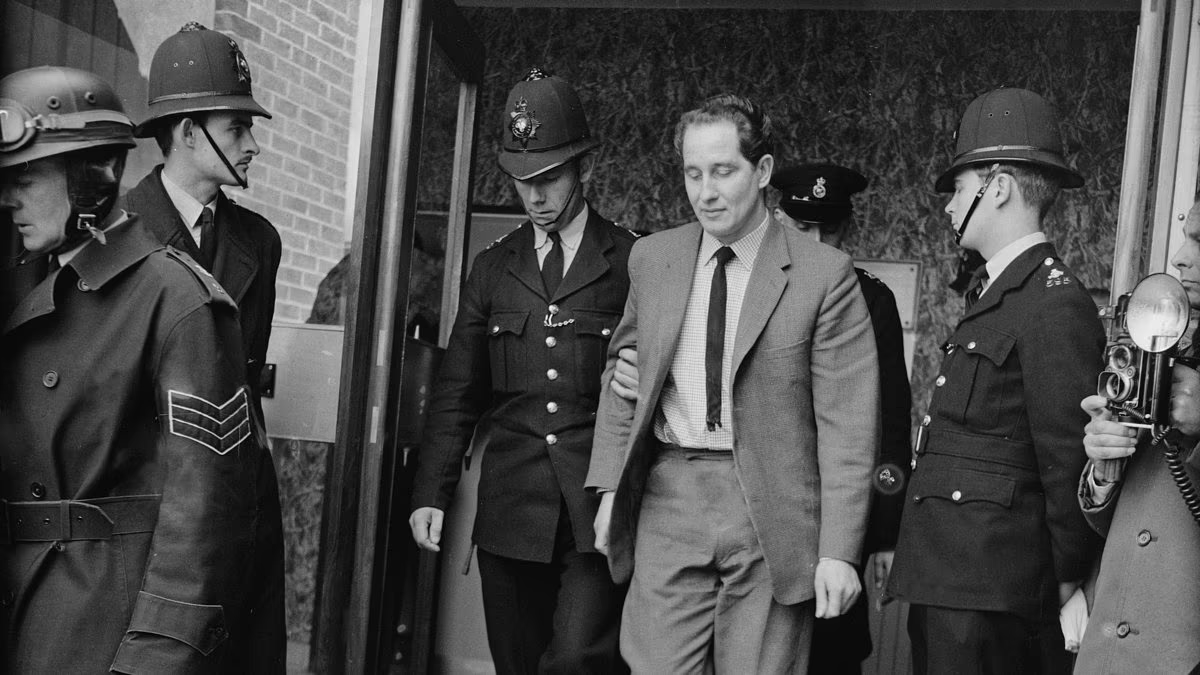
It was during the dead of night in the tiny hamlet of Ledburn in Buckinghamshire that a 15-man crew descended upon the tracks at Sears Crossing, stuffed a glove over a green signal light and cut off the railway telephone lines.The gang - dressed in boiler suits and ski masks to hide their identities - tricked the driver of a passing Post Office train into halting, before forcing themselves onboard and making off with 120 mail bags packed full of wads of notes, containing today's equivalent over £50million in cash.More than six decades later, the Great Train Robbery continues to be regarded as the most infamous heist in British history.Among the crew stood on Bridego Bridge that night in August 1963, forming a human chain to remove the 'high-value' Royal Mail sacks into awaiting getaway cars, was petty criminal Ronnie Biggs.Biggs played a fairly unremarkable role in the heist and it wasn't until later that he would become the most notorious name associated with it, after pulling off an audacious escape from HMP Wandsworth and creating a new life in Brazil. The Great Train Robbers, led by mastermind of the scheme Bruce Reynolds, made their escape to their hideout, Leatherslade Farm in nearby Oakley, to count their swag.The next morning, a teenage Ian Dowdon barely raised an eyebrow when he heard the news of robbery on the kitchen radio of his family home in the market town of Wootton Basset, eighty miles away in rural Wiltshire.Ian, then 15, was too busy thinking about the catering course he was due to start at Swindon College in a few months time to listen to the crackling of the radio over the breakfast table. One of Britain's most notorious criminals Ronnie Biggs pictured during his arrest on September 4, 1963, weeks after a 15-strong gang orchestrated the Great Train Robbery Bridego Bridge in Ledburn, Buckinghamshire, where the Great Train robbers carried out the £2.61million heist of a Royal Mail train Timeline of how Biggs carried out his infamous escape from HMP WandsworthLittle did he know that a dark secret his mother was harbouring would forever link his family with the heist – even if it took 60 years to emerge from the shadows. In the weeks after the robbery the country was gripped by the raid with front pages dominated by updates and offers of hefty cash rewards for information on the thieves.By September that year, 12 of the 15 robbers, including Biggs, had been arrested in various raids across the country. Scotland Yard's Flying Squad, led by detective chief inspector Tommy Butler, were able to apprehend the gang after a mystery accomplice tasked with burning down Leatherslade Farm, which sat just 27 miles from Bridego Bridge, failed to follow through on his promise. I know why Jack the Ripper was protected for so longHi, I'm Alex Matthews, Editor of The Crime Desk.In 2014, we revealed the bombshell evidence identifying Aaron Kosminski as the fabled Jack the Ripper. Now, we can reveal his astonishing connection to the Freemasons and claims this motivated his killings and protected him from life in prison. Sign up here to get our exclusive piece for free. Officers were then able to trace the robbers' fingerprints from objects left in the farmhouse.Biggs's mugshots, images of him being arrested, and later exposés of his life in South America after his escape from prison less than two years into his 30-year sentence would be plastered across national newspapers in the decades to come.Despite the notoriety of the case, Ian understandably thought nothing of his mother sharing the same surname as Biggs and he remembers his father only once making a joke about it over the dinner table.Iris had simply explained the connection away by saying it was a coincidence and the subject was never brought up again.So when more than half a century later, Ian, 77 - now a doting grandfather of five - was sent DNA ancestry results by his son Alex, he was not expecting for it to reveal anything remarkable.Ian already knew the basics. His mother had two brothers, Jack and Victor, but the Great War had caused rifts in the family and she had not kept in touch with either of them.Sitting now in his living room lined with bookshelves in the picturesque village of Herstmonceux, East Sussex, Ian told The Crime Desk: 'I always joke about this because I think he [Alex] wanted to find out if there was something a bit exotic in his background.'When the results came it was probably the same as most males in this country, a bit of Irish, Swedish, nothing exotic.'But then he came across something else.'When Alex received the results and began trawling through the extensive family tree sent back to him, he messaged Ian asking for the names of his great-grandparents.Ian replied: 'Henry Jack Biggs and Lilian Edna Biggs.'He jokingly added 'no relation to Ronnie'. As in, Ronnie Biggs, the infamous Great Train Robber.It was as though he had spoken it into existence. Ian Dowding, pictured holding an image of Biggs on his return to the UK to serve out his prison sentence after nearly 40 years on the run Ian's mother Iris Dowding, nee Biggs (pictured) had never revealed to her children that Great Train Robber Ronnie Biggs was her brother Pictured: The green Ford Zephyr escape car used by Biggs during his escape from Wandsworth Prison'I think she had four brothers,' read a surprise message from Alex, to which Ian replied that it was 'news to me, and I think to her'.'Then my son said one of the brothers were called Ronnie,' Ian told The Crime Desk.It turned out the Great Train robber was indeed his uncle.It is true that Biggs's role in the robbery was even more insignificant than it was intended to be.He was tasked by Reynolds with bringing along a driver who could steer the train the one mile from Sears Crossing to Bridego Bridge, where they would unload the sacks of cash.But Biggs failed even at his small role when the man he brought along, known simply as 'Old Pete', climbed onto the carriage only to realise he could not operate the huge diesel engine.The robbers then had to force the original driver of the train, Jack Mills, who was bleeding profusely after they had coshed him round the head, to move the train forward.While they managed to pull off the job itself, making off with £2.61m, the clean up that followed was shoddy.The 15-man gang, plus 'Old Pete', spent three days at the hideaway farm celebrating their gains, counting and dividing up their shares, and playing Monopoly with the stolen money - all without gloves on.The farmhouse would come to be referred to as the 'one big clue' after the accomplice they hired to torch it up after they fled did such a bad job of it that officers found their fingerprints on items around the house, including on the Monopoly board.Biggs would be arrested on September 4 that year, and would spend 13 months at HMP Wandsworth before executing his infamous escape.At around 3pm on July 8, 1965, during an hour-long period in the exercise yard, Biggs and three other inmates would scale the prison's 20ft-high wall with a makeshift ladder, while other prisoners started a scuffle to distract the guards.They then jumped onto a parked removals van waiting on the outside of the prison, before taking off in a green Ford Zephyr which was left ready for Biggs to execute his escape.For Ian, who had never known of his relation to one of the most famous criminals in British history, the revelation that Biggs was his uncle was fascinating.Ian had been extremely close with his mother right until her last days in 2018, and she had only ever told him about her two older brothers, Jack and Victor.She was on amicable terms with Jack but had fallen out with Victor early on and Ian had never met him.His mother had always told him a confusing story about her father's second marriage and how he had given away her mother's jewellery to explain away her estranged relationship with her family.He had always thought the real reason behind the family's broken ties was due to the affects of living through two world wars.'When you think our parents lived through the part of the century where they experienced the end of the First World War and the beginning of the Second World War, you'd think that's why there were fractured families.' Biggs pictured flexing his muscles on the Copacabana beach wearing an England shirt in Rio, Brazil, 1977, while he continued to avoid justice Text messages between Ian Dowding and his son reveals the moment Mr Dowding realised his uncle was the notorious Great Train robberBut it turned out his mother had been hiding a much more troubled familial link.During his teen years, Biggs was separated from his family in Stockwell, south London, and evacuated to live in Devon, and later Cornwall, while Iris had stayed home with her mother.When he returned home several years later, he spiralled into a life of petty crime - his first crime in 1945 being the theft of pencils.As time went on he spent more time in prison than not, and it was while he was serving a sentence for car theft and failed attempted robbery at HMP Wormwood Scrubs that he first met Reynolds.Biggs had attempted to move away from his criminal lifestyle by 1963 and had set up his own building firm. But it was when he approached Reynolds for a loan that he was instead recruited for his role in the historic robbery.While Ian was taken aback by the revelations, in some ways it instantly made sense.His mother had always been anxious, not even allowing the family to keep a landline telephone inside the house, and refusing to let anybody visit.She would often tutor Ian and his sister about how they should never steal and she had severed all ties with her family.He explained: 'She took that secret to the grave.'She would be turning in her grave if she knew I was telling everyone about this.'She must have thought it was shameful to be associated with such a criminal.'My mother was always very anxious, we weren't allowed to have a telephone in the house, she wouldn't have anyone over. It makes more sense now.'I would have been 15 when the Great Train Robbery took place, and of course it was all in the newspapers.'I look back and I'm still flummoxed because I think to myself 'well, we knew our mother's maiden name was Biggs', and his picture was in the paper when he was arrested and escaped from prison.'We must have said, my sister and I, to my mother 'oh your name is Biggs too' or something along those lines, but I think she said something like 'Oh it's a coincidence' and brushed it off.'We never questioned it more than that.'What I find most intriguing was that all through that period and the subsequent prison escape in 1965 when a week didn't go by without there being reports in the Daily Express, the paper my parents always had, my mother was able to lead a seemingly normal life when those details about her brother were in the news.'It makes you think, what happens when someone escapes from prison? What does the police do? Surely the first thing they do is contact all members of the family in case they go into hiding.'Whether my mother was contacted or not, I have no idea. But we didn't have a phone and I never saw any police officers turn up at our door.'Maybe because her surname changed after she got married, maybe she was under the radar.' Biggs, pictured in a police issued photograph, played a minor role in the heist but became one of the biggest names associated with it The Great Train robber gestures to photographers at the funeral of Bruce Reynolds in 2013. He would die later that yearBut even before the Great Train Robbery, Iris had never once mentioned her brother's existence.It is likely Iris would have cut all ties with Biggs long before the Great Train Robbery.Following his break from Wandsworth Prison in 1965, just 13 months into his sentence for the train robbery, Biggs spent nearly four decades on the run in Australia and Brazil.After fleeing first to Antwerp, Belgium, then Paris to undergo plastic surgery to change his appearance, Biggs moved to Adelaide, Australia, and later Melbourne, with his wife Charmian and their three sons.But when he was tipped off that police knew of his whereabouts, Biggs quickly escaped to Brazil.It was during his time in Rio that he became somewhat of a celebrity figure and one of the biggest names associated with the heist.He was tracked down and arrested in Rio in 1974, almost a decade after his escape, but his extradition was blocked because he had fathered a son with a Brazilian girlfriend.From here, knowing he was safe from being extradited, he began to embrace his international fame. He recorded songs with the Sex Pistols and charged tourists around £70 to attend barbecues and listen to his stories.It was only in 2001, on his own accord after suffering a stroke and wishing to spend the rest of his days in his home country, that he agreed to return to the UK and serve out the remainder of his sentence - before passing away in 2013.While Ian's mother felt a great deal of shame in knowing she was related to Biggs, Ian does not feel the same way.'I was flabbergasted but not upset or horrified in any way.'In fact I thought it was incredibly interesting and amusing, and I had no feelings that 'oh God, I come from a criminal family' or anything like that.'It didn't cross my mind at all. I was just amazed thinking back to my mother and things she had said and think 'how did she keep that secret quiet all that time?''So I'm not ashamed in the way that my mother was.'I think people now sort of look on the Great Train Robbery as being not such a terrible crime, even though there was some violence, but Bruce Reynolds you can read in Ronnie's book, stipulates that none of them would carry guns.'Some of them got sentences longer than some people did for murder.'So in some ways they were looked at as though they were victims, you know, to a degree.'There's almost a Robin Hood thing about it now, that it was only old banknotes, not as though anyone was harmed except for the one incident of physical violence to the driver.'
How I discovered my link to one of Britain's most notorious criminals
It was during the dead of night in the tiny hamlet of Ledburn in Buckinghamshire that a 15-man crew descended upon the tracks at Sears Crossing.
2,449 words~11 min read