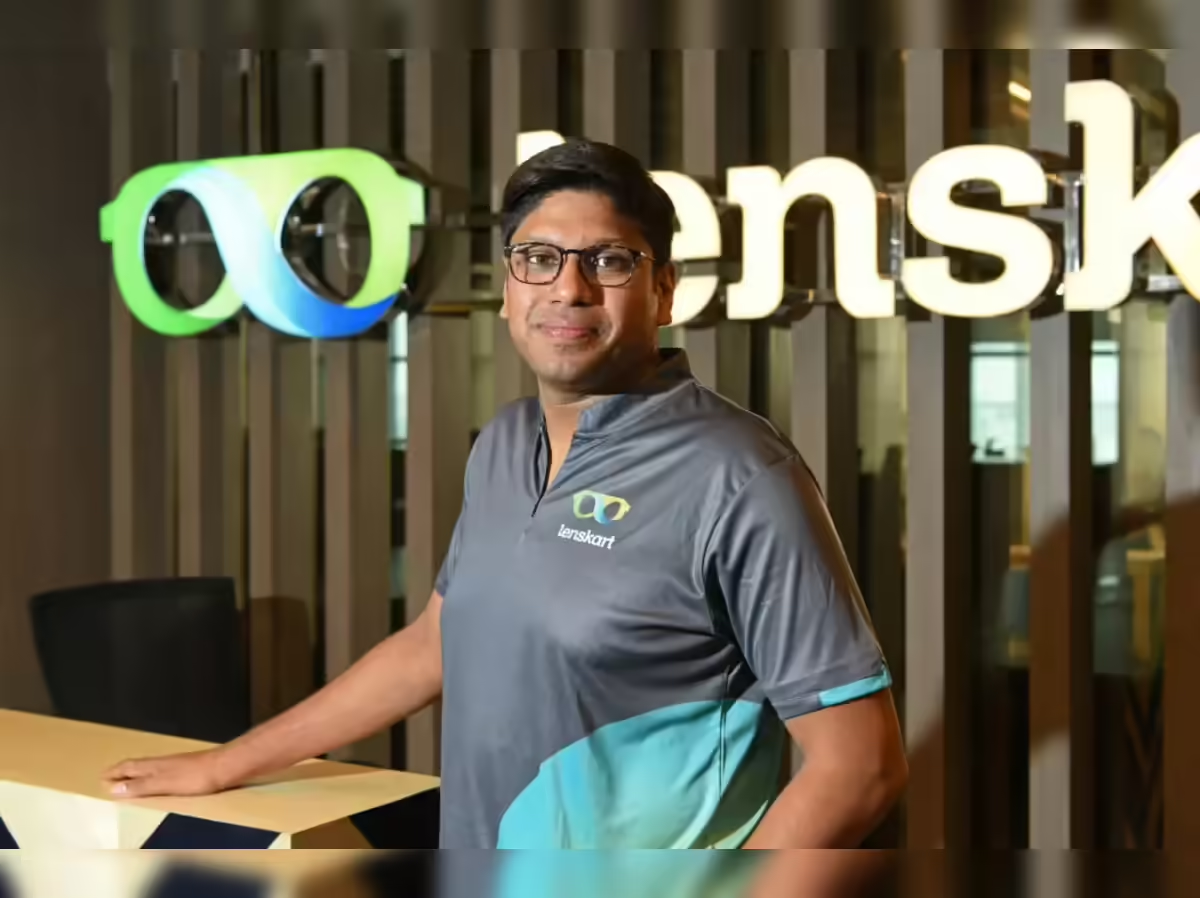
Lenskart posted a strong first quarter, with profit nearly quadrupling. This and more in today’s ETtech Top 5.Also in the letter:■ ETtech Done Deals■ Ola Electric’s PLI lifeline■ Physical AI regulation gapLenskart posts steady growth in Q1 revenue, profit as operating leverages kick inPeyush Bansal, CEO, LenskartLenskart reported strong growth in revenue and profit in the April-June quarter, helped by higher volumes, premium products, and international growth.Financials:Operating revenue: Up 43% at Rs 2,714 crore, driven by higher volumes in India, premiumisation and international growth.Net profit: Up 3.7 times at Rs 228 crore, as operating leverage improved.Yes, but: Lenskart continued to face higher costs as the Indian rupee weakened against the Chinese yuan (RMB). A significant share of its frames are sourced from China.“Despite this, product margin has continued to be resilient in both India and international (markets), absorbing the currency impact through two structural offsets: growing premiumisation and, increasingly, how much more of our own manufacturing we now do in-house,” the company noted.Also Read:Public markets add responsibility but won't change core focus: Lenskart CEO Peyush BansalLogistics platform Porter logs 54% revenue growth in FY26; profit rises four-fold(L-R) Pranav Goel and Uttam Digga, cofounders, PorterPorter reported strong growth and improved profitability in FY26, marking its second consecutive profitable year.By the numbers:Operating revenue: Up 54% to Rs 6,649 crore, compared with Rs 4,321 crore a year ago.Net profit: Nearly quadrupled to Rs 229 crore vs Rs 59 crore in FY25.The profit growth was partly helped by a Rs 32 crore deferred tax benefit. Porter was also profitable before tax, with better operating leverage improving margins.TCS, other Tata stocks fall up to 4% as N Chandrasekaran resignsN Chandrasekaran, chairman, Tata SonsTata group stocks fell up to 4% on Thursday, with the IT major Tata Consultancy Services (TCS) leading the decline.What’s the reason? The sell-off came after N Chandrasekaran stepped down as Tata Sons chairman ahead of the group’s annual general meeting (AGM) on August 18.TCS: Shares fell more than 4% to Rs 2,322. TCS is the group’s most valuable listed company by market capitalisation.Other stocks: Tata Motors Passenger Vehicles (TMPV) dropped 4%, while Tata Consumer Products and Tata Power fell around 2% each.TCS shares eventually closed 3.7% lower at Rs 2,349.70 on the BSE on Wednesday.Source: BSETell me more: Chandrasekaran chairs TCS, Tata Motors, and Tata Consumer Products, among other group companies. He has played a key role across the conglomerate since becoming Tata Sons chairman in 2017. He will stay until his term ends in February 2027.His exit comes amid uncertainty over the August 18 board meeting and Tata Trusts’ vote regarding the extension of his term. The trusts, which own about 66% of Tata Sons, are led by chairman Noel Tata, who is seen as opposing Chandrasekaran’s continuation.Also Read: TCS says received alerts alleging exposure of some employee dataYulu raises $93 million in equity, debt to expand EV fleetElectric mobility startup Yulu has raised $93 million in fresh funding, including $63 million in equity and $30 million in debt.Round details:GEF Capital Partners led the equity round. Yulu did not disclose other investors, lenders, or its valuation.The funding will help Yulu “quadruple” its fleet and expand into ecommerce logistics, bike taxis, and express parcel delivery.ET had broken the news that Yulu was in talks to raise $50 million from GEF Capital and One Planet Partners at a valuation of about $250 million, up from $200-210 million earlier. The startup had spent more than a year seeking funds after initially targeting $75-80 million.Shiprocket raises Rs 727 crore from anchor investors ahead of IPO Saahil Goel, CEO, ShiprocketEcommerce logistics platform Shiprocket has raised Rs 727 crore from anchor investors ahead of its initial public offering (IPO).More details: The anchor book included SBI Mutual Fund, HDFC Mutual Fund, ICICI Prudential, Motilal Oswal Mutual Fund, and global investors like Goldman Sachs, Nomura, Mirae Asset, and Societe Generale.Shiprocket’s Rs 1,617 crore IPO opens on August 12 and will value the Temasek- and Bertelsmann-backed company at Rs 7,056 crore post-money.Ola Electric gets two-year extension on cell-manufacturing PLI milestonesBhavish Aggarwal, CEO, Ola ElectricThe Ministry of Heavy Industries (MHI) has extended Ola Electric’s deadline to meet battery-cell manufacturing milestones under the Advanced Chemistry Cell (ACC) production-linked incentive (PLI) scheme.What’s happening?Ola has now been granted a five-year PLI window through 2031 after missing the original deadline.The company could receive up to Rs 7,240 crore in incentives, with quarterly payments starting next quarter.Also Read: Ola Electric loss narrows to Rs 336 crore, revenue down 45%The development comes after Ola’s auditor flagged its reversal of a Rs 57 crore provision for liquidated damages in Q1 related to missed investment milestones. This is despite MHI not approving Ola’s request for an extension and waiver of the penalty by June-end.Also Read:Big shift: Ola Electric moves to dealership model amid market share wipeoutUber takes bike taxis to 100 more cities in India as Rapido rivalry intensifiesRide-hailing company Uber is entering 100 more Indian cities, taking its network beyond 220 cities as competition in two-wheeler mobility intensifies.The rollout covers 18 states and one Union territory, with Uber Bike leading the expansion. New markets include Jammu, Tirunelveli, Silchar and Jamnagar.India’s physical AI boom outpacing law: ExpertsIndia’s push into physical artificial intelligence (AI) is outpacing the rules needed to govern robots, autonomous systems and other AI-powered machines, legal and policy experts told us.What’s the issue? India has no dedicated rules for physical AI. Existing laws on product liability, consumer protection, workplace safety, data protection and sector-specific regulation may apply, but most were created for systems where human control is clearer.This creates uncertainty over issues such as “how to certify an autonomous factory machine or what clearances an autonomous delivery robot needs”, said Kazim Rizvi, founding director at policy think tank The Dialogue.What else? Liability remains unclear too. Current laws could classify an autonomous robot as a defective product or raise industrial safety concerns, but do not clearly say who should be held responsible among the manufacturer, AI developer, technology provider and company deploying the system.Also Read:Beyond code, 9,000 physical AI jobs open in India as global demand rises to 80,000
Lenskart Q1 profit jump; Tata stocks tumble
Lenskart posted a strong first quarter, with profit nearly quadrupling. This and more in todays ETtech Top 5.
TL;DRAI
Lenskart posted 3.7x profit growth (Rs 228cr) and 43% revenue rise on premiumization and domestic manufacturing. Tata Sons' leadership transition risks governance at TCS, a critical IT services supplier to global enterprises.
1,011 words~5 min read