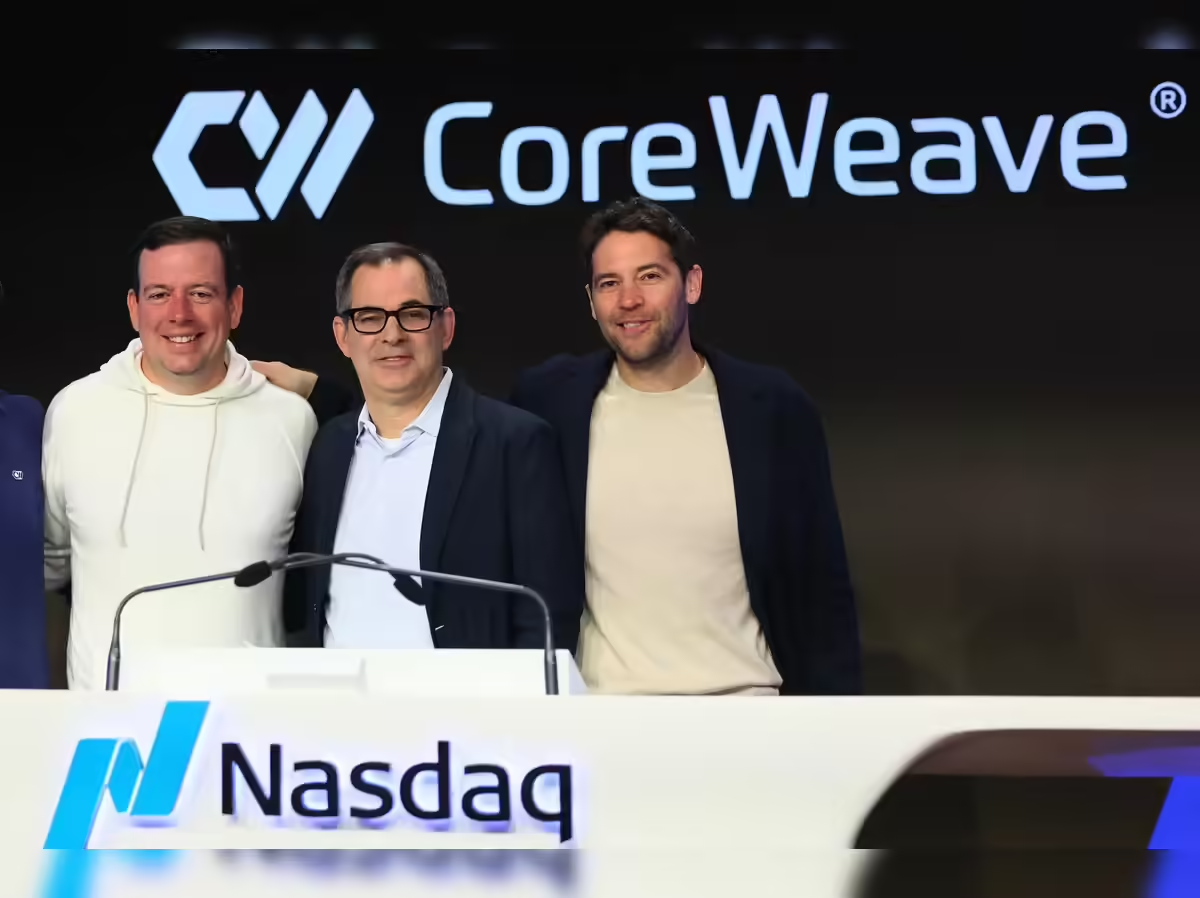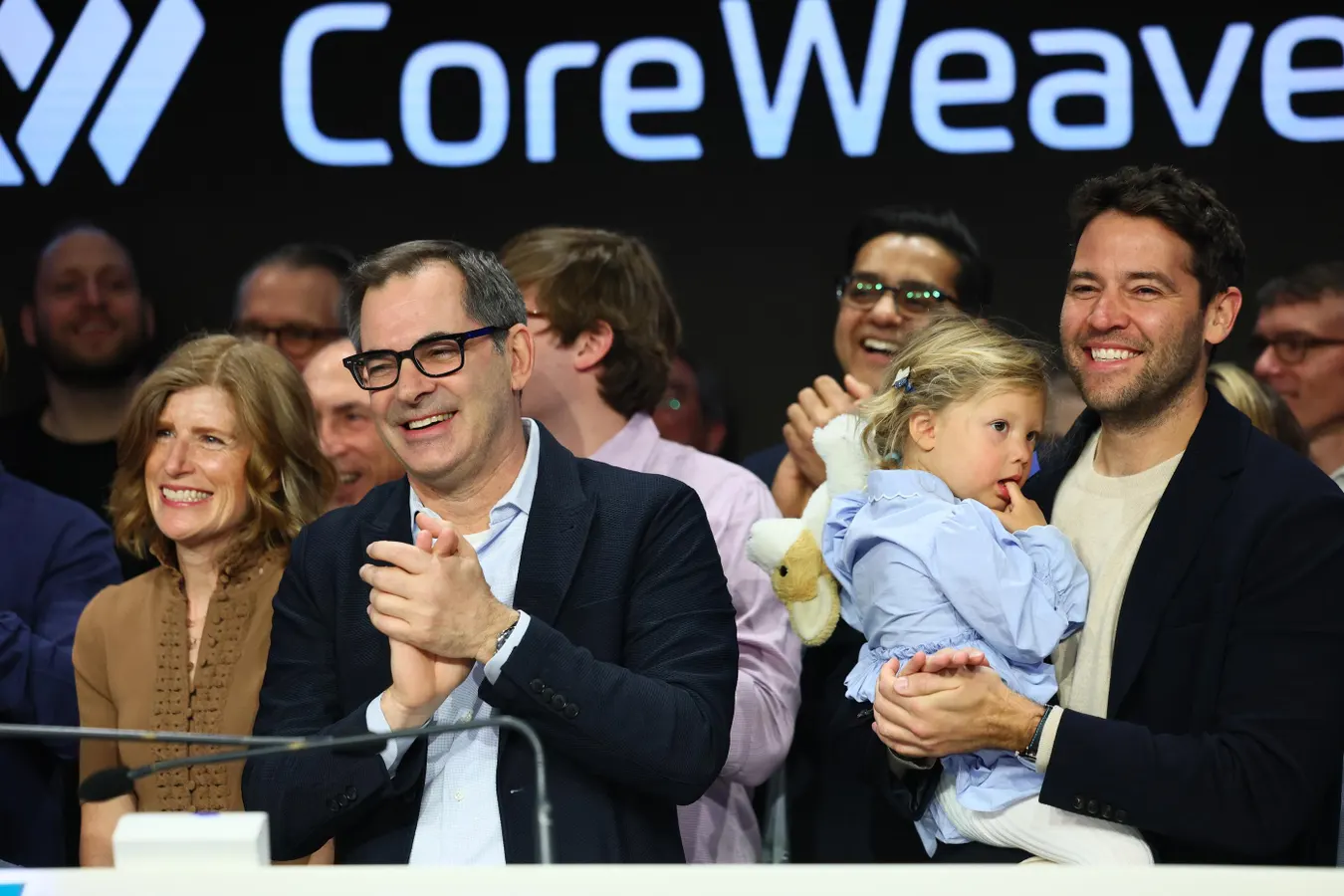
NEW YORK, NEW YORK - MARCH 28: Mike Intrator, Chief Executive Officer and founder of CoreWeave, and Brannin McBee, Chief Development Officer and Co-founder of CoreWeave, smile after ringing the opening bell surrounded by Executive Leadership and family during the company's Initial Public Offering (IPO) at the Nasdaq headquarters on March 28, 2025 in New York City. Cloud Based Artificial Intelligence Computing Company CoreWeave had its IPO this morning with its shares listed at $40. The company provides access to Nvidia graphics processing units for artificial intelligence training and workloads. (Photo by Michael M. Santiago/Getty Images)Getty ImagesCoreWeave stock rose about 18% in extended trading after issuing a solid second quarter earnings report Tuesday and forecasting a brighter than expected future, according to CNBC. Since CoreWeave stock fell after each of its previous five earnings reports, the reversal was significant. What happened? While CoreWeave revenue soared 112% to $3.45 billion, the stock responded to a raised 2026 outlook – to $3,52 billion; a $104 billion backlog, more than $25 billion in new customer commitments and a 5% adjusted operating margin (exceeding the 2.9% expectation, per Bloomberg).Despite bullish analysts views – implying 23% upside from the average price target of $130, per TipRanks -- the bear case – based CoreWeave’s $35 billion in debt, negative $5.7 billion in free cash flow; and GPU-depreciation accounting – remains compelling.Why Investors Responded Positively To CoreWeave’s Q3When it comes to the shares of AI cloud services providers, I wrote August 5, investors apply four tests to assess whether companies get an adequate return on their AI investments:MORE FOR YOUDemand and Capacity — Is demand already contracted or capacity constrained?AI Revenue Acceleration — Is AI-related revenue accelerating?Profitability and Cash Flow — Are operating profit and cash generation holding up?Capex-to-Returns Bridge — Does management provide a credible bridge from capex to returns?Applying these tests to CoreWeave’s results helps explain the stock’s positive response. Demand And CapacityCoreWeave’s demand is high and growing. With a $104 billion backlog and more than $25 billion of new commitments in the quarter – including work to expand Meta and Anthropic agreements – investors acted as though there was room for CoreWeave to expand capacity.AI Revenue AccelerationRevenue guidance went up to 158% implied growth, with full-year revenue raised to $12.8 billion. CoreWeave’s accelerating revenue clearly passed the second test.Profitability And Cash FlowProfitability and cash flow were negative. On an adjusted basis, operating income improved and was forecast to rise considerably. In Q2, operating income of $128 million — a 5% margin – was better than Q1’s 1% and CoreWeave forecast $985 million in operating income for the current quarter.However, free cash flow was negative $5.7 billion and the company’s net loss widened 116% to $626 million. Nevertheless, management said newer contracts carry contribution margins five to ten points above older ones – which may have assuaged investor concerns to essentially failing the profitability and cash flow test.Capex To Returns BridgeFinally, capital expenditures rose and are expected to continue to do so. While the path to net income remains unclear, less rigorous measures of return on capital expenditures – such as adjusted earnings before interest taxes and depreciation – as adjusted EBITDA was $1.5 billion at a 59% margin – show signs of improvement.Second quarter capital expenditures were $9.4 billion while 2026 capex is forecast to hit $37 billion – the middle of a range. Debt service and debt were high -- net interest expense more than doubled to $640 million -- and CoreWeave closed the quarter with about $35.1 billion of debt against $5.52 billion of cash. The improved operating margin of 5%, rising pricing on new contracts, a backlog up 246%, and contracted power – at 4.2 gigawatts – outrunning active power (1.5 gigawatts) all suggest demand still exceeds supply.The rise in CoreWeave stock – abetted by short-sellers with 18% of the stock’s float, per the Wall Street Journal, covering their positions – suggests that investors concluded backlog could become profitable revenue.Nevertheless, the concerns of those short-sellers are significant. “This company has probably given investors more concerns than any other tech company, considering how they do their finances, how they manage their balance sheet, how they do depreciation,” Futurum Group CEO Daniel Newman told CNBC.Major questions about CoreWeave going forward include: “Can they get access to the compute? Can they stand up the compute? Can they get the energy required for their various different buildouts, and as they stand up, can they do it on schedule and sell it for the highest prices?” Newman told CNBC.Bull Case Likely To PrevailWith Wall Street envisioning upside in the stock, the bull case looks stronger than the bear case.Reasons the stock will go up? CoreWeave locked in scarce Nvidia supply and converted it into long-dated contracts with the relatively cash rich AI buyers. Meanwhile, CoreWeave’s cost of capital is falling — it closed the first investment-grade-rated GPU-backed facility. And AI infrastructure demand is strong with capacity largely sold out, Citi’s Tyler Radke wrote in a report featured by Bloomberg.The bear case – that CoreWeave’s six-year useful life assumption for calculating GPU depreciation overstates operating income, does not seem to be moving the stock. Nor are concerns of high customer concentration – with Microsoft accounting for roughly two-thirds of fiscal 2025 revenue – frightening investors.To be sure, bullish investors should keep their eyes on whether CoreWeave can pass some key tests. Will the company meet its schedule for turning on new AI cloud services capacity – only about a third of contracted power is live, per Bloomberg? Will interest expense grows faster than operating income (which will require a near 14% operating margin).
CoreWeave Stock Up 18%: Inside The Risky Growth Machine
CoreWeave stock is rising as investors see a path to profitability with the company's adjusted operating margin rising from 1% to 5% and faster revenue growth ahead
TL;DRAI
CoreWeave Q2 revenue +112% to $3.45B; $104B backlog, $25B new deals; 2026 raised to $3.52B. Backlog-to-revenue bet outweighs $35B debt and negative FCF; power buildout execution (1/3 live) and Microsoft concentration (~2/3 FY25 revenue) remain break-even risks.
936 words~4 min read