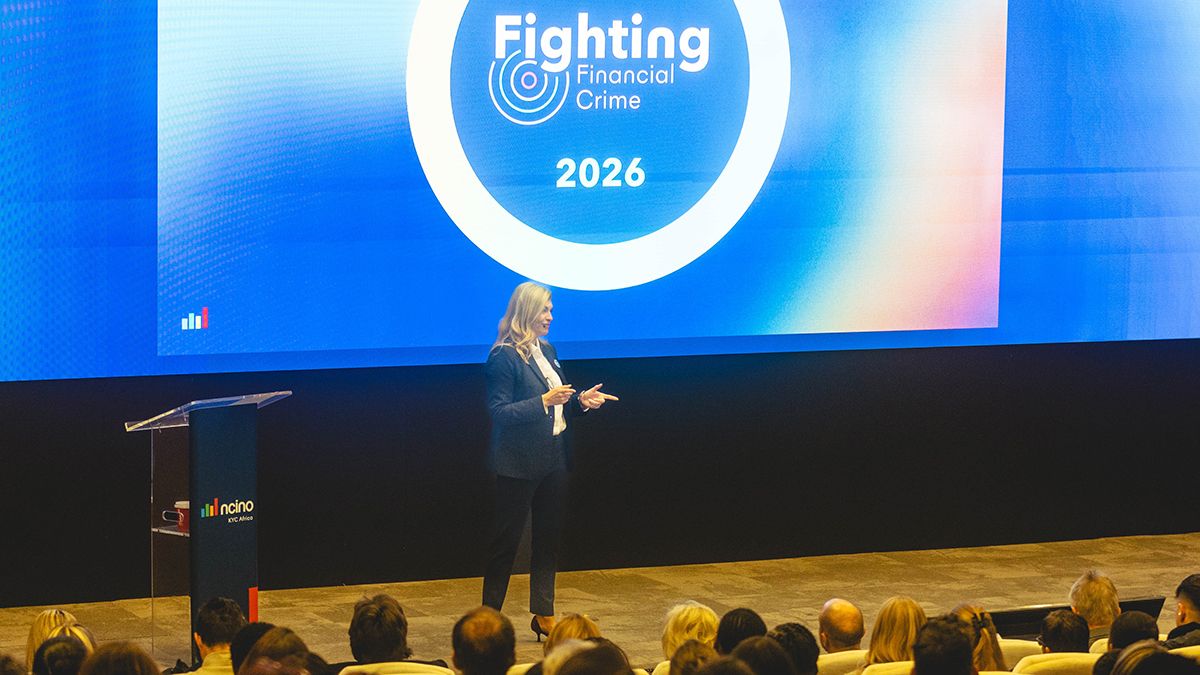
Tertia Barrett, area VP of sales at nCino KYC, addressing delegates at the company’s Fighting Financial Crime Conference 2026. (Image supplied) Fraud, corruption, state capture and human trafficking are fuelling financial crime in SA, according to nCino KYC. The fintech software and services company has urged the financial services industry to mobilise resources – including AI – to strengthen its defences.At the company’s recent Fighting Financial Crime Conference 2026, compliance professionals, legal experts and financial crime specialists gathered to discuss the realities of combating financial crime in the country.Investigative journalist Pieter-Louis Myburgh opened proceedings with a detailed account of SA’s most significant financial crime patterns. From the IDT’s R836 million oxygen plants scandal to the Digital Vibes PPE corruption network, Myburgh illustrated how illicit money flows through politically connected structures, how beneficial ownership is deliberately obscured and how paper trails eventually catch up with perpetrators.“His session was a powerful reminder that financial crime has names, faces and victims, and it is enabled, in part, by compliance failures at every level,” said Tertia Barrett, area VP for sales at nCino KYC.AI, crypto and quantum technologies are redefining the financial crime battlefield, according to nCino KYC. However, technology also has a key role to play in helping organisations strengthen their defences and comply with regulations.Barrett said institutions can no longer afford to manage compliance with the Financial Intelligence Centre Act (FICA) manually, given its critical role in efforts to combat financial crime.“Businesses cannot afford to use outdated technology, as criminals are constantly looking to use the latest tools to impersonate and create targeted attacks," she said. "Digital identity verification, real-time PEP and sanctions watchlist screening, as well as automated KYC document checks, are some of the ways institutions use technology to fight back.”Going forward, Barrett said, digital biometric authentication and verification should become non-negotiable in any business's onboarding process. “Instead of relying on a document that can be faked, the software uses a secure, three-step process to confirm that the person undergoing verification is alive and that the selfie captured matches their identity documentation and the record held by Home Affairs,” she said.Barrett said preventing and identifying financial crime can no longer be managed with spreadsheets, paper files and good intentions. “The volume of regulatory requirements, the pace of enforcement and the complexity of cyber crime – as well as managing client risk profiles – demand a more sophisticated approach," she said. "This is where purpose-built technology becomes not just useful, but essential.”nCino KYC said SA’s placement on the Financial Action Task Force (FATF) grey list fundamentally changed the compliance landscape.Barrett said the FATF identified non-financial sectors – including high-value goods dealers, attorneys and estate agents – as some of the biggest financial crime risks in the country, which contributed to SA's grey-listing.“Even after being removed from the grey list, the pressure on these industries to step up and comply with FICA remains relentless," she said. "Being removed from the grey list does not mean the work stops. Businesses are still being inspected and are expected to enforce all FICA requirements.”With the FATF set to conduct its next review of SA, enforcement is set to remain aggressive. Barrett said the regulator needs to demonstrate consistent enforcement to avoid the country slipping back onto the grey list – a scenario that would have devastating economic consequences.She cautioned businesses that have been putting off compliance in the hope that the issue would fade, saying the message is clear: the time to act is now. The cost of non-compliance – financial, legal and reputational – far outweighs the investment required to get it right.Barrett said financial crime does not just make headlines; it erodes trust, destabilises economies and costs SA billions every year.The conference was a reminder that financial crime is a people’s business – and so is fighting it.
nCino sheds light on what’s fuelling financial crime in SA
Delegates at the company’s recent Fighting Financial Crime Conference 2026 highlighted the impact of corruption, fraud, human trafficking and state capture.
635 words~3 min read