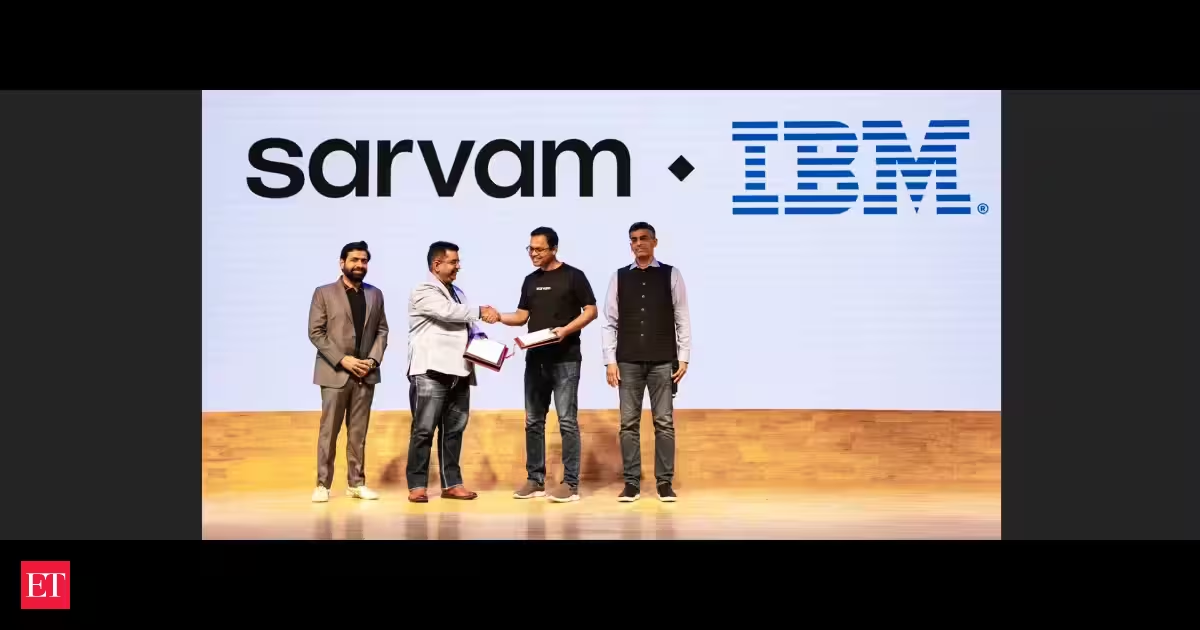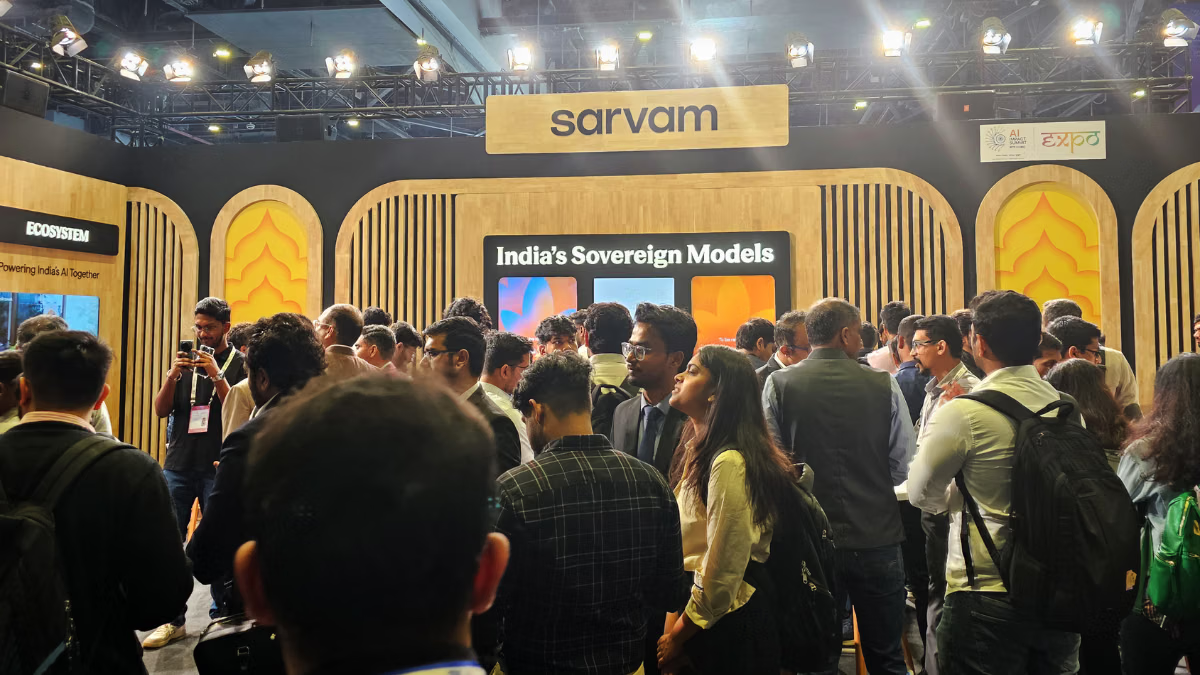
In February 2026, in a hall in Delhi, India unveiled its sovereign artificial intelligence models. Sarvam, the company the government had chosen to build the country’s own foundation model, released two of them, trained on Indian languages and Indian data by an Indian team using Indian government compute, and made available for anyone to use. Some of the most powerful people in global AI were in the room. It was a real achievement, and it deserved applause.
But here’s the part the applause skipped over.Every one of those models was trained on roughly 4,000 Nvidia chips that India cannot manufacture. Those chips carry memory made by three companies, none of them Indian. They are designed with software from two companies in the United States, etched by machines from a company in the Netherlands, and packaged by one company in Taiwan. The model at the top is genuinely sovereign. Almost everything underneath is rented.
Sovereignty in layers, where it matters
Sovereignty in AI is not something a country either has or lacks. It is a property of each layer of a very tall stack, and it inverts as you go down. The layer that earns the headlines, a national model, is the cheapest to reach and the least decisive. The layers that actually determine a country’s fate — memory, chips, and the machines that make those chips — sit at the bottom, where almost no one can build and the suppliers shrink toward one. You can cook a sovereign dish. Owning the kitchen and growing the ingredients is another matter entirely.Consider who controls the tap. Two companies dominate the frontier of AI chips: Nvidia and AMD. Both design their chips in the United States and manufacture them in Taiwan. And access is a lever. As of early 2026, Nvidia’s most capable exportable chip can be sold to China only under a managed arrangement, with 25 per cent of every sale routed to the US government, licences granted case by case, and a volume cap. Read that again. Access is not blocked. It is metered, licensed and priced, and the terms can change with a policy memo. Whoever controls the tap sets the terms of your AI programme.This is the uncomfortable fact beneath the whole enterprise. The leverage over the deep layers of AI sits overwhelmingly in one place. It is not that a single country controls the world, but that the chokepoints cluster in one bloc, with the US at its enforcement center, able to reach through its allies. It meters the chips. It reaches into the Netherlands and Taiwan because their crown-jewel companies operate inside an allied control regime whose rules can extend even to foreign-made goods built with American tools. It owns the chip-design software outright. Dependency, in other words, is latency. It sits there quietly, costing nothing, until the day someone decides to turn it into leverage.India has already seen a version of this. In 2025, a major American software provider abruptly suspended services to a large Indian company to comply with foreign sanctions that did not legally bind the company itself, freezing the firm’s day-to-day operations until a court stepped in. The dependency had been invisible right up to the moment it was used.Sovereignty at any layer is meaningless if the layer beneath it can be withdrawn. A country’s independence is set by the least substitutable link in the chain, not by the model it announced at the top.That may sound like a counsel of despair, but it’s not. No country needs to own every layer. There is a difference between running AI and building it. Running models at home, on imported or diversified chips, is far more achievable than manufacturing the frontier from scratch. For a nation’s daily needs, it may even matter more. India’s own semiconductor programme has, sensibly, aimed at packaging and assembly first, leaving a leading-edge fabrication plant—a ten-year, multibillion-dollar undertaking—for later. The goal is not to make everything, but to make sure nothing essential has only one owner.Why India hasn’t joined the race