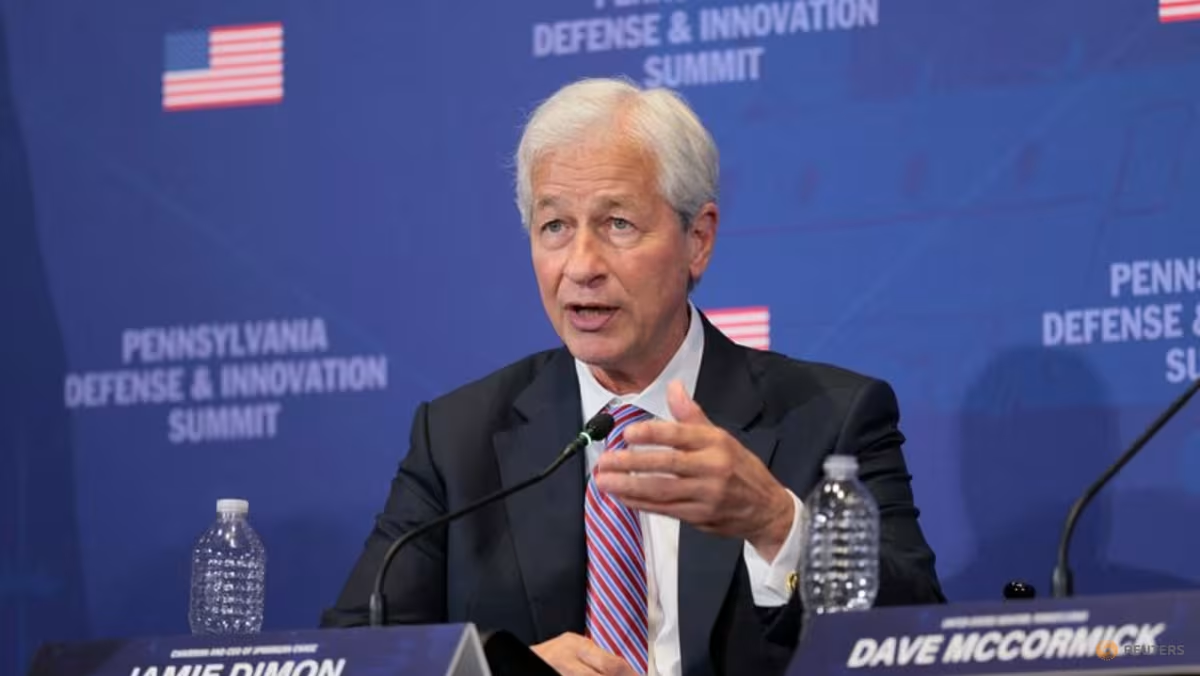
Photo illustration: Sarah Grillo/Axios. Photo: Win McNamee/Getty ImagesREDONDO BEACH, California — The bus departed Impulse Space and was hurtling down the highway, bound for an In-N-Out Burger somewhere southeast. Inside, JPMorgan Chase CEO Jamie Dimon and other executives were discussing defense tech: its ups, its downs, its risks, its opportunities.How could they help? Where were the relevant watering holes? And what would it mean to get creative, to avoid the pitfalls of the past?"The notion that this country is behind is frustrating, but I'm very uplifted by what they're doing," Dimon said. "You walk around companies like Impulse Space — they're doing amazing stuff."The big picture: In October, JPMorgan Chase tossed $1.5 trillion into the national-security ring with its Security and Resiliency Initiative. At first a stateside push, it has since extended to include Canada, Europe and the U.K.Billions of dollars have already been committed. Billions more could be poured on top."My real concerns started with the war in Ukraine in 2022," Dimon said, referencing a fight that has forced a rethink of weapons, tactics and global power."Talking with some retired generals about the challenges really opened my eyes."Driving the news: Axios tagged along with Dimon and crew last week as they toured Impulse, a space-mobility startup led by SpaceX's first employee, and talked with missile, drone and aircraft makers, energy specialists, manufacturers, and data whizzes.The back-to-back engagements were part of an annual bus tour, in which Dimon and other top bank execs consult with employees, clients and communities across the country.This year's trip was dedicated to California, starting in Healdsburg and zipping through San Francisco, Modesto, Santa Barbara and Los Angeles. It wrapped in Orange County.State of play: Defense was once a dirty word in some West Coast circles. Now, startups and neo-primes nestled around LAX and SFO are sinking their teeth into the Pentagon budget and boxing out older, more orthodox companies from the headlines."Being a 30-year veteran of Silicon Valley, I've never seen this kind of effort, this manufacturing push. It's real. I can feel it," said John China, the co-leader of JPMorgan Chase's innovation economy practice.JPMorgan sponsored this year's NatSec100, an inventory of prominent private-capital-backed companies and their defense contracts. A dozen previous listees have IPO'd."We have to be out here regularly," China said. "We have to be in front of these folks."Zoom in: The Security and Resiliency Initiative is dedicated to critical industries such as aerospace and defense, manufacturing, energy and health tech.Its more than two dozen subcategories include battery storage, command and control, critical minerals, munitions, shipbuilding and space launch.And there are big names advising it: former Defense Secretary Robert Gates, retired Gens. Chris Cavoli and Paul Nakasone, and former Speaker of the House Paul Ryan among them."We're bringing our human capital and financial capital to help give oxygen to this important effort," said Doug Petno, a JPMorgan Chase co-president."This couldn't be a symbolic gesture — it needed to be a meaningful commitment backed by visible, measurable action."Threat level: Should the U.S. fail to kick its defense-industrial base into high gear, fail to excise Beijing from its most-sensitive stockpiles, fail to juggle the Asia-Pacific with the Middle East with the Arctic, it risks losing the next war.The bottom line: "It looks like the engine behind the arsenal of democracy has been ignited, from nuclear energy to missile defense and shipbuilding to supply chains," Dimon said."We're here to help. We're here to learn."
Exclusive: On the defense-tech road with Jamie Dimon
"Talking with some retired generals about the challenges really opened my eyes."
TL;DRAI
JPMorgan Chase deployed $1.5 trillion for defense-tech through its Security & Resiliency Initiative, with CEO Dimon touring California startups. Defense tech—once Silicon Valley pariah—is now mainstream, capturing Pentagon contracts and outpacing legacy contractors.
568 words~3 min read