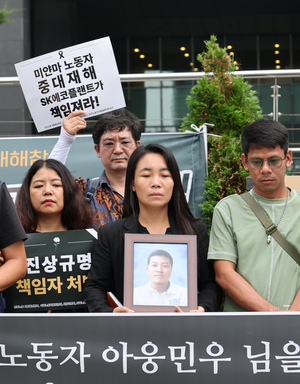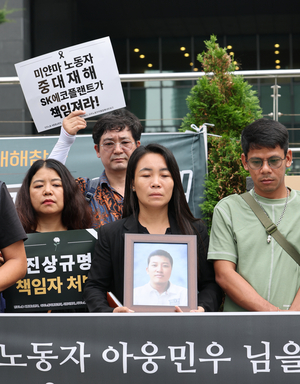
Myanmar worker’s payroll records raise questions over extreme hours and labor conditions at major rail project site Bereaved family members of Aung Min Oo attend a press conference calling for accountability over the death of the Myanmar worker in front of SK Ecoplant headquarters in Seoul on July 16. (Yonhap) A Myanmar worker who was killed last month at a KTX railway construction site had worked as many as 355 hours in a month, averaging more than 11 hours a day, payroll records showed.Aung Min Oo, 37, also worked stretches of 16 to 20 hours across two consecutive days and went entire months without a full day off, according to records first reported by the Kyunghyang Shinmun.The records were submitted by the Korea National Railway to Rep. Yoon Jong-oh of the Progressive Party.Aung died July 1 after becoming trapped in a conveyor belt while inspecting it alone at a construction site in Asan, South Chungcheong Province. The conveyor did not have an emergency stop device that he could use, according to the investigation.He had worked since November 2024 for LT Sambo, a subcontractor on a project to add two tracks to the 46.4-kilometer high-speed rail section between Pyeongtaek and Osong. The project was commissioned by the Korea National Railway and is being built by SK Ecoplant.Payroll records show Aung worked all 31 days of December 2024.In March, he logged 52.1 "gong-su," a unit used at Korean construction sites to calculate labor and wages. One gong-su generally corresponds to an eight-hour workday, with additional amounts applied for overtime, night and holiday work.Yoon's office estimated that Aung worked 355.2 hours that month, or an average of 11.45 hours per day.Although two days were recorded as days off, the lawmaker's office said they followed overnight shifts lasting roughly 16 to 20 hours, meaning Aung effectively had no full day off that month either.His employment contract listed Saturdays and Sundays as days off.The records also raised questions about wage disparities. LT Sambo's June payroll showed foreign workers classified as general laborers were paid 103,200 won ($73) per gong-su, while Korean workers received between 120,000 won and 250,000 won.The records do not establish whether the Korean and foreign workers performed identical jobs or had comparable levels of experience.Ha Dong-hyun, an occupational safety official with the Korean Confederation of Trade Unions' Sejong-Chungnam branch, said migrant workers at the site were believed to have routinely worked far beyond Korea's 52-hour weekly limit."Working such long hours inevitably takes a toll on their health, and mistakes are more likely in a dangerous working environment," Ha said.He added that low base wages could push migrant workers to take on more overtime to increase their earnings.Yoon called for an investigation into working hours, wages, safety training and hazardous work assignments at publicly commissioned construction sites employing migrant workers.An SK Ecoplant official said the main contractor has limited ability to directly oversee individual workers' hours and wage arrangements with subcontractors, but would continue to encourage compliance with labor laws.SK Ecoplant apologized to Aung's family last month and agreed to introduce measures aimed at reducing the workplace risks migrant workers face.
Myanmar worker killed at KTX site worked up to 355 hours a month
A Myanmar worker who was killed last month at a KTX railway construction site had worked as many as 355 hours in a month, averaging more than 11 hours a day, pa
519 words~2 min read