Story audio is generated using AI
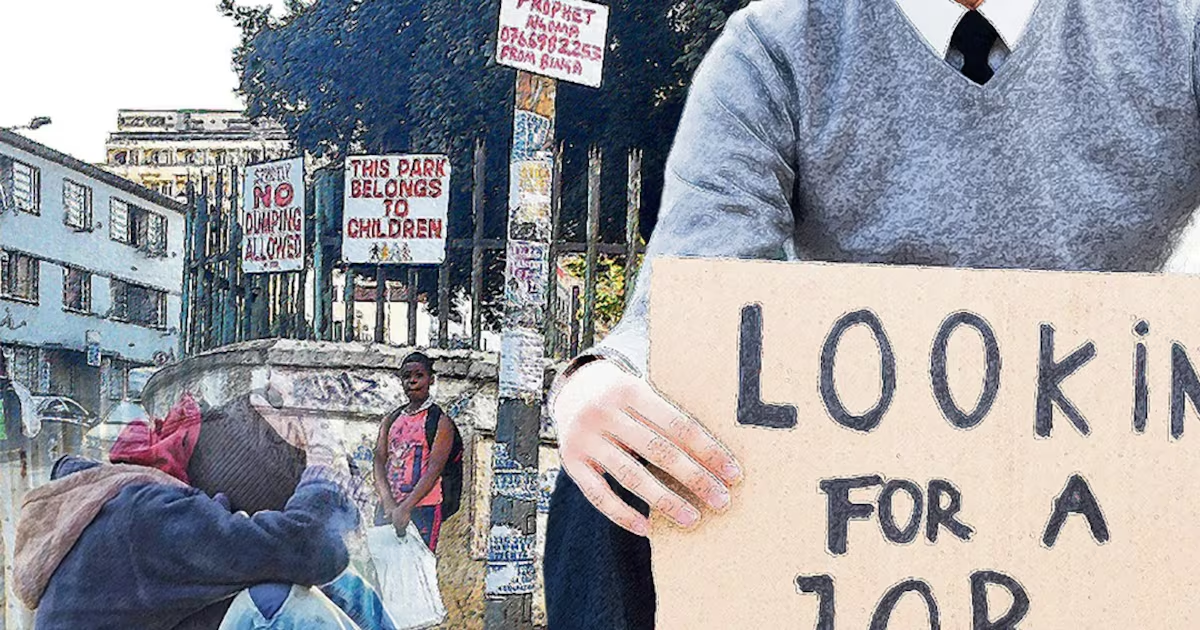
Young South Africans were again the worst affected as unemployment scaled higher in the second quarter of 2026, with community and social service, mining, agriculture and manufacturing sectors shedding the most jobs.Just three months ahead of municipal elections, opposition parties were quick to pounce on the data from Stats SA on Tuesday as a clear sign of the government’s failure to spur the economy towards the growth levels needed to get millions of citizens working.The jobless rate jumped to 33.6% in the second quarter from 32.7% in the first three months of the year, with the number of unemployed people increasing by 345,000 to 8.5-million while the total of those with jobs fell by 16,000 to 16.7-million.The number of jobless young people aged 15-34 soared by 264,000 to 5-million, almost matching the total of employed youth, which fell by 40,000 to 5.6-million. As a result, the youth unemployment rate increased by 1.5 percentage points to 47.4% in the second quarter.ActionSA led a chorus of criticism from several parties that laid blame for the malaise at the feet of the government of national unity (GNU) formed by President Cyril Ramaphosa after his ANC lost its three-decade long outright parliamentary majority in the 2024 general elections.“While millions of South Africans are unable to find work, the GNU remains consumed by internal battles, political horse-trading and disagreements between its constituent parties. Ministers continue to enjoy and abuse the privileges of office while South Africans are expected to endure an unemployment crisis that has persisted for years,” ActionSA MP Alan Beesley said in a statement.The DA, the second largest party in the national ruling coalition, said it will push for greater urgency and ambition in the GNU’s economic reform agenda.“Economic reform is happening far too slowly to spur growth at the pace required to create jobs. Businesses and investors are still held back by red tape, unreliable basic services, failing ports and rail, and crime that makes it harder and more expensive to build, invest and employ people,” DA leader Geordin Hill-Lewis said.The Stats SA data shows the number of people employed in the formal and household sectors decreased by 41,000 and 9,000, respectively, in the second quarter, while those in the informal sector rose by 34,000.The largest decreases in employment were recorded in community and social services (57,000), mining (26,000), as well as agriculture and manufacturing at 15,000 each.Stemming the loss of jobs requires reinvigorating towns and cities where economic activity actually occurs, as well as fixing the drivers of industrialisation, Rise Mzansi leader Songezo Zibi said.“Without capable, functional and accountable local governance, businesses cannot expand, basic services fail, and local economies crumble,” he said.“We cannot industrialise or create sustainable jobs without getting the basics right. Water, energy and freight logistics are the lifeblood of economic growth. When ports are congested, rail lines break down, water supply collapses and energy remains precarious, industrial growth is impossible,” Zibi said.Economists had predicted bleak jobs numbers for the second quarter, partly citing higher input costs for businesses due to the US-Iran war, which has sent oil prices spiralling.The latest Rand Merchant Bank/Bureau for Economic Research confidence index shows local businesses came under significant pressure in the second quarter, with the operating environment deteriorating due to supply constraints linked to the Middle East conflict.The government has long acknowledged that the economy, which only mustered growth of 1.1% last year, is not expanding anywhere near the levels needed to significantly dent unemployment.Labour federation Cosatu, an ANC ally, said the latest jobs report is “beyond depressing” and demanded what it called bold, decisive action to tackle the crisis. “We cannot continue to normalise 1% economic growth and dangerously high levels of unemployment, poverty and inequality,” Cosatu spokesperson Matthew Parks said.“The extent of this crisis requires a bold and aggressive stimulus package to kickstart the economy, rebuild public and municipal services, make capital affordable and accessible for SMMEs and industrial sectors, and extend relief for the unemployed by expanding public employment programmes.“Similarly, efforts to reduce the price of electricity, restore rail and ports to full capacity, and invest in economic infrastructure and tackle crime and corruption must be accelerated.”The Motor Industry Staff Association (Misa) said the government, business and labour must urgently collaborate to create permanent employment opportunities, adding that investment in skills development, targeted support for small businesses and policies that stimulate industrial growth are crucial.“The rising unemployment rate is not just a statistic; it represents families under pressure and communities losing hope. We must act with urgency and compassion to restore dignity through decent work,” said Martlé Keyter, CEO of operations at the association.Youth unemployment in particular was the focus of an annual public economics conference hosted by the Government Technical Advisory Centre last month. National Treasury director-general Duncan Pieterse told delegates that as the dominant divisions in the manufacturing sector, which used to provide jobs, become increasingly less labour intensive, the country must look to sectors such as tourism and construction to help reduce unemployment.In an address to the same conference, finance minister Enoch Godongwana said that “South Africa will not defeat youth unemployment at scale without faster, inclusive economic growth”.He added: “But growth will not happen by itself. It requires reform. Reform requires implementation. Implementation requires capable institutions. And capable institutions require credible public finances, good data, accountability and discipline.”Business Day