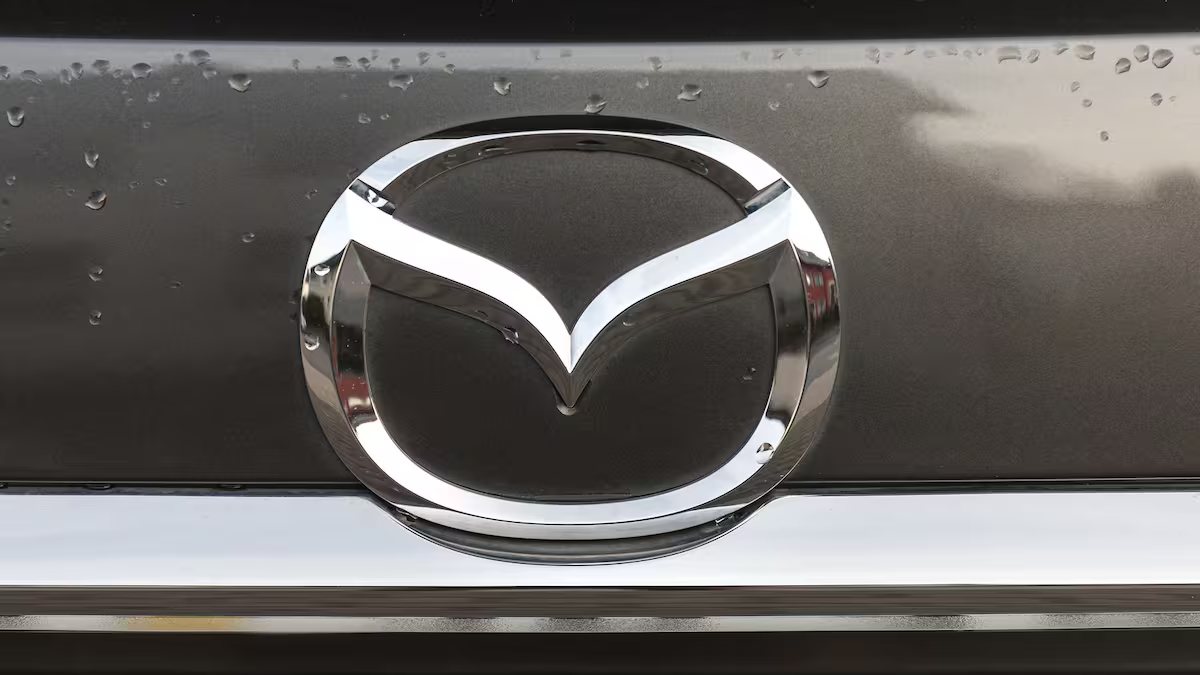
When Veolia employee Rob Dignum's work vehicle was written off in 2024, he thought he'd get a similar replacement.He had taken a significant remuneration deal with the water company 20 years ago which meant he could use the work vehicle as a private vehicle at a sacrifice of his annual bonus, superannuation, health cover, life cover and overtime payments.But the ute was "downgraded" following the crash and the replacement was no longer suitable for family life.Dignum took his case to the Employment Relations Authority when Veolia refused to change it, claiming he was unjustifiably disadvantaged by being provided with a ute that was insufficient to meet his family's needs when used privately.In the decision, authority member David Beck ruled although Veolia was following its motor vehicle guidelines when allocating Dignum a vehicle, it unjustifiably disadvantaged him as it ignored a separate agreement Dignum had that had bought the right to being allocated a higher-specification vehicle.Mazda v MitsubishiDignum had been employed continually by Veolia since 2012 and its predecessor water company United Water since 1997.When Veolia acquired the business in 2012, Dignum was employed on his previous terms and conditions.It included that when Dignum's salary was increased in August 2007, the new salary package included "the full private use of a company vehicle as a buyout of [his] annual bonus, superannuation, health cover, life cover and overtime payments".On August 27, 2007, Dignum accepted a salary option described as "Option 2 - $73,500 + a car - $20 per week contribution as per United Water Vehicle Use Policy".The $20 contribution to the cost of the vehicle was revoked by Veolia in September 2025.Since 2011 he had been provided with three leased double-cab utility vehicles, with the last one being a five-seater, Mazda BT50 GTX (the Mazda ute) in August 2021. The ute was not required to display company signage.But after a car crash that Dignum was not at fault for in September 2024, the ute was written off.Veolia then replaced it with a two-and-a-half-door Mitsubishi ute that had company signage on it and a GPS monitoring system installed.Dignum immediately raised concerns with his team leader that the new vehicle did not meet his family needs and significantly differed in specifications from the Mazda ute.Dignum said the ute was not a suitable replacement and, in his view, not consistent with his employment terms and conditions.In an email response, the team leader proposed removing the GPS monitoring system and covering the signage but expressed a view that the Mitsubishi had been correctly provided in accordance with Veolia's vehicle selection policy.Dignum reiterated his concerns about the Mitsubishi ute and suggested he was entitled to a vehicle suitable for his personal and family needs and that the provision of a vehicle was part of his remuneration package, and the change of vehicle had been effected as a variation without consultation that he did not accept.He felt the new vehicle was a "downgrade".Vehicle policy did not acknowledge agreementVeolia acknowledged the new vehicle differed from Dignum's previous vehicle, but asserted they were applying their existing policy consistently in the belief that the new vehicle suited the needs of Dignum's role and had been objectively allocated in accordance with a vehicle selection table.Veolia has a motor vehicle framework for providing staff with vehicles. The framework has four categories of company vehicles defined by hierarchical positions.It allocated Dignum a vehicle model from the lowest tier titled Tool of Trade vehicles.In explaining the reasoning for the selection, Veolia emphasised it met the requirements of Dignum's role - a premise consistent with it being regarded as falling into the Tool of Trade category rather than a higher-specification vehicle allocated to a person in a leadership role.But Beck said the vehicle selection was not consistent with how Dignum's remuneration package was structured and agreed."In applying the policy, Veolia has not been consistent with their past vehicle allocation," Beck said."I find Mr Dignum has been unjustifiably disadvantaged by being allocated a vehicle on a 'Tool of Trade' basis when he had a separate agreement that he had bought the right to being allocated a higher-specification vehicle."Neither Dignum nor Veolia wanted to comment on the decision.Beck considered whether it was appropriate to order a penalty for a breach of Dignum's employment agreement but considered it was inappropriate as no explicit breach had occurred given Veolia applied its own vehicle selection policy.However, Beck ruled Dignum should be compensated for being allocated a vehicle based on his role as a tool of trade as he had lost remuneration, being the benefit of remuneration and other benefits he had foregone from the time the new vehicle was allocated."Mr Dignum has conservatively claimed this amount as $13,500 per year. As this is an ongoing loss and presumably can be objectively calculated, I will direct the parties to come to an agreement on the quantum," Beck said.* This story originally appeared in the New Zealand Herald.Open Justice
Veolia worker Rob Dignum wins ERA case after ‘downgraded’ ute ruled unfair
When Veolia employee Rob Dignum's work vehicle was written off in 2024, he thought he'd get a similar replacement.
817 words~4 min read