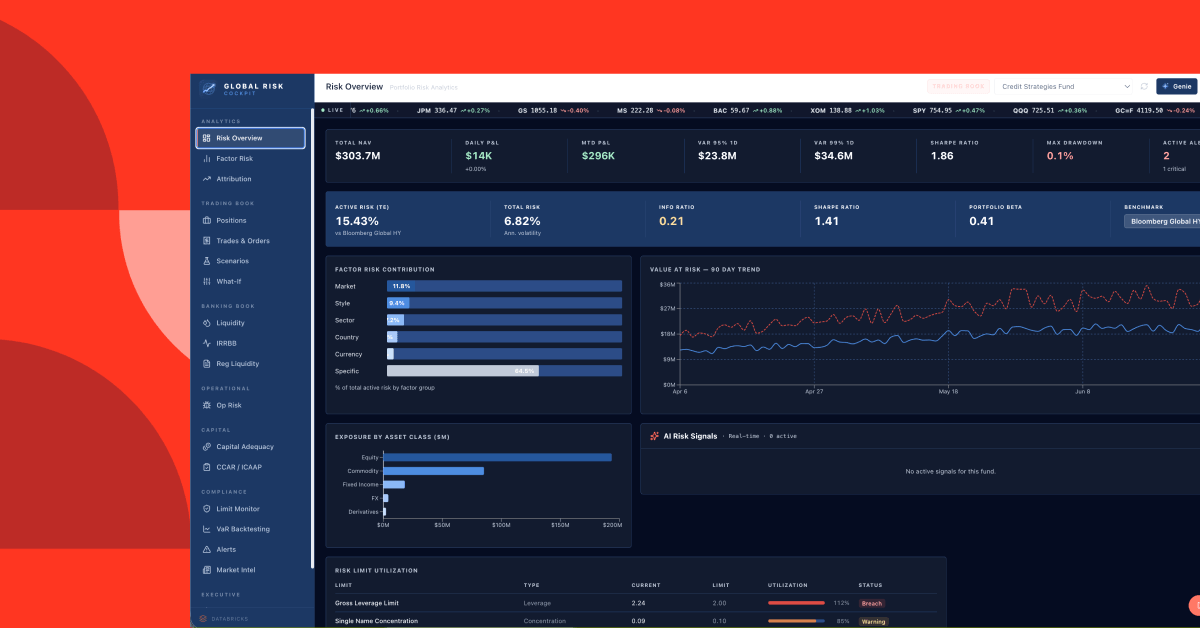
Powering real-time, AI-driven risk decisioning for the modern CRO with unified, governed, and auditable data on the Databricks Platform.
by Amit Kumar Jha, Amee Vora, Andrea DeSosa and Suresh Sethuramaswamy
In a volatile macroeconomic environment, enterprise risk management today is constrained less by modeling sophistication and more by data latency. While financial modeling has evolved significantly over the past two decades, the underlying data architecture supporting these models often remains anchored in legacy, batch-oriented architectures.
For many Tier-1 financial institutions, risk aggregation continues to rely on fragmented data estates, nightly batch processing, manual data reconciliation across business units, and retrospective reporting frameworks. However, recent market events demonstrate that when risk materializes in modern, interconnected markets, legacy architecture creates severe visibility gaps that prevent timely intervention.
That gap matters because the role of the Chief Risk Officer is changing. Deloitte’s survey of risk management found that more than 90 percent of respondents believe risk management is becoming more important to achieving strategic goals, and that organizations with more integrated risk programs tend to outperform those with less integrated approaches. The implication is clear: boards increasingly expect the risk function to contribute to growth, resilience, and decision quality, not simply act as a retrospective control point.