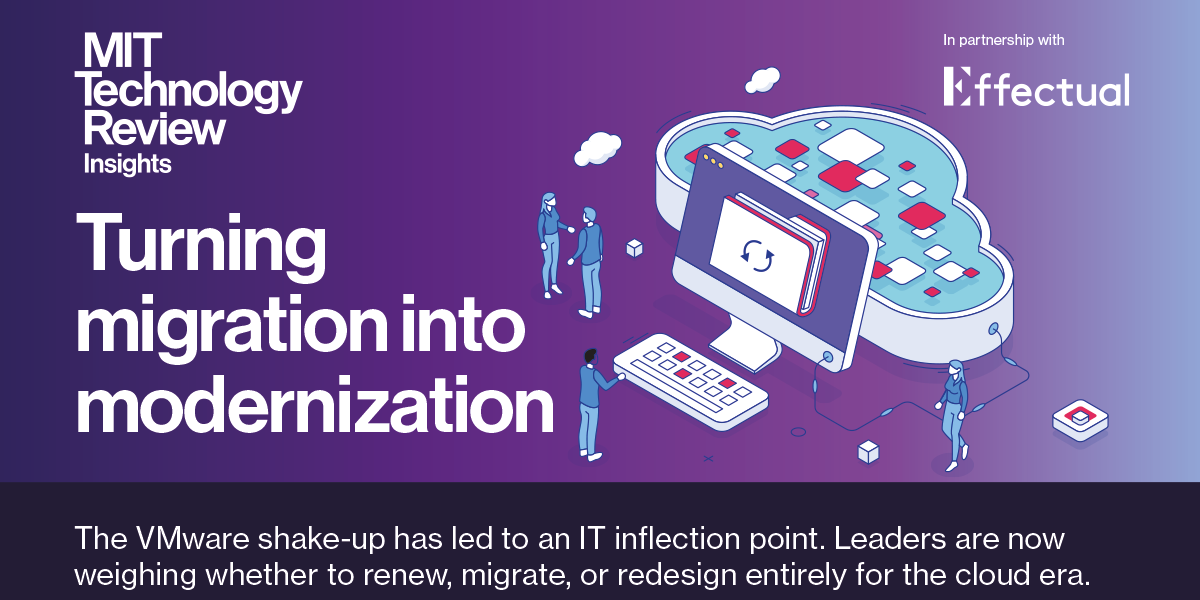
Sue Odle is CEO of StorMagic, where she helps organizations simplify on-site virtualization for distributed IT environments.gettyVMware migration has moved out of the strategy deck and into budget, staffing and risk conversations. Broadcom’s acquisition changed the economics and structure of virtualization for many customers. Broadcom's VMware ended the availability of perpetual licenses in many standalone offers and moved customers toward subscription and bundled offerings. Gartner research predicts that more than one-third of VMware workloads could migrate elsewhere by 2028.It's a mistake to treat VMware migration as a single infrastructure project. For distributed organizations, there are two tightly coupled questions to ask: “What replaces VMware?” and “What replacement strategy works at the edge, with hardware, people, connectivity and operational realities already in place?”The Edge Isn't The Data CenterDistributed sites are too often treated like smaller versions of the data center. That assumption is where many migration plans start to break. A store, clinic, warehouse, manufacturing site or branch office doesn't have the same staff, space, climate, hardware footprint or downtime tolerance as a centralized facility. There may be no local IT team. Connectivity may be inconsistent. Maintenance windows may be limited to small blocks of time outside business hours. Hardware may need to fit in a back room, office closet or compact rack instead of a controlled data center environment.Migration is rarely a clean swap. At an enterprise scale, it never is. Teams need to understand which workloads run locally, how much data needs to move, what supports daily operations and what happens if something goes wrong.At the edge, even a small disruption can affect revenue, customer experience, inventory visibility, production output or employee productivity. VMware exits at the edge require disciplined, evidence-based planning. A data center playbook applied everywhere can create avoidable risk. Edge infrastructure has to be purpose-built for environments where IT teams are remote, space is limited and local applications still have to keep running.Downtime Changes The Risk EquationThe business case for moving away from VMware is often framed around cost. Cost matters, especially when licensing changes force organizations to revisit budgets sooner than expected. But migration risk still has to be weighed alongside licensing savings.At the edge, downtime isn't abstract. It can mean stalled transactions at a store, delayed shipments from a warehouse, interrupted production on a factory floor or manual workarounds in a clinic. It becomes a revenue, customer experience and operational continuity problem.Cisco’s Splunk research found that unplanned downtime costs Global 2000 companies $600 billion annually, with an average cost of $15,000 per minute. The same research found that the aggregate cost of downtime has risen 50% in two years. Although those figures reflect large global organizations, the lesson applies directly to distributed environments: Even brief disruption can become expensive when the affected systems sit close to revenue, customers or production.This is why phased migration is often the more responsible approach. Leaders should identify which workloads carry the highest business dependency, which systems can be moved with lower risk and which locations require a different plan because of staffing, connectivity or uptime constraints. Moving everything at once may look efficient in a spreadsheet, but edge environments usually reward patience and preparation.Hardware Reuse Deserves More AttentionMany organizations use platform changes as a reason to refresh hardware. In some cases, that’s the right decision. In many distributed environments, existing servers may still have useful life left.Every hardware decision becomes more expensive at scale. Each new server must be bought, shipped, installed, powered, cooled and maintained. Across hundreds or thousands of sites, those costs multiply quickly. Refreshing the software layer while reusing existing hardware can reduce the cost and disruption of full replacement. It also gives IT teams a more practical path to modernization when budgets, supply chains and staffing are under pressure.As more workloads remain local, leaders should avoid assuming that modernization always requires new hardware. Instead, they should determine whether current hardware can support a simpler, more resilient model with the right software in place today while planning for hardware-dependent innovation over time as economic conditions better support the capital investment.One Migration Plan Won't Fit Every EnvironmentA successful VMware exit strategy should account for the differences between core data centers, regional hubs, branch offices and small edge sites. Each environment has different economics, dependencies and risk thresholds.Core data centers can often absorb complexity. Edge locations usually can't. They need infrastructure that's simple to deploy, easy to manage remotely and resilient enough to keep local applications available without constant intervention.Partner readiness also matters. Many organizations rely on VARs, MSPs or integrators to support distributed infrastructure. If a migration plan requires highly specialized skills at every site, it may become difficult to sustain. Simplicity affects training, deployment, troubleshooting and long-term ownership.A migration strategy that requires heavy local intervention may be technically sound on paper but impractical in the field. The right approach should reduce operational burden, not transfer complexity from one system to another.Migration Should Reduce Future RiskA VMware migration should leave the organization with more options, greater flexibility, clearer ownership and a better foundation for the environments that matter most to the business. For all distributed-edge environments, that means asking practical questions early: Which workloads must stay local? Which systems can tolerate downtime? Which hardware can be reused? Which partners can support the new approach?The goal of migration shouldn't be replacement for replacement’s sake. It should be lower operational risk, clearer control of data and infrastructure that can adapt as conditions change. Technology and business are in a complex period, and no one can predict where the market will be two years from now.Forbes Technology Council is an invitation-only community for world-class CIOs, CTOs and technology executives. Do I qualify?
Why VMware Migration Requires A Different Strategy At The Edge
Distributed sites are too often treated like smaller versions of the data center. That assumption is where many migration plans start to break.
943 words~4 min read