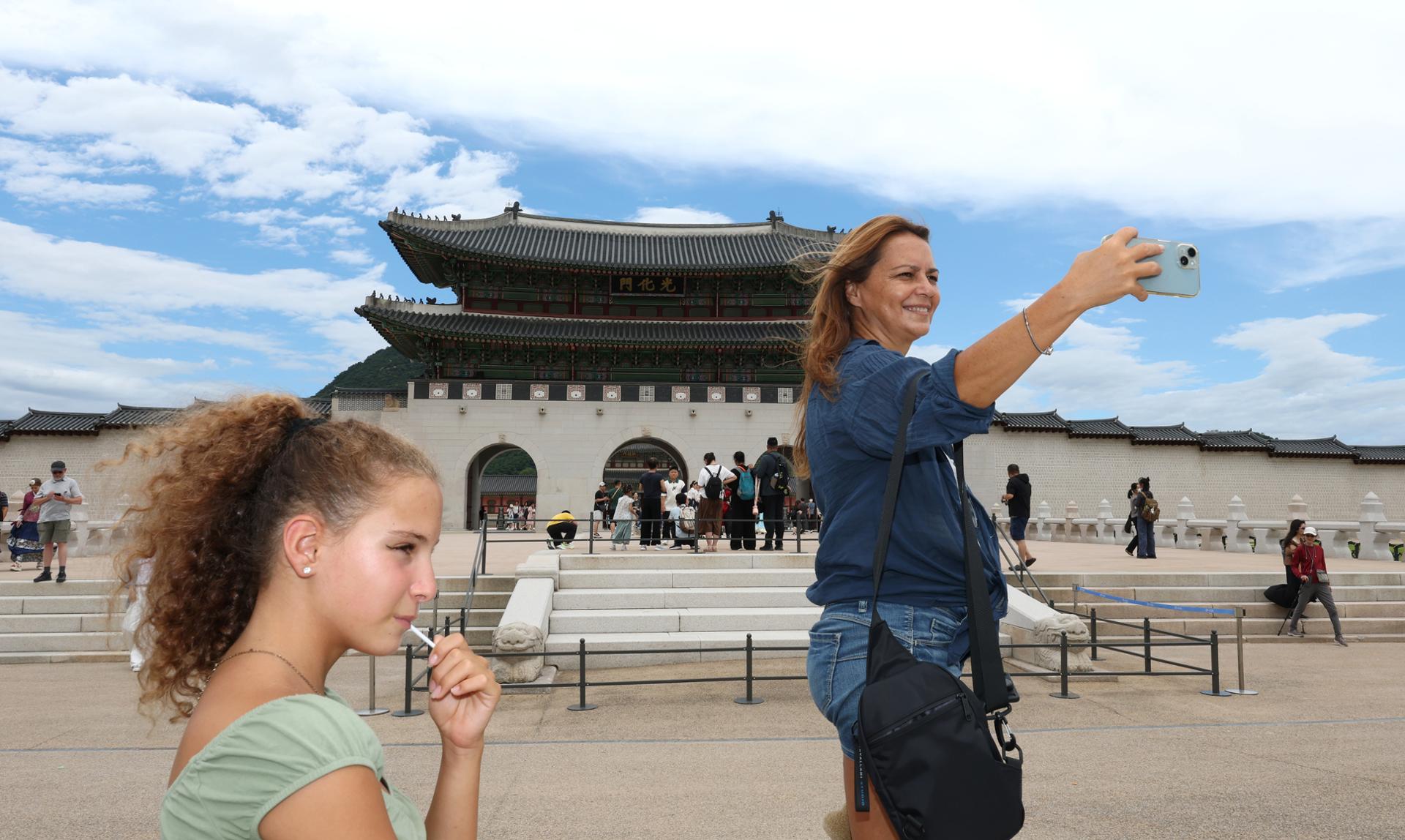
A young person pauses on the street near Hongik University Station in Seoul on Thursday. (Yonhap) Spending in South Korea via cards issued overseas has risen nearly tenfold over the past three and a half years, according to a report released Tuesday.The report by Korea Credit Data shows that the monthly index for overseas card sales reached 960 in June, an increase of 9.6 times the 100 recorded in January 2023.The analysis covered about 328,000 businesses nationwide that use KCD's Cash Note management service to record overseas card transactions.Overseas card sales generally trended upward during the period, except for seasonal declines early in the year, with particularly sharp increases in spring and fall.The share of overseas cards in total card sales at the businesses also rose sixfold, from 0.2 percent in January 2023 to 1.2 percent in June.Over the 12 months from July 2025 through June 2026, Seoul accounted for 65 percent of all overseas card sales, followed by Gyeonggi Province at 11 percent, Busan at 8 percent and Jeju Island at 5 percent.Busan posted the fastest year-on-year growth in overseas card sales, at 60 percent, followed by Jeju at 53.1 percent, Seoul at 36.4 percent and Incheon at 35.9 percent.Medical and cosmetic services accounted for a large share of overseas card spending in the service sector. Dermatology clinics made up 40 percent of overseas card sales in the sector, followed by plastic surgery clinics at 14 percent and other medical institutions at 9 percent.Spending was more evenly distributed among restaurants. Korean set-menu restaurants accounted for 19 percent of overseas card sales in the food service sector, followed by meat restaurants at 18 percent and Western-style restaurants at 8 percent.In retail, fashion and apparel businesses accounted for 28 percent of overseas card sales, while convenience stores made up 13 percent.Overseas card users also spent more per transaction than domestic card users across all three major sectors analyzed.In the service sector, the average overseas card transaction was 166,000 won ($117), about 3.5 times the 47,000 won average for domestic cards. The averages were 32,000 won for overseas cards and 19,000 won for domestic cards in retail, and 33,000 won and 28,000 won, respectively, at restaurants.Despite the rapid growth, overseas card spending remained heavily concentrated among a relatively small number of businesses.The top 1 percent of businesses by overseas card sales accounted for 66.9 percent of the total over the past year. The top 10 percent accounted for 90 percent.A similar concentration was seen geographically. Businesses in Seoul's government-designated special tourist zones, including areas such as Myeong-dong, Itaewon, Jongno, Jamsil and Gangnam, recorded average monthly overseas card sales of 3.48 million won.That compared with 540,000 won at businesses in traditional markets and 299,000 won in neighborhood commercial districts. Overseas cards accounted for 13.9 percent of total card sales in tourist zones, the highest share among the types of commercial districts analyzed.KCD said the findings showed that the surge in overseas card spending was concentrated in Seoul and in sectors and locations popular with international visitors, including cosmetic medical services, major tourist districts and large retail businesses.The company called for support such as improved payment infrastructure and business management services to help smaller neighborhood merchants benefit more from the growth in foreign visitors.Separate BC Card data released last week also showed a sharp increase in spending by foreign visitors. Their card spending rose about 54 percent in the first half of this year from the same period in 2025, with medical services among the categories showing strong growth.Korea received 10.7 million foreign visitors in the first half of this year, the highest figure recorded for the period and up 21 percent from a year earlier.
Foreign card spending in Korea up nearly tenfold in 3 years
Spending in South Korea via cards issued overseas has risen nearly tenfold over the past three and a half years, according to a report released Tuesday. The rep
613 words~3 min read