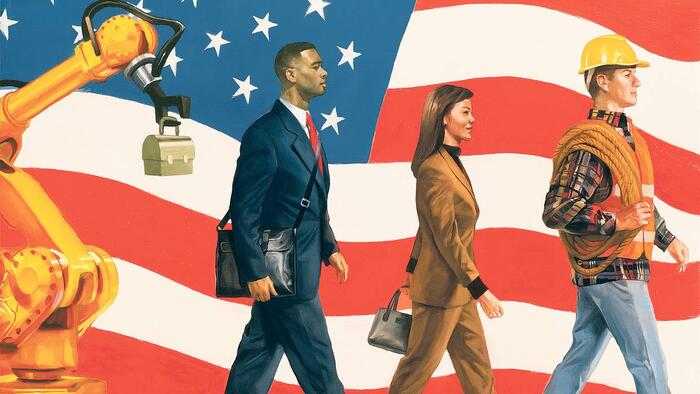
Forget housewives, America is entering the era of the stay-at-home boyfriend.Thirty years ago, men had a seven million job advantage over women in the American labor force – but today the gap has completely evaporated. For only the third time in US history, women now outnumber men in the workforce, a milestone that economists say reflects an important shift in the nation's economy. That's mostly because jobs are being created in industries where women have long dominated – like healthcare, education and caregiving – while traditionally male sectors such as manufacturing and construction are shedding workers. According to Indeed Hiring Lab, the US added 1.2 million jobs over the two years to February – a full two-thirds of this growth, or 814,000 positions, went to women.At the same time, male employment fell by 142,000 jobs between February 2025 and February 2026, according to Indeed's analysis.Unlike the other two instances when women overtook men in US employment – the Great Recession and the COVID-19 pandemic – this time researchers say it's about long-term changes in the labor market. 'The last two times this happened, it didn't stick and the gap closed back up once the economy bounced back,' finance expert Dawid Siuda told the Daily Mail. 'There's no downturn to bounce back from – the job market right now is not in any shocking crisis. So this looks more like a real shift.' Typically female–dominated fields like nursing and education continue to see job growth, while male–dominated industries are seeing slowing or stagnant growth Shampaigne Graves told the Daily Mail that 'girly jobs' are increasing in the marketplaceConsumer expert Shampaigne Graves isn't surprised by the shift. She told the Daily Mail that women are 'dominating' the fields that 'they've always had.' ''Girly jobs' are increasing in the marketplace,' Graves said, mentioning a shortage of workers in teaching, nursing and social work.'Because these jobs are traditionally associated with women, men aren't interested in applying for them,' she told us. 'I believe that what this means for the economy as a whole is there will continue to be a wealth transfer to women in larger amounts.'According to Fortune, healthcare and social assistance, which are 78.9 percent female, added 1.8 million jobs between July 2023 and July 2025, making up more than half of all US job growth at that time. In the field of speech-language pathology – a career where many practitioners earn six-figure salaries – women dominate, making up a staggering 96.4 percent of master's students. As for nursing, 87 percent of bachelor’s students were women.At the same time, male-skewing sectors, including manufacturing, tech, financial activities, and media have been 'stagnant or contracting.'A new analysis shows that the manufacturing industry lost 108,000 jobs in the 12 months to February – more than the 68,000 jobs that the Bureau of Labor Statistics previously estimated.According to certified management accountant Dmitri Maxim, this is not just evidence that women are surging ahead – it's evidence that America’s job growth has become 'concentrated' in female-dominated care sectors 'while male labor–force participation has continued to weaken.' Healthcare and social assistance, which are 78.9 percent female, added 1.8 million jobs between July 2023 and July 2025, making up than half of all US job growth at that time Economists projected a moderate gain of approximately 115,000 nonfarm payroll jobs for the last jobs report – and expected the unemployment rate to hold steady at 4.3 percent Maxim told the Daily Mail that as an accountant, 'I would call this a trend line rather than an anomaly. In the early 1990s, men held almost seven million more payroll jobs than women.' 'That gap has been narrowing for more than three decades, so another crossover was increasingly likely,' he added. 'The real question was when it would happen and whether it would persist.'But across the board, Americans are exiting the workforce. The US Department of Labor reported a 61.5 percent labor-force participation rate in June 2026 – the lowest its been in decades. Last year's participation rate hovered around 62.3 percent. Meanwhile, the latest jobs report painted a mixed picture of slowing hiring and a shrinking workforce, with employers adding just 57,000 roles.The unemployment rate edged down to 4.2 percent, according to the US BLS, with hiring continuing in professional and business services, health care and social assistance.
Women outnumber men in the workforce for the third time in history
Women are now outnumbering men in the workforce - and economists know exactly why.
718 words~3 min read