The Bitcoin chain enforcing BIP-110 has not produced a block since Saturday night, and the proposal's supporters — including Luke Dashjr, who maintains Bitcoin Knots and is chief technology officer of the mining pool Ocean — are now discussing a change to Bitcoin's proof-of-work algorithm.
Activation is arithmetically out of reach. BIP-110 locks in only at block 963,648 and activates at 965,664, both fixed heights with no date-based timeout, which means the fork has to mine 2,015 more blocks at the full network difficulty before it gets any relief from a retarget.
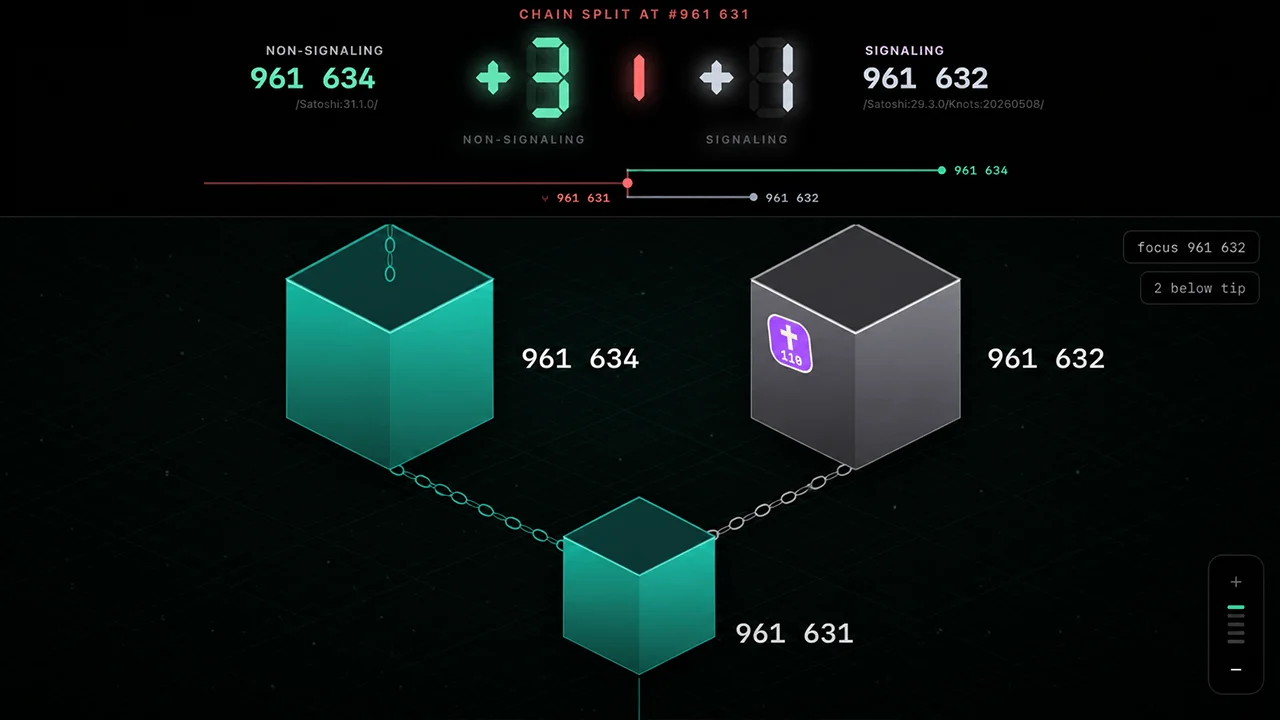
The split happened at height 961,632 on Aug. 8, when the proposal's mandatory signaling window opened and nodes running the rules began rejecting any block that did not signal bit 4. Two blocks were mined on the enforcing side, both by a self-organized crew called Roughnecks using Ocean's BIP-110 stratum endpoint. Their coinbase fields read "< OCEAN.XYZ > Roughnecks."
By midday Monday in New York the enforcing tip was still 961,633 on mempool.guide, which follows the BIP-110 rules, while Bitcoin had passed 961,890 on mempool.space — a gap of more than 250 blocks and widening by about six an hour.
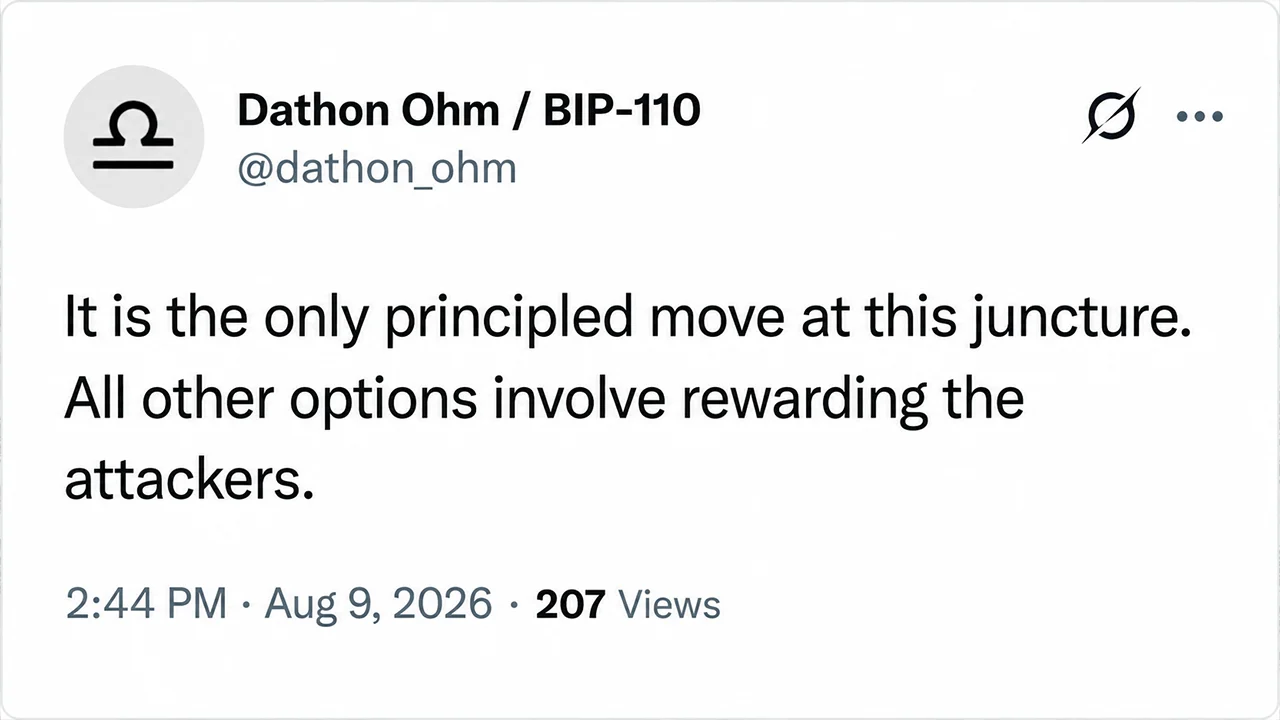
The proposal, authored by Dathon Ohm and crediting Dashjr with the original draft, would have added seven temporary consensus rules aimed at arbitrary data. New output scripts would have been capped at 34 bytes, or 83 bytes for OP_RETURN outputs, with data pushes and witness items limited to 256 bytes. Taproot annexes would have become invalid, control blocks capped at 257 bytes, and the OP_SUCCESS and OP_IF/OP_NOTIF opcodes barred from tapscripts. Coins created before activation were exempt, and every rule would have expired after 52,416 blocks, roughly a year.