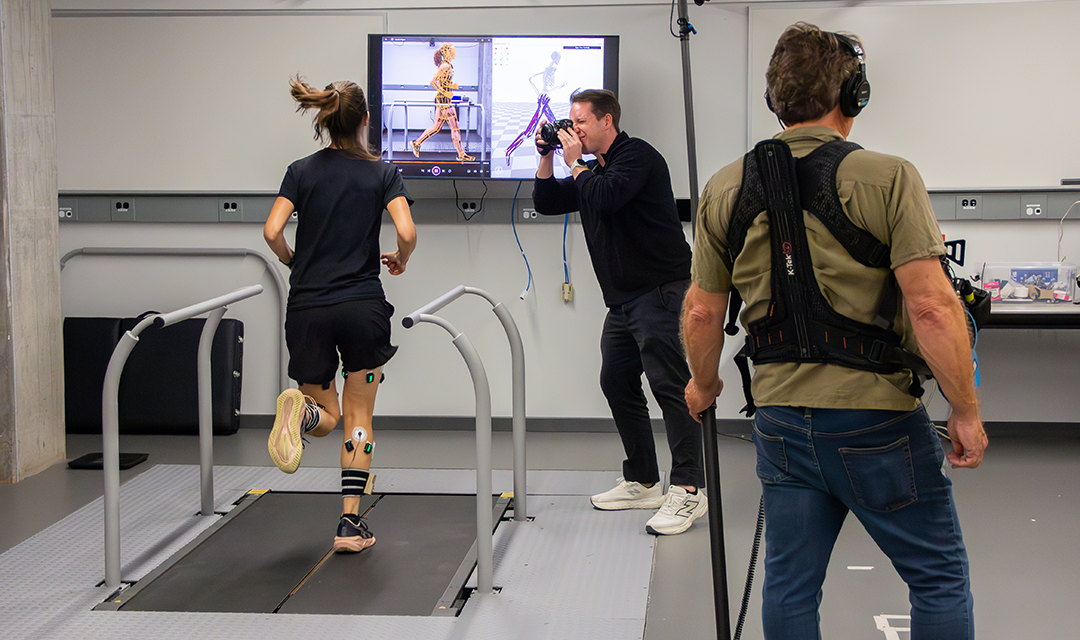
Every step you take carries valuable information about your health. The way your knees bend, your hips rotate, and your feet strike the ground can reveal whether you’re performing at your athletic peak, recovering from an injury, or even developing a neurological condition. For decades, scientists have known that these subtle movement patterns offer powerful clues about human health, but accurately measuring them has traditionally required specialized laboratories equipped with expensive cameras, reflective markers, and expert operators.
Now, researchers at Carnegie Mellon University, in collaboration with the University of Pittsburgh, have shown that wearable sensors can deliver laboratory-grade accuracy, opening the door to measuring human movement where life happens. For researchers and clinicians, that means understanding not just how people move in a laboratory, but how they move through everyday life.
In a study published in Nature Communications, a research team led by Eni Halilaj, associate professor of mechanical engineering, evaluated wearable sensor measurements against biplane radiography, a technology widely regarded as the gold standard for measuring skeletal motion. The researchers found that modern wearable sensors can match the accuracy of traditional laboratory motion-capture systems during short recordings. They also developed a new biomechanics-informed sensor fusion method, IMoveLab, that further improves accuracy and eliminates the compounding errors that have long challenged wearable systems during extended recordings.