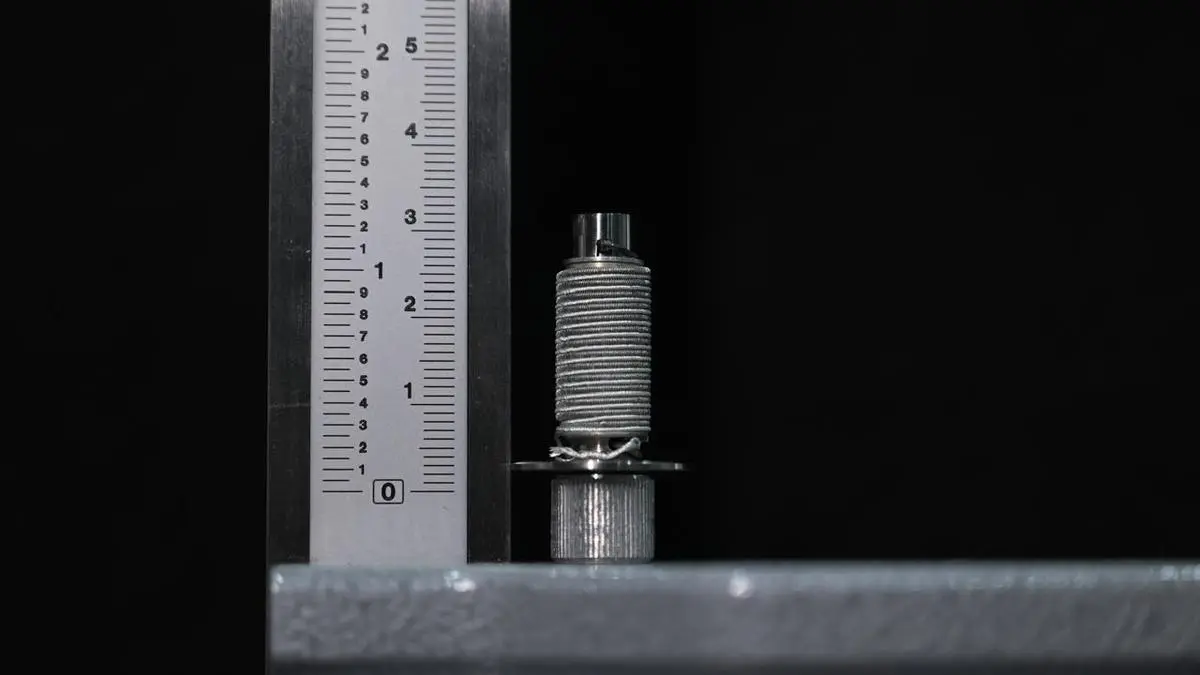
A homegrown 10-gm cooling technology for missile seekers has broken a tightly guarded Western monopoly on such products. The journey to this lean manufacturing success story began with a chance meeting in 2018 between IIT Bombay alumnus Pravin Salinkar, Co-owner of Techno Defence Pvt Ltd, and a director of a Defence Research and Development Organisation (DRDO) lab. It led to Salinkar accepting a critical defence manufacturing challenge.Control regimeFive years later, the defence tech firm that he co-owns with another IIT Mumbai alumnus Sudarshan Saraf, with a small team of engineers and technicians, mostly women, successfully reverse-engineered and built the strategic missile-cooling capability known as ‘Joule-Thomson (JT) Cooler’. The strategic capability is controlled under the Missile Technology Control Regime (MTCR) and possessed by only a few countries including the US, France, and Israel.Describing the innovation journey, Salinkar, 75, said he received funding under DRDO’s Technology Development Fund (TDF) scheme in 2020 for the indigenous design and development of the JT Cooler — a compact, lightweight and vibration-free device that rapidly cools infrared (IR) sensors and focal plane arrays (FPAs) in missiles to cryogenic temperatures of around -196°C.Such cooling is necessary because, at ambient temperatures, the IR sensor or seeker — the ‘eye of the missile’ — generates its own thermal energy, producing background noise, or dark current. This noise can overwhelm the weak IR signatures emitted by distant targets, causing the seeker to lose track of them.Precise cooling by the JT Cooler suppresses this internal thermal noise, enabling missiles to detect and track targets more accurately. However, the technology is not required for missiles fitted with seekers that rely on systems such as satellite navigation, he explained.Complex projectA complex engineering project, Techno Defence’s JT Cooler uses a design distinct from those of foreign players. The company developed specialised production techniques and equipment, leveraging local small-scale and cottage industries. Assembly requires skilled work under a microscope, pure materials and clean environments, backed by stringent quality controls to meet defence-grade reliability standards.By 2023-24, he said they were able to complete the project and hand it over to the DRDO for trials which have been successful. “Now, our JT Cooler is inviting interest from abroad and we are in talks with a foreign country for the product’s export. Since it’s a strategic component governed by the MTCR, there are lots of restrictions on it and a special export permit is required for shipping abroad,” he said.For indigenous production, the company stated that missile manufacturers will have to reach out to them as they are the sole producers of the JT Cooler.Published on August 10, 2026
How a Mumbai start-up cracked missile cooling tech
Mumbai start-up Techno Defence develops indigenous missile cooling technology, breaking Western monopoly and opening new defence export opportunities.
431 words~2 min read