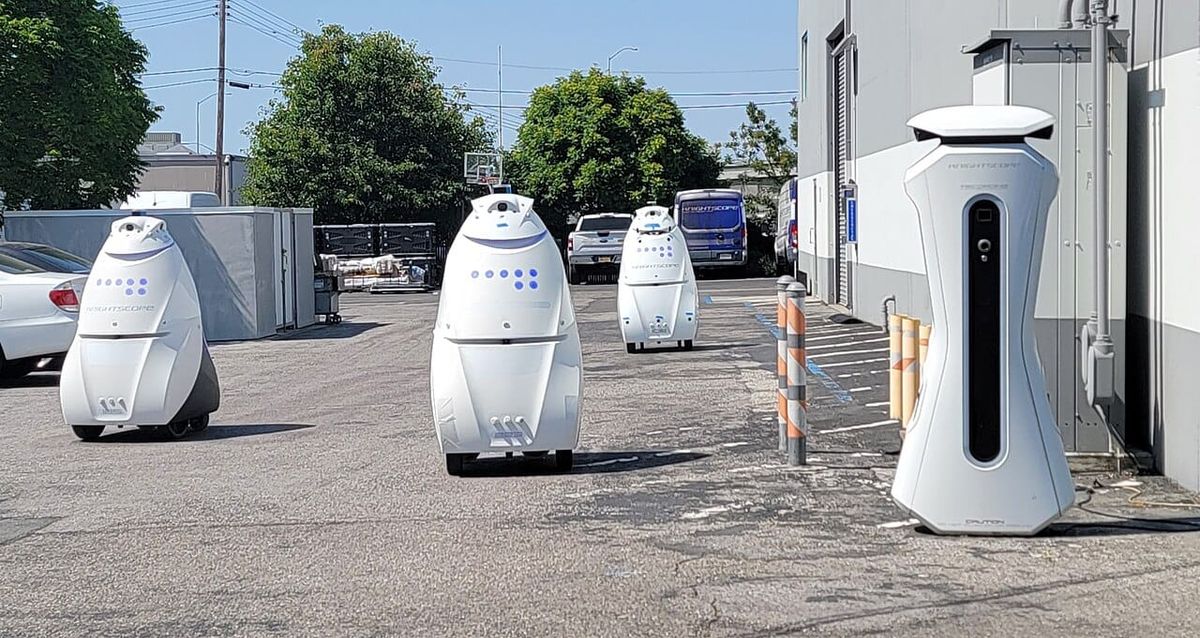
Robotics companies promise that video-camera-toting security robots can deter and detect crime. But many companies are rethinking the approach after a trail of canceled contracts and questions about whether the artificial intelligence-powered bots are meeting the needs of businesses and local governments.Proof News found evidence of at least 21 security robot deployments since 2015. We contacted contract holders and combed news articles and determined that at least 13 of those programs have ended. Silicon Valley-based Knightscope secured the most security robot contracts, according to Proof’s analysis, and also suffered the bulk of cancellations.For example, New York City’s then-Mayor Eric Adams installed a Knightscope robot on the overnight shift at the Times Square subway station, but the program was scrapped when the pilot expired in 2024. City leaders did not respond to Proof News’ questions about why the robot wasn’t renewed. By the end of its assignment, it was reportedly gathering dust in an empty storefront. Outside Columbus, Ohio, the city of Dublin pulled the plug on a Knightscope robot in May, ending its two-year pilot program after less than 10 months. The city enlisted the robot, dubbed DubBot, to patrol a downtown park, but city spokeswoman Robyn Gray said it “did not fully meet our operational needs,” and failed to identify any criminal incidents or lead to any tickets or arrests.Sheila Sparks isn’t surprised. Her family has operated Sparks Protection Services near Columbus for more than a decade and said a human touch is essential to de-escalating sticky situations. “A robot can’t do that,” Sparks said. Seeking a new path forward in the security industry, Knightscope CEO William Santana Li said the company is forging a new model, combining its robots and AI-powered software with another key ingredient: human security guards. Knightscope announced it purchased Event Risk LLC, a national security guard firm, earlier this year.Knightscope has incurred net losses since inception in 2013, according to its most recent quarterly filing with the U.S. Securities and Exchange Commission, and is $273 million in debt. Knightscope hopes its pivot to incorporate people will give it a greater share of the physical security market — which the company believes is worth an estimated $230 billion annually.Li declined to answer questions about the disbanded programs, but said in an email, “Technology cannot do everything — and neither can people — but the combination can be very powerful.” ROBOTS VS WORLDKnightscope and other American made robotics companies could get a boost from the recent U.S. Federal Communications Commission ban on foreign-made mobile robot imports. Officials cast the move as a national security imperative given the machines’ surveillance capabilities. But American roboticists are facing more than foreign competition. Robots have long struggled to navigate environments constantly in flux. AI can’t handle the ambiguous situations that security guards and police face daily, said Missy Cummings, a robotics professor at George Mason University. While AI decision systems perform well in narrow circumstances, she said, they can perform “miserably” as soon as algorithms are outside their training dataset.“AI and robots for security have had a long problematic history,” Cummings said in an email, speaking generally. “I do not see this changing anytime soon.”
The Roboguard Revolution is Short-Circuiting
Knightscope and other robotics companies are rethinking automated security following canceled contracts. One pivot? Human guards.
TL;DRAI
13 of 21 security robot deployments since 2015 failed; Knightscope's NYC and San Antonio pilots collapsed after AI bots couldn't navigate or respond. AI cannot manage ambiguous scenarios. Knightscope is pivoting to hybrid robot-guard teams, proving that pure automation was oversold for security work.
1,407 words~6 min read