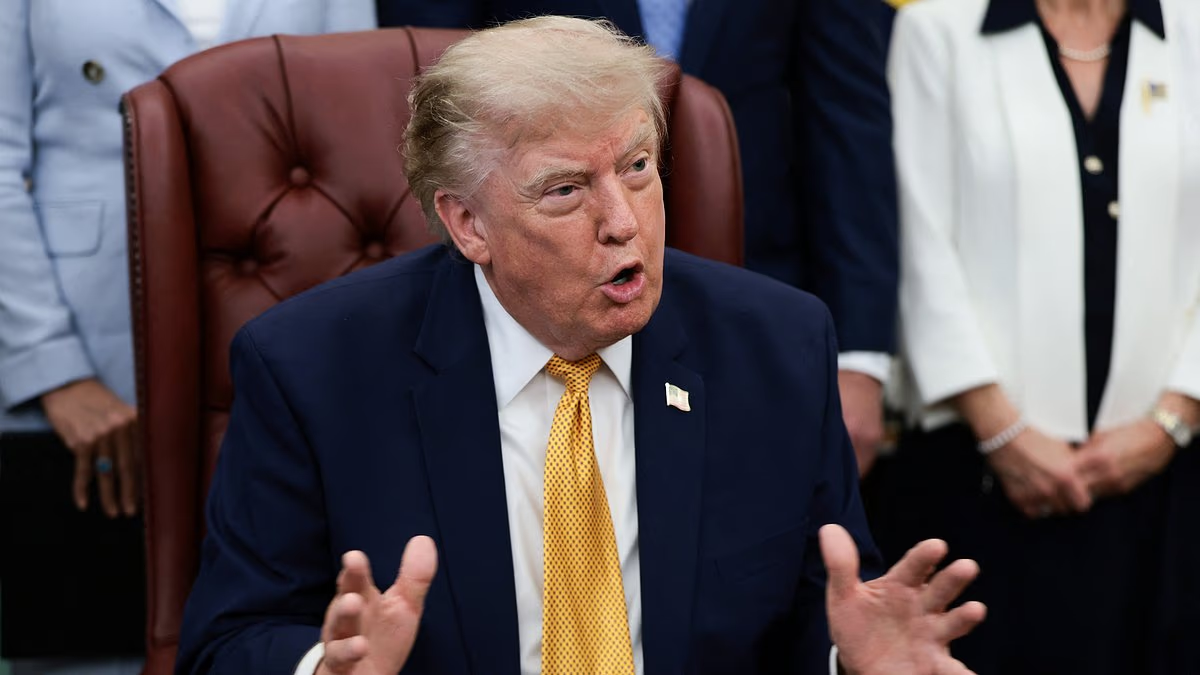
TRUMP: ‘WE ARE LOW-KEYING IT’: After weeks of threatening a “massive attack” if Iran doesn’t open the Strait of Hormuz and sign formal a deal to give up its nuclear ambitions, President Donald Trump has shifted tactics, indicating in a brief phone interview with Axios that he’ll rely on economic pressure to bring Tehran back to the table.“We are low-keying it,” Trump told Axios’s Barak Ravid. “We are just watching Iran with its huge inflation and the fact they have no money.” Trump is putting his faith in the U.S. blockade of Iranian ports, which he said has left “in very bad shape” economically with no money to pay its troops.This latest tack comes after Mohammad Bagher Zolghadr, the secretary of Iran’s Supreme National Security Council, issued a list of demands Saturday that former Defense Secretary Mark Esper called “beyond the pale.”
“They’ve put forward demands of the United States, which frankly are ridiculous and should be rejected out of hand,” Esper said on ABC’s This Week Sunday program. “Demands such as the withdrawal of all U.S. forces from the region, reimbursement for the cost of the war, the fact that we would end our blockade, we would end sanctions.”“They haven’t apparently left any room for negotiation,” Esper said. “It shows that they believe they have the upper hand, they believe they’re winning, and they are emboldened. And that’s what we’re up against right now after, what, five and a half months of conflict.”IRAN THROWS WRENCH INTO HORMUZ DEAL WITH NEW LIST OF DEMANDS TO US‘WE ARE ONLY SEMI-NEGOTIATING’: Trump has repeatedly said a deal to reopen the strait was “imminent,” and last week called Iran “unbelievably duplicitous” for insisting publicly that it was not negotiating with the U.S. while Trump was advancing the narrative that productive talks were underway.Iran has insisted there have been no direct talks with the U.S. while it was negotiating an agreement with Oman to reopen the strait under the control of the two countries. “We currently have no negotiations with America. Yes, messages are being exchanged through intermediaries,” Iranian Foreign Minister Abbas Araghchi told reporters. “This is not called negotiation, it’s an ‘exchange of messages.”Trump told Axios, “we are only semi-negotiating with them,” while insisting, “It will work out. It always works out. It’s like a chess game.”“Unfortunately, this is wishful thinking,” Danny Citrinowicz, former head of the Iran branch of Israel’s military intelligence, posted on X. “Iran’s economic situation is undoubtedly severe, but economic pressure alone is unlikely to force Tehran either to surrender at the negotiating table or to abandon what it considers core strategic interests, including its ability to contest control of the Strait of Hormuz.”“Iran has spent decades operating under intense economic pressure and has repeatedly demonstrated an ability to absorb considerable pain without fundamentally changing course. It could take many months, if ever, for economic conditions to become politically intolerable,” Citrinowicz wrote. “And even then, if Tehran believes the choice is between capitulation and escalation, its track record suggests that escalation is the more likely response.”EDITORIAL: TRUMP’S EMPTY THREATS ARE PROLONGING THE IRAN WARTHE MUNITION SHORTAGE IS REAL: If there was any doubt that a shortage of most American high tech weapons is real and limiting military options with regard to Iran, it was put to rest by a letter Deputy Defense Secretary Steve Feinberg. In it, he implored industry leaders to urgently ramp up production and delivery of weapons, “including munitions that are in extreme shortage due to the war with Iran.”According to a Pentagon memo obtained by the Washington Post, Feinberg gave defense contractors three weeks to submit plans to “drive significantly faster, more aggressive delivery schedules and/or increased production for critical capabilities.”“The administration is trying hard in multiple ways,” Esper said on ABC. “But when you’re talking about taking two years to build a Patriot missile, whatever we do now is not going to help in the short term.”Last week, during a signing session, Trump — who had railed against reports of the munitions shortage as “treasonous,” — conceded that while the Pentagon has a “virtually unlimited supply,” of older, less accurate weapons, the supply of high-end “elite” munitions is “a little bit tighter.”“We have certain types of munitions which may not be as accurate. They’re not as elite,” Trump said, while insisting they “are very powerful and very good …and we have an unlimited supply. And so we’re in great shape.”“It is a serious situation that goes back to the end of the Cold War and decisions we made between them and then with the onset of the Iraq and Afghanistan wars,” Esper said. “In the last six, seven months, it’s really taken a toll that we’ve now found ourselves considerably low with regard to interceptors such as Patriot and THAAD, and to some ground attack weapons as well.”“When I look at the world, I’m most concerned about China and the messages it may be sending there and the deterrent effect of our munition stockpiles,” Esper said. DAN CAINE LOOKING FOR ‘OFF-RAMP’ FOR IRAN WAR DUE TO LIMITED MILITARY OPTIONS: REPORTGood Monday morning and welcome to Jamie McIntyre’s Daily on Defense, written and compiled by Washington Examiner National Security Senior Writer Jamie McIntyre (@jamiejmcintyre) and edited by Keely Bastow. Email here with tips, suggestions, calendar items, and anything else. Sign up or read current and back issues at DailyonDefense.com. CLICK HERE TO SIGN UP OR READ BACK ISSUES OF DAILY ON DEFENSEWILL PUTIN TEST NATO’S BEDROCK ARTICLE 5? A report from the Wall Street Journal last week has ignited a debate about whether with the U.S. bogged down in Iran and running low on high-tech munitions Russian President Vladimir Putin might send troops into a NATO country, in a small-scale incursion, just to see if NATO actually has the will and the wherewithal to respond.“Article 5 of the North Atlantic Treaty states that an armed attack against one NATO member shall be considered an attack against them all,” NATO states on its website, calling the provision an “unwavering pledge.” The Wall Street Journal cited a U.S. intelligence assessment that a limited assault on an allied country could be launched in the next few years to test NATO’s resolve.“I think it has to be taken seriously. The Russians have been playing around with incursions for the last couple of years,” former Defense Secretary Leon Panetta said on CNN. “Last September, they used an armed incursion to go after Poland. In May, they used an armed drone to go after Romania. And just this last week, an explosive-laden drone was found in Germany that belonged to a Russian intelligence team. So these are real threats.”“Putin will use either cyber or use drones or could possibly even use a military incursion to be able to test NATO and test Article 5 and whether NATO will respond,” Panetta said.“Putin would have to be either very desperate, or reckless, or very wrong. He’s being misled all the time by people around him,” said Anne Applebaum, staff writer for The Atlantic. It couldn’t be a full-scale invasion because Russia has not been able to occupy Donbas for the last ten years.”“The Russian army isn’t able to occupy Poland. That’s not what people are afraid of. They’re afraid of some kind of test,” Applebaum said. For example, Russians might declare, “We need to come to the rescue of oppressed Russian speakers of Latvia. Putin might try to do that, as a way of spooking Europe, or showing that NATO alliance isn’t real, a ‘paper tiger.’”US INTELLIGENCE SUSPECTS RUSSIA BEHIND EXPLOSIVE DRONE PLOT AT GERMAN AIRPORT: REPORTKENDALL: WHAT DID I DO? Trump was infuriated when the news media exposed his hamfisted cover story about why he didn’t fly his new luxury Air Force One out of Ankara following the NATO summit last month. Trump told reporters he was flying on his old Air Force One “for old times sake,” and sending the new 747 ahead to Mildenhall Air Base in the U.K. so U.S. troops based there could get a firsthand look at the plane.The New York Times reported the real reason was that the Qatari-donated flying palace has been rushed into service without the air defenses required for use in potentially hostile air space. Trump’s Justice Department issued subpoenas to New York Times reporters, but then withdrew them. Now the Pentagon is going after former Air Force Secretary Frank Kendall who was quoted in the original July 9 article as saying: “Time didn’t permit all the normal Air Force One modifications, so some mix of security, communications and support is missing.”“With the Iran situation, this could be of concern,” Kendall said, adding “Frankly, I’m surprised to see this plane used outside the U.S.”“Effective immediately, the Department of War has REVOKED former Secretary of the Air Force Frank Kendall’s eligibility for access to classified information and his ability to hold any sensitive position,” Pentagon spokesman Sean Parnell posted on X. “This action follows his unauthorized disclosure of classified information regarding Air Force One’s capabilities to a media outlet. Safeguarding classified information is a non-negotiable duty. Those who violate that trust forfeit the privilege of access and any role requiring it.”“I’m mystified,” Kendall said in a text message to Wall Street Journal. “I’ve been extremely careful to not say anything that could be classified, and as far as I know I have not said anything classified …“So far no one has told me what I’m supposed to have revealed.”PENTAGON REVOKES EX-AIR FORCE SECRETARY FRANK KENDALL’S SECURITY CLEARANCE OVER AIR FORCE ONE COMMENTSTHE RUNDOWN: Washington Examiner: Dan Caine looking for ‘off-ramp’ for Iran war due to limited military options: ReportWashington Examiner: Iran throws wrench into Hormuz deal with new list of demands to USWashington Examiner: Houthis restart strikes against Yemen in latest problem for US strategy in regionWashington Examiner: Zelensky says up to 50,000 North Korean soldiers could be deployed to RussiaWashington Examiner: Senate GOP punts party-line budget fight until after August recessWashington Examiner: Senate confirms Todd Blanche as attorney general before August breakWashington Examiner: Pentagon revokes ex-Air Force Secretary Frank Kendall’s security clearance over Air Force One commentsWashington Examiner: Inside the Army’s breakneck mission to get tech to the frontlinesWashington Examiner: Trump-nominated judge orders Pentagon to end halt on wind projectsWashington Examiner: Nagasaki marks 81st anniversary of U.S. military dropping atomic bombWashington Examiner: Trump Treasury pushes banks to stop doing business with illegal immigrantsWashington Examiner: White House report card: Less than one-third of Americans are proud that Trump is presidentWashington Examiner: The curious case of the New Mexico plane crash tied to military jamming activitiesWashington Examiner: Editorial: Trump’s empty threats are prolonging the Iran warWashington Examiner: Opinion: Trump’s gift to Iran that keeps on giving — his name is JD VanceWashington Examiner: Opinion: Trump battleships would help China turn the Pacific into graveyardWashington Examiner: Pentagon should investigate Adm. Bill Owens’s China collusionAxios: Trump to Axios: “We are low-keying it” with IranAP: Pentagon Pushes Defense Companies to Boost Weapons Production After Concerns of Depleted StocksAP: Iran’s leaders think they have Trump cornered, but their strategy carries great risksWall Street Journal: Army Opens Test Ranges to Private Industry to Help Break Munitions BottleneckWall Street Journal: U.S. Intel Finds Putin Could Test NATO’s Resolve With Limited IncursionBreaking Defense: Pentagon Wants ‘Expanding Options’ for Nuclear Weapons, Officials SayWall Street Journal: Pyongyang Missile Test Signals Growing Conflict Between North Korea and US AlliesNew York Times: Syria Agrees to Reorganized Russian Military PresenceDefense News: Trump-Class Battleship Program Will Cost $275 Billion, CBO Report SaysThe Atlantic: How the U.S. Squandered Its Strategic AdvantageNew York Times: ‘I Was So Wrong’: Iranians Say Trump’s Promises Never Came TrueDefenseScoop: War Data Platform Integration Plans Under Scrutiny as DOD Hustles to Weaponize AIWall Street Journal: Trump Is Increasingly Frustrated With His Homeland Security SecretaryAir & Space Forces Magazine: New SOUTHCOM Permanent Cartel Task Force Will Expand Air Force RoleBreaking Defense: Australia Commits to Buying Secretive AIM-260 JATM Missiles, First Non-US UserAir & Space Forces Magazine: New 7th Air Force Chief Faces Tough China, North Korea Air MissionAir & Space Forces Magazine: Senate Confirms Schiess as Next Chief of Space OperationsAir & Space Forces Magazine: KC-135s Battle Damaged in Iran War Arrive at Tinker for RepairsTHE CALENDAR: THURSDAY | AUGUST 13 10 a.m. — Hudson Institute discussion: “Six Months After Epic Fury: The State of the Conflict in the Gulf,” with Behnam Ben Taleblu, Iran Program senior director and senior fellow at the Foundation for Defense of Democracies; Michael Doran, senior fellow and director at the Center for Peace and Security in the Middle East; Ludovic Hood, senior fellow at the Center for Peace and Security in the Middle East; and Zineb Riboua, research fellow at the Center for Peace and Security in the Middle East https://www.hudson.org/events/six-months-after-epic-fury-state-conflict-gulfFRIDAY | AUGUST 14 7:30 a.m. 11493 Sunset Hills Rd. Reston Va. — Government Executive Media Group discussion: “Beyond the Platform: Inside the Army and Navy’s Expanding Unmanned Systems Market,” with John Carbone, senior technical director for supporting government and critical infrastructure for Everfox; David Hutchins, director of defense technologies and naval systems for Forecast International; Erin Kocourek, vice president of business development and space for CACI; Matt Marsden, senior director of solutions consulting for Palo Alto Networks; former Assistant Defense Secretary for Space Policy John Plumb, head of strategy for K2 Space; Todd Stevens, vice president of mission strategies and advanced capabilities and strike, deterrence and missile defense for Lockheed Martin Space; and Nick Wakeman, editor-in-chief of Washington Technology https://events.govexec.com/wt-power-breakfast-beyond-the-platform/