Back to Articles
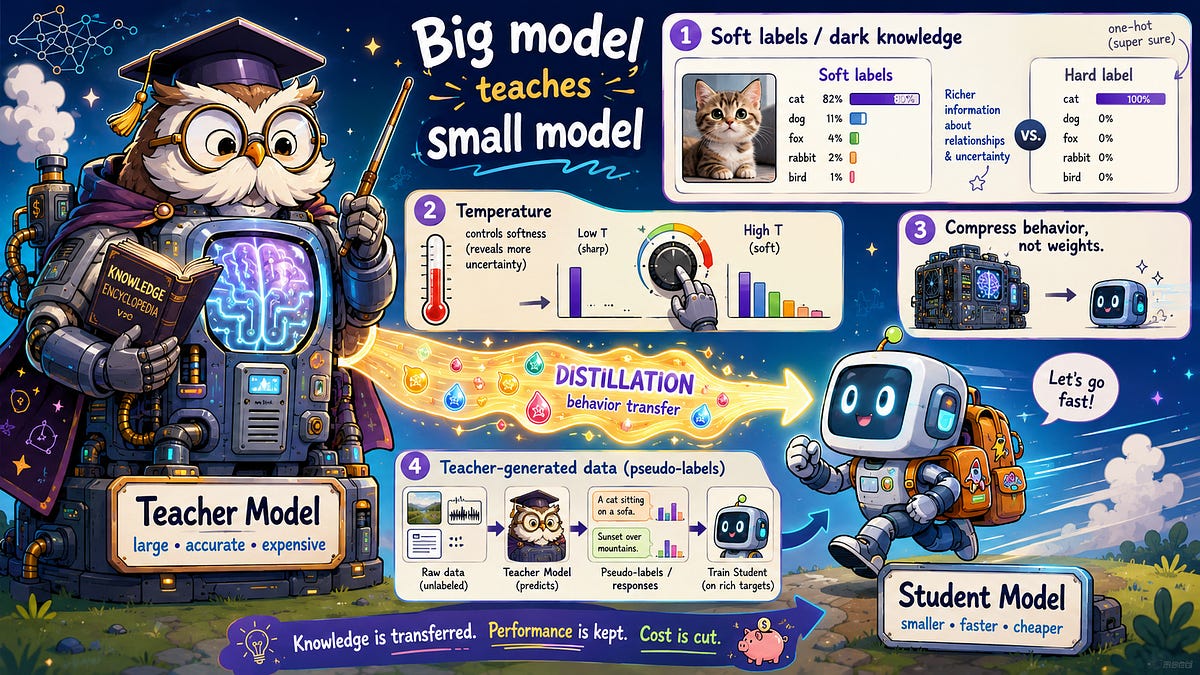
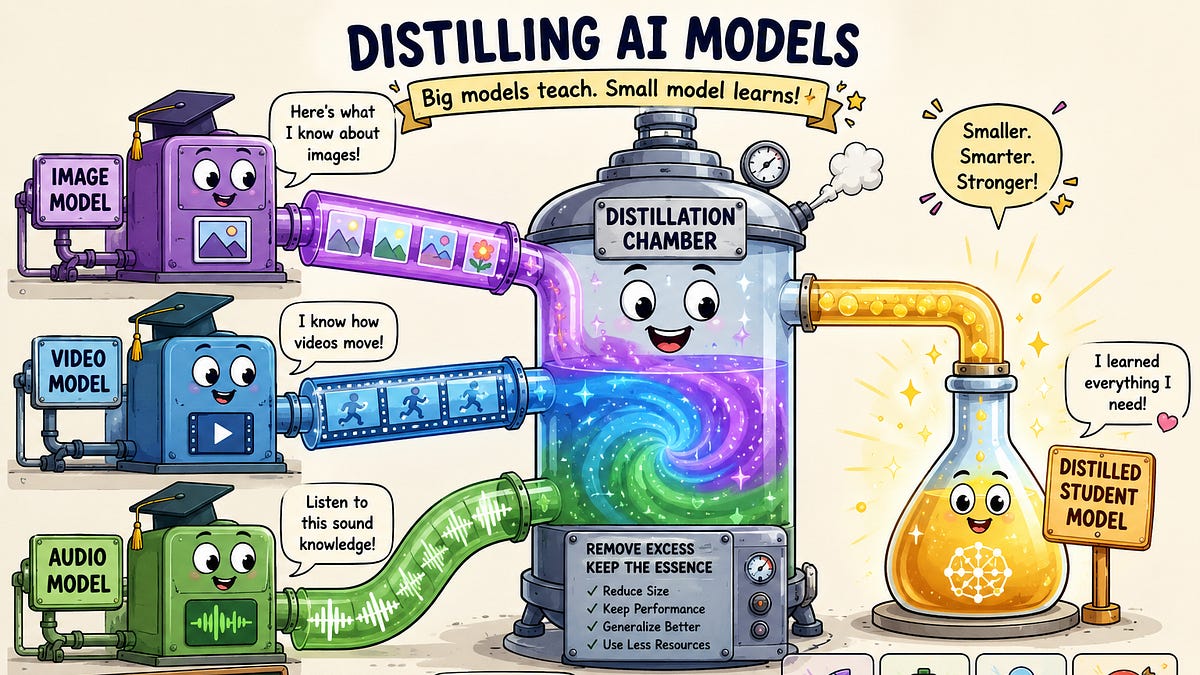
Knowledge distillation, training a smaller student model to match the performance of a larger teacher, is a well-known technique in Machine Learning. With the recent wave of open-source Large Language Models, such as gpt-oss, Qwen, GLM, or Kimi, it has become a mainstream research topic again. Deploying these very large models is expensive: the recent Kimi-K3 model has 2.8 trillion parameters and needs roughly 3TB of VRAM just to load. Compressing them into smaller models and recovering the original capabilities through knowledge distillation has therefore become standard practice, with companies like Nvidia (Nemotron 3 Puzzle 75B) or Multiverse Computing (Hypernova 60B) recently releasing high-quality compressed models.
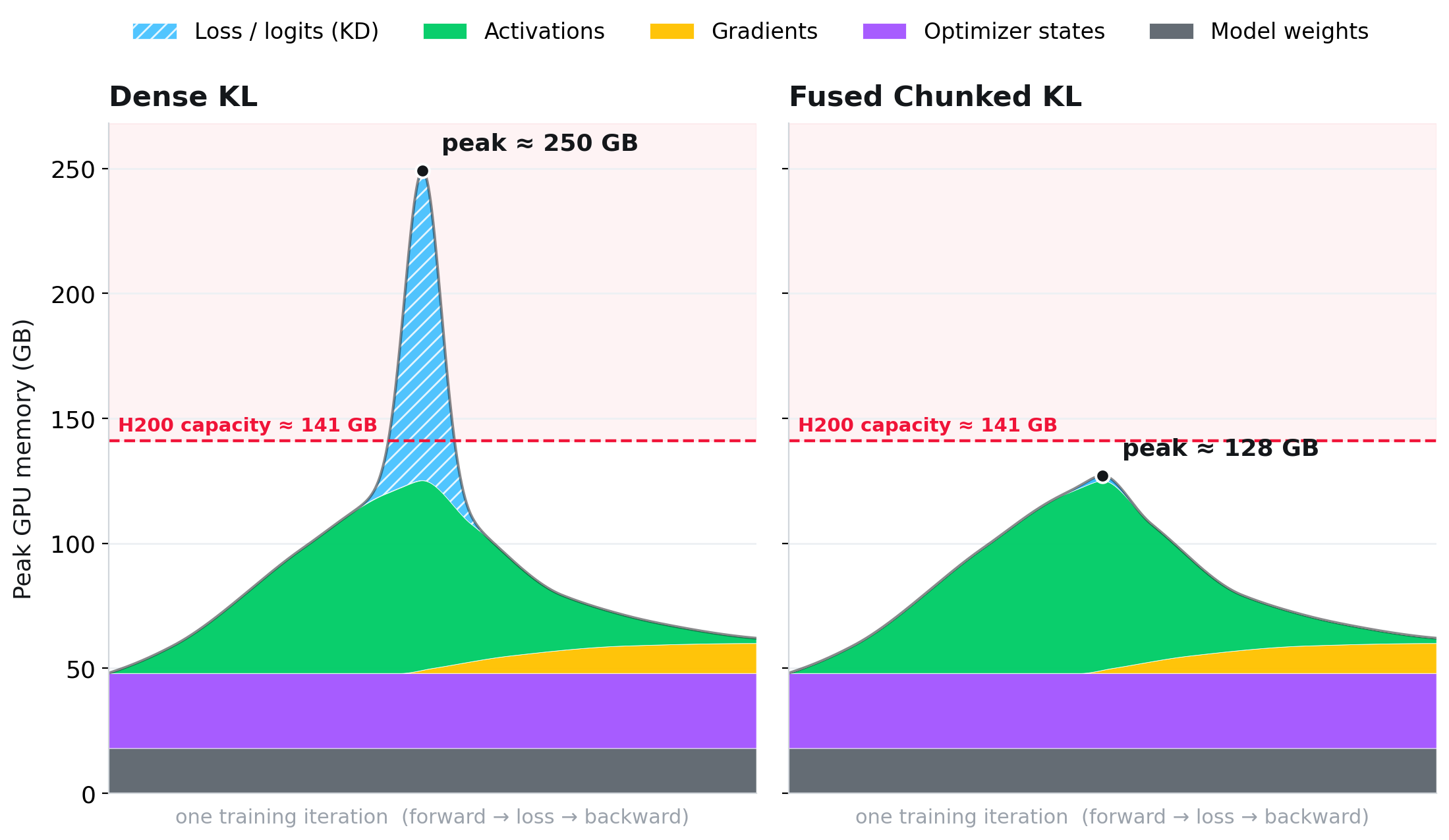
The distillation step is what decides most of the final quality, but it's also usually the most expensive part of the pipeline. Keeping both the teacher and student loaded, and producing a probability distribution over the entire vocabulary for every token, requires enormous amounts of VRAM, typically feasible only with hundreds of GPUs and careful tensor-parallelism strategies. Our latest paper, Efficient Knowledge Distillation for LLMs: Offline Top-K Logits and a Fused Chunked KL Loss, tackles this with two systems changes: caching the teacher's top-K logits once so the teacher never has to sit in memory alongside the student, and a new, memory-efficient KL-divergence loss that avoids ever materializing the full vocabulary-size × sequence-length matrix, cutting VRAM use far below what the default implementations in libraries like PyTorch or NVIDIA Megatron-Bridge achieve. Together, these two changes cut training cost enough to make long-context healing possible on a single GPU, and cheap enough to make large-scale experimentation practical.