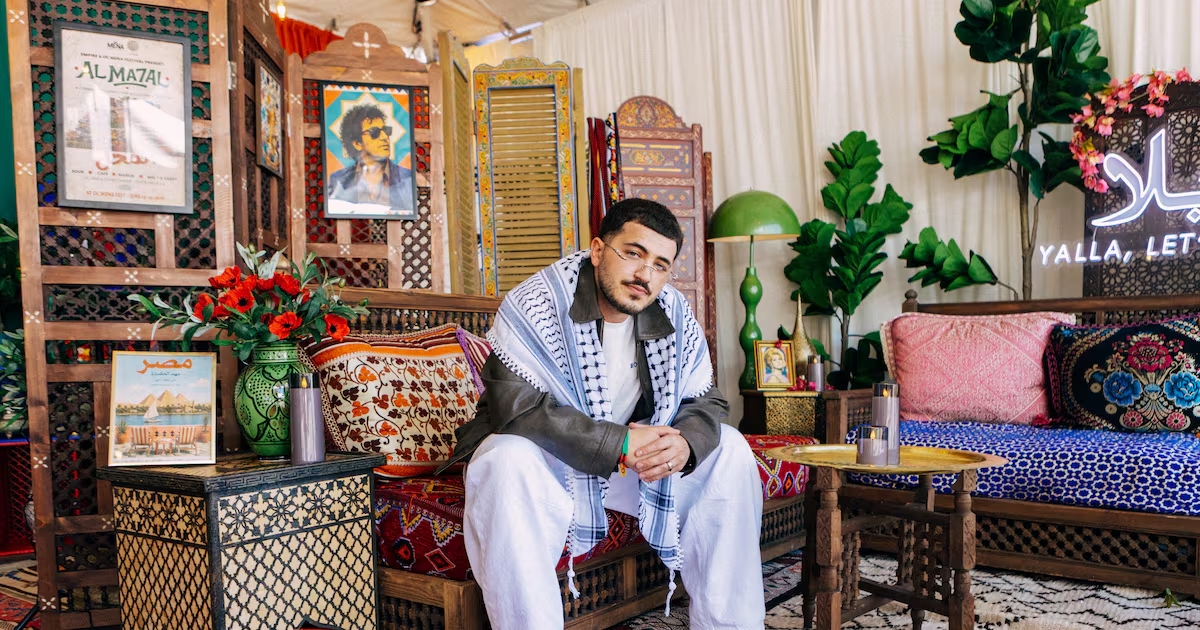
In 2021, Issam Alnajjar wrote a simple love song in his bedroom in Amman.Hadal Ahbek, meaning “I will always love you,” was as direct and potent as its message. With its conversational lyrics, warm acoustic guitar and wordless “ra-pa-pa” refrain, the almost lullaby-like song stood apart from the often overwrought Arabic balladry of the region. It became a genuine crossover track, topping Spotify’s Global Viral 50 the following year, drawing streams from Canada to Indonesia and turning the 17-year-old Palestinian-Jordanian singer into an international pop prospect.The following years brought a major record label deal, a well-received debut album, a support slot for Maroon 5 in Egypt and the 2021 GQ Middle East Breakthrough Musician of the Year award. By the time he received the award, the bedroom in Amman had been replaced by a plush hotel room in Dubai and the thrill of creating a great song had been replaced by exhaustion and bewilderment at what comes after unexpectedly becoming a viral star.“That day was really stressful,” he recalls of the award ceremony. “I was very sick and came late to the event. I just felt like I had no energy for anything. I felt down and remember thinking, ‘If receiving the award is such an accomplishment, then why am I not happy?’ I went to the award show and then went straight back to the hotel instead of celebrating.”Five years later from that low point, Alnajjar speaks to The National from the same bedroom in his family home in Amman, where he learnt the guitar amid the social restrictions imposed during the Covid-19 pandemic.“The room is the same, but the decor has changed,” he smiles. “Coming back here made me really understand why I am doing this, because it reminded me of who I was: just this kid who was living by himself, basically, since the age of 14, discovering music and falling in love with it. It is a chilled space, but a very important room.”His return marks both a fresh start and the end of the most recent phase of Alnajjar’s journey, which resulted in his latest album, Night in Cairo. The album is the culmination of five years spent in Los Angeles, traversing songwriting sessions and recording studios while navigating the thrilling and cutthroat nature of the music industry.▶Alnajjar says he had to grow up quickly.“In a way, I started my career backwards. Having a big song and being thrown into the industry and the business side of it really changed who I was before and after. I mean, you really have to be tough as you learn that it is an industry based on feelings and credit. If your feelings aren’t validated and if you’re not getting your credit, it takes a real toll on you emotionally, and that affects your whole life,” he says. “I was a lot more innocent, just loving life, and wanted to build a circle where I could just be myself. Throughout my whole career, things were changing. I had to move and start from the beginning again and again and again and again. It kind of made me lose touch with who I am as a person. So it took me a while to understand what I really am as a person and artist.”Issam Alnajjar performs at Beat the Heat in Dubai. Photo: Salxco UAMShow caption: Issam Alnajjar performs at Beat the Heat in Dubai. Photo: Sa…The seven-track Night in Cairo, a suite of songs inspired by Egyptian popular music that Alnajjar showcased in a recent show in Dubai, illustrates the labour-intensive approach of the major-label system. Alnajjar says the tracks were selected from more than 50 songs written with various collaborators over two years. Yet it is also the most cogent release of his career, following his experiments with the more electronic pop production of his previous EP, 2023’s Waray. That release included collaborations with EDM star R3hab, Egyptian pop star Mohamed Ramadan and French rapper Gims.Night in Cairo brings together both worlds, with the production and musical accompaniment recorded in Los Angeles, while the lyrics and initial song concepts came together in the Egyptian capital. There, Alnajjar spent time working with lyricists and producers including Ahmed Ortega, Amir Shiko and Mohamed Shafaay.Despite the sunshine, palm trees and Los Angeles being the nexus of the music industry, Cairo’s crowded and vibrant streets felt more like home to Alnajjar.“Growing up, I listened to a lot of Egyptian music and a lot of Egyptian artists. It was always in the house. It was always being played everywhere. So it was kind of familiar, and I wanted to show appreciation and show that these roots are, like, music is for everyone, you know? I wanted to give those flowers to Egypt in general,” he says. “At the same time, I see the similarities. Egypt is definitely a destination for every artist in the Middle East. If you make it in Egypt, you make it in the Middle East. It’s kind of like America for the Arab world.”The tribute to Egypt is not direct. It has more to do with the values the city traditionally exudes: a keen attention to lyrics, the use of orchestras and an awareness of sounds coming from both the streets and concert halls.▶Amari is a stately song that swells around acoustic guitar and was recorded with a 36-piece orchestra. The vibrant Zaffeh is named after the wedding procession and built around an instrumental chorus channelling the occasion.Ya Sidi, meanwhile, draws from a recording by Syrian-Egyptian singer Asmahan, retaining elements of its melody while changing the lyrics and production.Ironically, this is perhaps where the influence of Los Angeles music circles is most apparent: he has the confidence to tackle a catalogue that many of his peers consider sacred.“It just made sense for me to sing it because it matched my voice, and that’s the most important thing because you don’t want to change so much about the song,” he says. “I love the idea of recreating. But there’s a very thin line where it could be done very wrong. It could sound cringey, or it could sound like it’s not really giving it that real respect, you know.”▶That also extends to the Arabic language, Alnajjar notes, the inflections and syllables of which can sometimes be at odds with the confines of Western composition.“We always struggle with that,” Alnajjar says. “Even some letters in Arabic are sometimes very hard to sing. But it’s just letting go of making it perfect and focusing more on what feels good.”It is the kind of hard-won confidence that Alnajjar has brought back to Amman, where he now lives and is celebrated as a seasoned artist still on the rise. That was acknowledged last month when he performed at the opening of the Jerash Festival, the country’s most acclaimed annual cultural event, as it celebrated its 40th anniversary. More than that honour, Alnajjar says the most important gift was the one he gave himself by returning home.“I just wanted to honour the person I was all those years ago and tell him, ‘Yo, it’s not that serious. Just go create some music. This is how you fell in love with it.’”
‘I started my career backwards’: Singer Issam Alnajjar on new album and life after viral hit Hadal Ahbek | The National
Night in Cairo combines Egyptian songwriting with lessons drawn from five difficult years in Los Angeles
1,197 words~5 min read