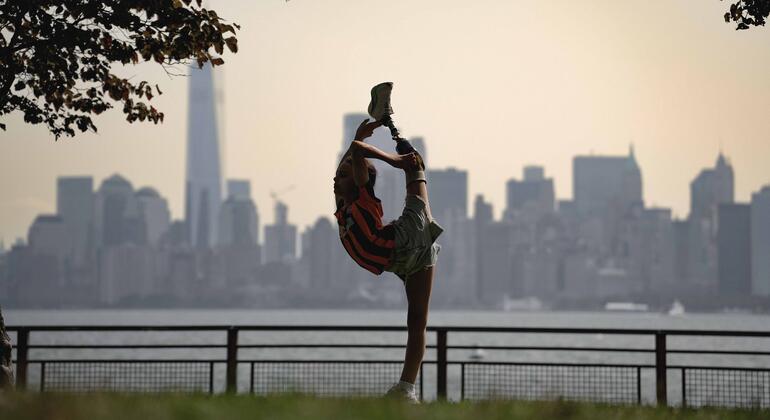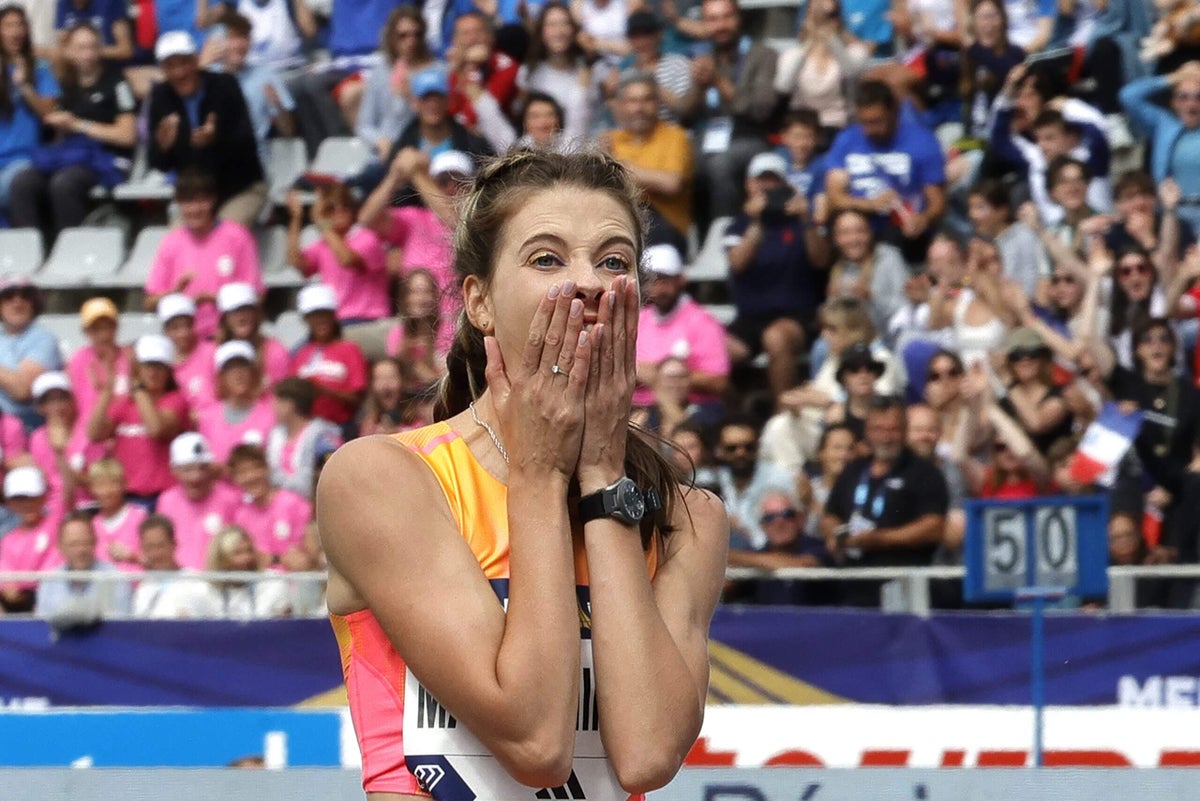
When Yaroslava Mahuchikh competes, she does so with added weight on her shoulders.“I want to win gold for my people,” the high jumper says. “A lot of soldiers watch or read the news and they write to me: ‘Thanks for representing Ukraine.’ Because of them I have the opportunity to represent my country and (keep) our country alive.”Born in Dnipro, eastern Ukraine, in September 2001, the majority of Mahuchikh’s professional track and field career has been intertwined with the Russia-Ukraine War, the biggest ground war in Europe since World War II. Russia first attacked in 2014, but the war then escalated four years ago when Russia started a full-scale invasion on its neighbor, attacking the Ukrainian capital Kyiv and the city of Kharkiv in February 2022.A month after that February invasion, Mahuchikh competed at the World Indoor Championships in Belgrade, Serbia, and won her first global title with a 2.02 meters clearance. Having been a teen sensation — she won silver at the 2019 World Championships with an under-20 world-record jump of 2.04m, and took bronze at the 2021 Olympics — this gold took the then-20-year-old to new heights.Three more global titles have followed, including Olympic gold in 2024. She’s the youngest ‘grand slam’ high jumper by six years — holding the Olympic, world championship and European crowns indoors and outdoors by the time she was 22. Only two other athletes — Mariya Lasitskene (28) and Stefka Kostadinova (31) — have achieved that feat.She’s a five-time European champion (three times indoors) and, at the upcoming edition in Birmingham, England, which starts today, Mahuchikh has the chance to emulate Spaniard Ruth Beitia as a three-time continental gold-medal winner. The championship record of 2.03m should be under threat, too.“I’m going there to protect my title,” she grins over a video call.Yaroslava Mahuchikh celebrates winning the women’s high jump at the World Athletics Indoor Championships in Poland in March. (Kirill Kudryavtsev / AFP via Getty Images)Russian athletes will not be in Birmingham. They are still excluded by governing body World Athletics, a stance which “hasn’t altered,” according to president Sebastian Coe last month. But the International Olympic Committee (IOC) has provisionally lifted its suspension of the Russian Olympic Committee, opening the door for their participation under the Russian flag at the 2028 Los Angeles Games.“When I saw this news, I was pretty shocked because nothing has changed in our world since 2022,” Mahuchikh says.“For us Ukrainians, it was really tough. I’m really thankful to Coe because he supports Ukrainian athletes and he has a strict position.”The IOC’s policy change is especially pertinent for Mahuchikh. High jump is a sport historically dominated by eastern and central European nations. Of the 88 women who have jumped 2.00m or above, nearly half are from that region — 14 are Russian and seven are from Ukraine.“We were talking, us girls, about why we have so (many) competitive high jumpers and, truly, we don’t know,” she laughs. “It’s just in Ukraine, high jump is really a national event.”In March, there was a Ukrainian high jump double at the World Indoor Championships in Torun, Poland: Gold for Mahuchikh in the women’s event, while Oleg Doroshchuk claimed the men’s title.“I’ve come back to the shape that I was in before the 2024 Olympics,” Mahuchikh says. “I feel it with my technique, I feel my speed.”“I have big goals,” she adds. “At my first Olympic Games (2021), I won a bronze medal. (From) the second one I have gold. At the third (2028), I would like to win gold with an Olympic record.”Winning gold in L.A. would make her only the second woman to retain the Olympic high jump title, replicating the feat of Romanian Iolanda Balas in 1960 and 1964. Meanwhile, the Olympic record of 2.06m was set by Russia’s Yelena Slesarenko in 2004.“I wrote my name into the history of track and field,” she says of her success two years ago. “But I want to make it again.”Mahuchikh’s training camps typically take place in Estonia, although she is speaking to The Athletic from Belgium as she puts the finer details on her preparations for this week’s European Championships, where she will first be in action on August 13 during qualification for Saturday’s final.She is close to her season peak, which in training terms means one high jump session per week, half of what she was doing at the start of the year.Training also includes the hurdles and long jump, events she competed in as a child. “When I met my coach, Tetiana Stepanova (in 2011), I thought that I’d be a hurdler,” she says.Now she uses those disciplines to improve her runway speed, completing sprinting drills with the hurdles spaced at different distances. That is to mimic how she transitions from big steps early in her run-up to short steps before take-off.The last step “should be short and fast,” she says, “because this is physics.”
Yaroslava Mahuchikh on making history while her country is at war: ‘I want to win gold for my people’
Olympic high jump champion Yaroslava Mahuchikh is aiming to retain one of her numerous titles at this week's European Championships.
1,457 words~7 min read