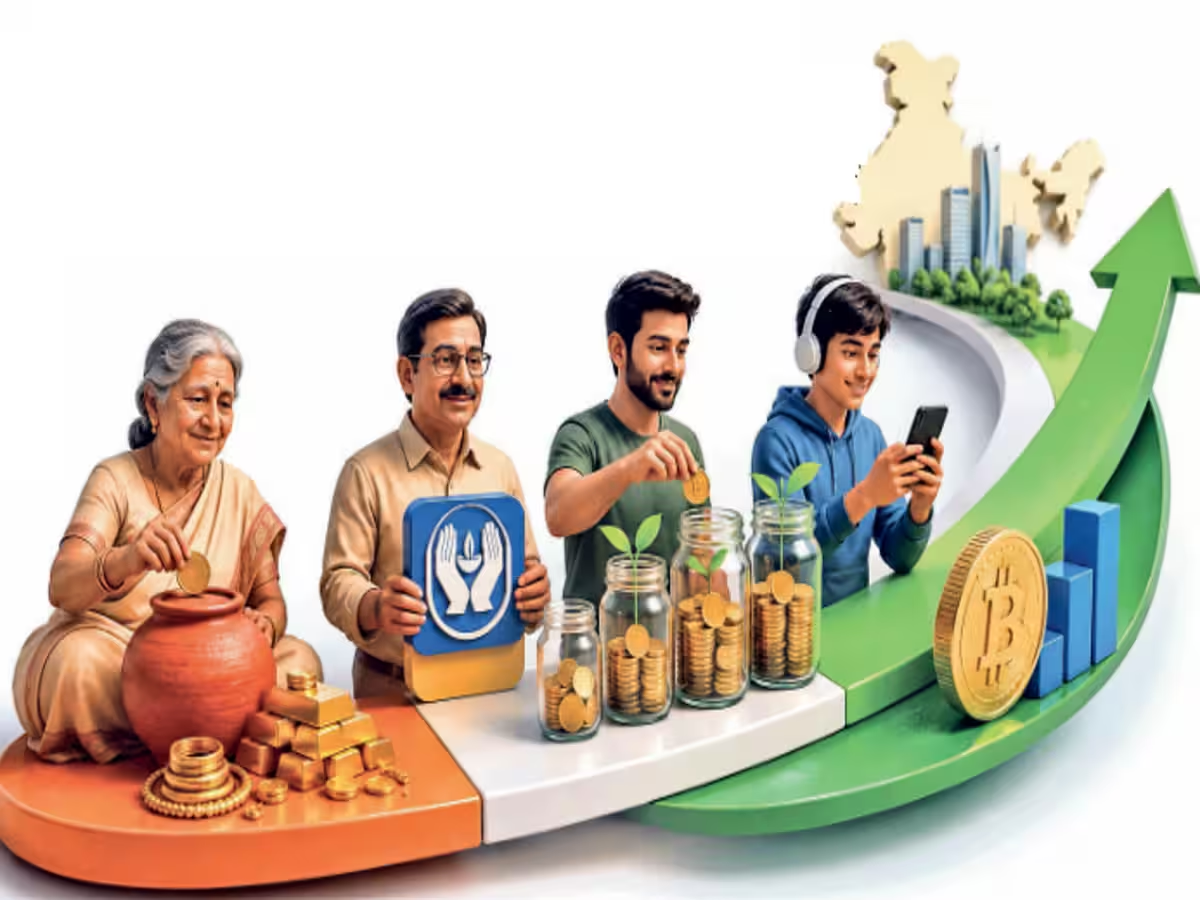
In 1994, a young woman joined HDFC in Kolkata and, like many salaried Indians then, began saving a few hundred rupees a month in a recurring deposit. There was no app, no Systematic Investment Plan (SIP), and she knew nothing about the share market. Three decades later, an 18-year-old in Thiruvananthapuram was already six years into investing—using his father’s demat account during the Covid-19 lockdown, before he was old enough to open one of his own.Between these two decisions lies the story of how India transformed the way its people build wealth. One generation saved because it had few alternatives; the next invests because it has many. That, perhaps more than anything else, is what financial inde pendence looks like.To understand how all this has played out, ET Wealth spoke to seven investors between the ages of 18 and 67. Their portfolios look wildly differ ent from one another. Each of them started investing in a different India, with different products and a different idea of what money was even for. We explore how today’s young investors differ from their parents.The careful saverFor 67-year-old Bengaluru-based ad vertising professional Pratap Kumar, building wealth started with saving, not investing. When he began earning in the late 1980s, money was always tight. “Those days salaries were not that high,” he recalls. With two sons to educate and household expenses piling, whatever he could save went into safe and familiar options. Gold was one of them. He regularly put money into jewellery shop instalment schemes. “You paid every month, and after 24 months you could buy gold by adding a little extra money,” he says. He also contributed to his provident fund while working in a salaried job.Before you continue readingHow financially free are you?Most people overestimate their financial freedom. Discover your Financial Freedom score through a quick surveyThose savings later helped him build the first floor of his house. When he left his job in 2001 to work on his own, he became an LIC and general insurance agent for a couple of years to earn an additional income while building his business.The stock market never attracted him in his early years. His father and brother invested in shares, but his own experi ence with Initial Public Offers (IPOs) was disappointing. “Most of the IPOs I applied for with the little money I had, I never got lucky,” he says. With limited savings and a fear of losing money, equities never became a priority.His story shows how many Indians ap proached money before financial markets became widely accessible. Savings ac counts, provident funds, gold and fixed deposits were considered safe, while stocks were seen as risky and difficult to under stand.Things changed in the early 2000s when he met a financial adviser. Around 2002-03, he began investing through SIPs in mutual funds and continued them for two decades. Over time, he also invested in fixed depos its, post office savings schemes, senior citi zen savings schemes and insurance. Even today, he keeps a small amount in direct equities, buying and selling shares for mod est profits.His portfolio changed slowly over the years. Until his late 30s, almost all his mon ey stayed in a savings account. After turn ing 40, he moved into mutual funds while continuing with bank deposits and other safe investments. Looking back, he believes mutual funds played the biggest role in building his wealth and helped him invest in real estate as well. His only regret is not investing more in equities earlier. “I could have done better,” he says. Today, Kumar estimates his net worth in crores. But for him, wealth is not about the number. “It’s the confidence that I don’t need to depend on anyone for anything,” he says.Bricks and compoundingIf Kumar’s story is about preserving wealth, Jayati Ghosh’s is about adding to it, one layer at a time. Ghosh , a 55-year-old resident of Kolkata, joined HDFC in 1994, after graduating. She started at the bottom of the organisation and spent 30 years at the firm, achieving financial freedom at 52 and retiring as Deputy Vice President in 2023 after HDFC merged with HDFC Bank. “Our wealth was built patiently over decades through discipline, consistency and the power of compounding,” she says. Like many salaried employees in the 1990s, her first investment was a recurring deposit. She also bought LIC endowment and money-back policies, which were popu lar at the time. But today, she feels those products did not create much wealth. “The money stayed there for years, and the re turns were small,” she says.As India’s economy opened up, new in vestment opportunities started appearing. In 1995, HDFC offered shares to her at Rs.10 each. That became her first real investment in the stock market. Soon after, she began applying for IPOs. One of her early suc cesses was UTI Bank (now Axis Bank). She bought shares at around Rs.20 and later sold them for about Rs.60-70.She became more active in equities dur ing the early 2000s, but the 2008 market crash changed her approach. She lost around Rs.3.5 lakh, a large amount for her at the time. After that, she stopped trading and focused on holding good companies for the long term.Pratap Kumar, 67BengaluruProfession: Advertising professionalStarted withSavings account, gold, Provident FundAlongside equities, she contin ued building wealth through other avenues. She contributed not just to Employee Provident Fund (EPF) but also voluntarily increased her PF contributions for almost three dec ades. Her home loan Equated Monthly Instalments (EMIs) gradually built a valuable real estate asset. As her income increased, she started SIPs in mutual funds around 2016-17 and later added products like Portfolio Management Services (PMS) and Alternative Investment Funds (AIF).Employee Stock Option Plans (ESOPs) played a key role in Ghosh’s wealth creation. She invested 80% of her gratuity amount in unlisted NSE shares at around Rs.800 each. Three years later, the shares are worth about Rs.2,125, taking the investment to near ly 2.7 times its original value. Today, her portfolio reflects how investing in India has evolved. It includes real estate, direct equities, mutual funds, PMS, AIFs, gold, silver and NPS. For Ghosh, financial independence means peace of mind. “Knowing that all my needs are taken care of without depending on a regular salary.”The sandwich generationThe four investors in the middle of this story—Ravi Nagrani, 42; Navneet Gupta, 39; Monil Thakkar, 29; and Anjali Jaiwal, 28—belong to one broad generation, but they didn’t invest alike. Thakkar and Jaiswal put their very first salary to work in the mar ket. Nagrani and Gupta took the long way round.The early starterRavi Nagrani, a 42-year-old resident of Pune, finished hotel management in 2004, took a job at Grand Hyatt Mumbai on Rs.5,000 a month, paid Rs.1,800 for a shared flat—and started investing. “It was natural for me to invest rather than spend,” he says, crediting his mother’s saving habit in their joint family. He began with bank fixed deposits, the only product he understood. In 2005, after Franklin Templeton set up a stall in the hotel canteen, he made his first equity mu tual fund investment, funding his SIP with a booklet of post-dated cheques.The funds did well through the 2007-08 boom. Then came two les sons. In 2008, he got caught in the Reliance Power IPO frenzy as he and his mother put in about `1 lakh. The stock listed near Rs.400 and sank. The hype surrounding the investment was immense. The experience taught him that popularity alone does not make a good investment. But the bigger les son was about holding on. When the 2008 crash hit his mutual funds, his MBA finance professor asked him one question: do you need the money today? He didn’t. Nagrani, who is Co-founder of The Prudent Investor, a mutual fund distributor, didn’t sell. “Staying invested during the 2008-09 crash and continuing to invest over the next two decades helped build a sizeable invest ment portfolio that eventually gave me the confidence to leave the corporate world in 2023,” he says.For a long stretch, he was roughly 95% equity, with the only debt coming from his compulsory Provident Fund. He added US funds around 2013-14. Today the portfolio is well balanced: around 60-65% total equity (about 46% Indian, 15% global), gold near 14%, and debt around 25%. He skips crypto, and his cricket metaphor explains why. “I don’t need to hit a six on every ball. If I get 10-12% returns, I’ll easily achieve all my life goals.” He describes his position as “Coast FIRE”, a version of Financial Independence, Retire Early (FIRE), where his retirement corpus is already in place and can grow on its own while he covers his current expens es. “Financial independence isn’t about re tiring early or buying expensive things. It’s control over my time. If I want to play tennis on a weekday morning or take a paragliding lesson, I can. That’s worth more than a big ger house.”Jayati Ghosh, 55KolkataProfession:Ex-housing finance bankerStarted withRecurring deposits, LIC policies, EPF/VPF, gold savings schemes, FDsNavneet Gupta, 39BengaluruProfession: EntrepreneurStarted withReal estate, FDs & goldRavi Nagrani, 42PuneProfession: EntrepreneurStarted withFixed depositsThe late bloomerUnlike many investors who started with stocks, 39-year-old Navneet Gupta spent more than a decade building wealth without touching the equity market. “Real estate was the natural choice at that time,” says Gupta, founder of ServiceGTD, a managed eldercare platform. His first major invest ment, made in 2013, was an under-construc tion apartment in his hometown. The stock market made him uncomfortable. A close family member had entered the broking business just before the 2008 financial crisis and suffered heavy losses. That experience left a lasting impression. “Our view of the stock market was that it wasn’t the right place to put money,” he recalls. For years, he stayed with real estate, fixed deposits and gold.The turning point came during the Covid-19 lockdown. With more time on his hands, Gupta started reading books by authors such as Morgan Housel, Nassim Nicholas Taleb, Warren Buffett and Charlie Munger. “I realised there was a method to investing. It wasn’t just gambling,” he says. He started investing in equities in 2021, but unlike many first-time investors during the post-Covid boom, he avoided chasing quick returns. He focused on fundamentally strong companies, invested gradually and held them for the long term.Three years later, he made another im portant decision. Believing that markets had become expensive, he exited his direct stock portfolio in late 2024 and shifted most of his equity investments to professional portfolio managers. At the same time, he increased his allocation to gold, believing it would perform better if equity markets slowed.Today, his wealth is spread across real estate, professionally managed equity portfolios, gold, bonds and cash. Looking back, Gupta’s biggest regret is not starting earlier. “I had income from 2009 but started investing in equities only in 2021,” he says. For him, financial independence is about having the confidence to take risks. His sav ings gave him the courage to leave a secure job and start his own business, something he believes would have been impossible without a financial cushion.From research to richesFor 29-year-old Monil Praful Thakkar, the investment journey began with an unusual trigger: he started investing because he was writing about personal finance. Working on content for financial companies introduced him to mutual funds and stocks, while his then-girlfriend, now his wife, encouraged him to stop just reading about investing and actually get into it.In February 2019, he started a Rs.5,000 monthly SIP in equity mutual funds. “I have not missed a month since,” he says. At the time, he wasn’t confident enough to pick individual stocks, so mutual funds became his starting point. A year later, after learn ing how to analyse companies, he opened a demat account and bought his first stocks— Infosys, SBI and HDFC Bank.Just weeks later, the pandemic sent markets crashing. His portfolio fell by nearly 25%, but instead of stopping, he in vested more. “I was getting my salary every month, so I used the opportunity to buy more,” he says.Today, equities account for nearly 80-90% of his portfolio, spread across mutual funds and direct stocks. He has gradually diversified into gold and recently added Real Estate Investment Trusts (REITs). One investment he has avoided is crypto currency. “I never understood it well enough to invest,” says the brand and content marketing professional.His biggest lesson came not from losses but from holding on for too long. One of his stocks multiplied many times before giving up a large part of those gains. Looking back, he believes long-term investing is important, but so is knowing when to book profits.Over the past seven years, he has invested consistently. His investment corpus is now close to three times his annual salary. More importantly, those investments have already helped him pay for his wedding, buy a vehicle, travel and fund further stud ies. “What I’m most proud of isn’t the returns,” he says. “I haven’t missed a single monthly investment and have steadily increased the amount I invest. Today, I invest up to Rs.60,000 every month.”Monil Thakkar, 29MumbaiProfession: Brand & MarketingStarted withEquity mutual funds Portfolio today70% equity funds,15% stocks, 7-8% gold, 5% NPS and PF, 2–3% REITs & FDsAnjali Jaiswal, 28PrayagrajProfession: Cyber security engineerStarted with40-44%Equity Mutual Funds, 20–25% Debt, rest cash/savingsPortfolio today60–65%Equity, ~20–25% Debt, small allocation to GoldEvan Thomas Kaduthanam, 18ThiruvananthapuramOccupation: CA Foundation studentStarted withDirect stocks (through father’s demat account) in 2020Goals before returnsUnlike many young investors chasing market returns, 28-year-old Prayagraj resident Anjali Jaiswal began in vesting with a single goal: funding a postgraduate course she otherwise couldn’t afford. She started investing soon after getting her first job in 2020. With no financial background, she re lied on guidance from her brother and a financial planner, who recommend ed equity mutual funds. “The idea was to keep my money safe while learning how investing works,” she says.She began by investing Rs.10,000 every month from her salary. After switching jobs two years later, she in creased that amount to Rs.20,000-25,000. Her portfolio has also evolved, with equity now making up around two thirds of her investments, while the rest is in debt and a small allocation to gold. Unlike previous generations that often invested first and planned later, Jaiswal builds her portfolio around specific goals. Her postgraduate education was the first milestone, and she successfully funded it through her investments.Now her focus has shifted to a different set of goals: an international holiday, buy ing a car, getting married, and eventually purchasing a home. For her, financial in dependence isn’t about retiring early. It is about having the freedom to make life choic es without worrying about money. “I want to travel, create memories and make decisions without financial pressure,” she says.She believes younger investors have more opportunities than their parents did, thanks to better access to information and investment products. But she also believes success still comes down to one thing: disci plined investing over the long term.Looking at all four investors together, one clear pattern emerges. The difference is not that millennials invest more; it is that they start much earlier. This change is visible across India too. In FY12, shares and mutual funds comprised just 1.8% of household financial savings. By FY25, that share had risen to 15.2%, showing that Indians are now investing earlier than ever before.Born Into ItThiruvananthapuram-resident Evan Thomas Kaduthanam, an 18-year-old, represents new India. His first investing ex perience wasn’t a trip to a bank. It was his fa ther’s demat account during the lockdown, around when he was 12. “Father used to give me some pocket money, and I’d try to invest and make some profit.” That early phase was scrappy intraday trading in names like SBI and Tata Steel. “I was losing much more money on the commission fees than any thing else. That’s probably why I stopped.”His first real goal wasn’t retirement. It was an iPhone. “I was crazy about it in Class 10, and I realised just working for it wouldn’t get me there, so maybe I could invest and get that compounding effect.”Now earning by building websites and helping brands, Kaduthanam began invest ing in mutual and index funds with his father’s help last year.He considered crypto but walked away— not because he thought it was too risky, but because he didn’t understand it and found the rules too restrictive.“There’s a lot of regulation and tax con straints. A safer option was mutual funds or index funds.” Today, about 80% of his port folio is in mutual funds. Including physical gold and a small allocation to direct equi ties, the mix is roughly 80:20.That instinct, to reject what you don’t understand, is a trait he shares with every older investor in this story, all of whom skipped crypto for the same reason.Kaduthanam’s goals are near-term and experiential: he bought the iPhone and still didn’t liquidate the investment, and he’s now saving for a bike trip from Kanyakumari to Kashmir. He’s studying for CA Foundation, aiming at investment banking. And he’s clear about the influ encer economy that helped him.“It’s one of the only free sources of in formation. The videos that teach you fun damentals are worth it. The ones that say buy this stock today for a guaranteed 100% return, those are stupid,” he says.The biggest difference is the order in which the tools arrived. Earlier generations learnt to invest and then, decades later, got the technology. Kaduthanam learnt the technology first and grew into investing. “The older generation tries to make the most informed decisions; they learn the most about a topic, then invest. The younger generation wants to get into it and learn by doing,” he says.Financial freedom to an 18-year-old? “Being able to travel around the world with out worrying about things back home.” And no, the money wouldn’t make him stop. “I don’t think I’d stop working. I’d just put in some riskier bets and look ahead.”Freedom, not securitySeven people. Seven portfolios. Yet the big gest change wasn’t the products—it was how Indians began thinking about money.Earlier generations saved first and invested only if there was something left at the end of the month. Today’s young investors do the opposite. They invest first and plan their spending around it. Their parents chose products like LIC policies, fixed deposits or plots of land. The younger generation starts with a goal — higher education, travel, a home or financial free dom—and then chooses the investment that helps achieve it.The meaning of wealth has changed too. For Pratap Kumar, wealth meant never having to depend on anyone. For Ravi Nagrani, it meant having the confidence to leave a corporate job. For Navneet Gupta, it meant taking the risk of becoming an en trepreneur. Monil Thakkar believes true wealth is about having freedom to choose and take hard decisions without being con strained by finances. Anjali Jaiswal is investing for a foreign trip today and a home tomorrow. And 18-year-old Kaduthanam belongs to a generation that has never known an India without online investing.These changes reflect a much bigger transformation. Over the past decades, India’s incomes have risen, millions of de mat accounts have been opened, and invest ing has become easier than ever. Mutual fund assets have grown rapidly, investment apps have replaced paperwork, and finan cial products are now available at the tap of a phone. Every generation invested differ ently because every generation grew up in a different India.
From gold and LIC policy to SIPs and crypto: How investment habits changed from Boomers to Millennials to Gen Z - The Economic Times
Modern Indians are redefining investment strategies; rather than saving first, the youth now prioritize their financial goals before choosing investment products. This evolution signifies a desire for financial independence, allowing individuals the liberty to make choices unburdened by financial strain. The advent of technology and improving accessibility to investment options has significantly enhanced wealth accumulation opportunities, indicating a broader trend of increasing incomes across the nation.
Indian investors shifted from gold and LIC (Boomers) to SIPs and equities (Gen Z), with 18-year-olds now investing via demat. Fintech democratized wealth-building: younger cohorts invest for opportunity, not necessity, driving retail-investing growth in India's markets.