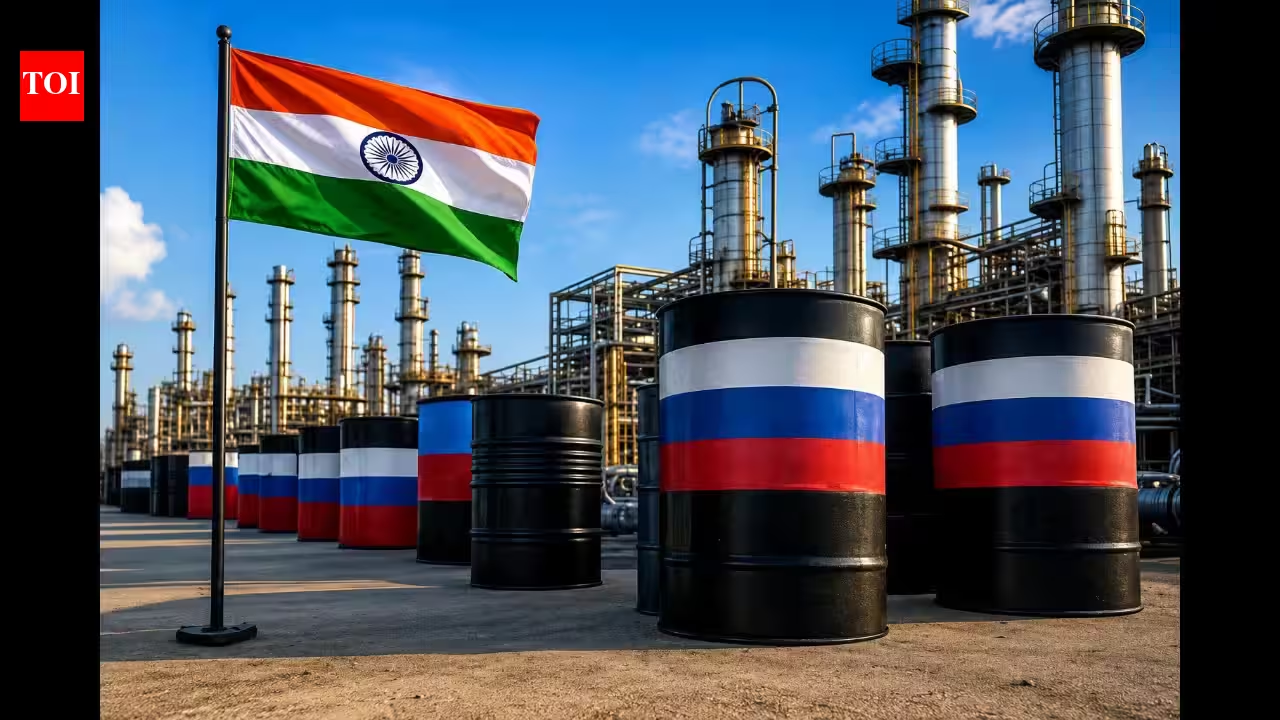
India can withstand pressure over Russian oil tariffsIndia's economy is unlikely to face a major shock even if the US increases pressure on countries buying Russian oil, according to Anindya Banerjee, head of commodity and currency research at Kotak Securities. He said the country can manage a shift away from Russian crude without putting significant pressure on inflation, fiscal deficits or overall economic stability.Speaking to ANI on Saturday, Banerjee said the benefit India currently gets from buying Russian crude is much smaller than it was when the Ukraine conflict began. This means replacing Russian supplies with oil from other countries would not have a major impact on India's economy.His comments came after the US Senate passed a bill on Friday with an 86-11 vote that could allow tariffs of up to 100% on countries such as India and China for buying Russian crude oil and natural gas.Russian oil discount no longer as bigWhen the Ukraine conflict began in 2022, Russian crude was being sold at a discount of $15 to $20 per barrel. But that gap has now narrowed sharply to around $2 to $3 per barrel as demand for oil outside the Gulf has increased."See, we have to understand the context... Russian crude at a current discount rate, the benefit is around $2 to $3 billion a year and not a day," Banerjee said.He pointed to India's annual oil import bill of nearly $150 billion, saying the current savings from Russian crude are relatively small compared with the country's overall import spending.For Banerjee, the bigger concern is not where India buys its oil from, but how much oil costs globally."Every $10 jump in the average price of oil for India, the imported basket, roughly translates into a $15 billion jump in the annual oil import bill," he said.A prolonged rise in crude prices above $100 per barrel would therefore pose a much bigger risk to India's economy than losing the discount available on Russian oil."I don't think the Russian crude or switching away from Russia to other sources... is going to have a big impact on our macroeconomic situation now."India building alternatives to dollar paymentsBanerjee also raised concerns about the wider impact of US-led sanctions. He said that by using the global financial system as a tool against other countries, America could eventually hurt its own interests."So it's kind of America is actually hurting its own interest over the long term," he remarked.India has already been building alternative ways to settle international trade. These include the Reserve Bank of India's efforts to promote rupee trade through Vostro accounts, bilateral trade settlement using UAE dirhams and possible links between Central Bank Digital Currency (CBDC) systems among BRICS countries.According to Banerjee, these efforts could become increasingly important as countries look for ways to avoid settlement-related problems.Supply of oil unlikely to be a problemThe possibility of US action against "shadow fleets" could create concerns around the movement of Russian oil. However, Banerjee said Indian refiners should be able to manage such challenges.He said oil movement depends on three key parts: banks, insurers and tankers, and that tankers are the easiest part to arrange through non-Western sources."Logistics have been able to handle it... no new kind of risk has emerged, which was not there over the last four years," he said.India has also spread its crude purchases across more than 40 countries, including Venezuela, African nations and the United States. The country's energy sourcing has been backed by the energy diplomacy of Prime Minister Narendra Modi and external affairs minister S Jaishankar.India also has 10 to 12 days of government strategic reserves and another 70 to 75 days of commercial stocks. This puts its total import cover close to the G7 benchmark of 90 days."As far as India is concerned, supply is not going to be an issue," Banerjee stated.Meanwhile, Banerjee said that the current pressure over Russian oil and the ongoing India-US trade negotiations should not rule out a mutually workable tariff arrangement.He also warned that using payment systems as a tool of pressure could speed up the shift away from the dollar globally over the next six to seven years.Despite the current tensions, he expects the tariff issue to move towards a resolution."I think the tariff deal will happen on its own course... It's in the best interest of both countries to come up with a workable tariff policy," he concluded.
Why Trump's 100% tariff over Russian oil may not be India’s economic headache
India's economy is unlikely to face a major shock even if the US increases pressure on countries buying Russian oil, according to Anindya Banerjee, head of commodity and currency research at Kotak Securities. He said the country can manage a shift away from Russian crude without putting significant pressure on inflation, fiscal deficits or overall economic stability.
730 words~3 min read