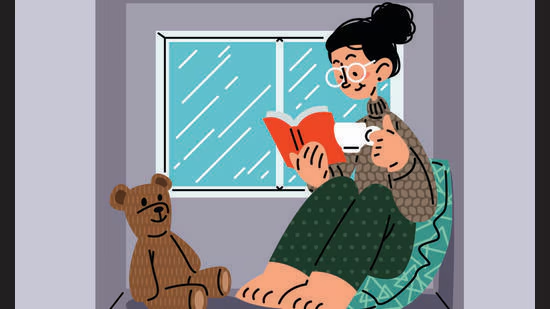
The monsoons have come and made the dust settle. I’m legs stretched out on the window seat of my childhood bedroom in Kolkata with a Moleskine journal and colour pens, looking out at this raingreen rectangle. Brishti is the Bangla word for rain – is it not the sweetest word? It has the sound of water falling through air and leaves, a syncopated funk of liquid sheets. Through this curtain of rain and white noise, Kolkata of the monsoons is a gauzy fable-like thing. When the rain stops for short spells, the gauze lifts and you have a window like this.The trees I’m looking out at are full of parrots. Thick with parrots. So many parrots that I cannot tell them apart from leaves until they flutter or fly out or flash a red beak. In the journal, I draw many green parrots with red beaks and hide them in the leaves. A few fly out. A level below the canopy of parrots lies a lacey fringe of krishnachura trees with bright red flowers the colour of curved parrotbeaks. My father used to stand at this window, hands held behind his back, gaze focused on the green for a precise length of time, twice a day. “You must keep a few minutes to look at trees. It’s good for the eyes and good for the mind”. I look at the trees now and hear those words, one of his three most frequent reminders: drink water, walk, look at trees. For a doctor, he had always been remarkably spare with medications, both in his prescriptions and in his long and well-lived life. That large life and larger love still live in the rooms of this house, in vibrations and dust and the staticsong of rain. Granular. Uncontained. Untimestrapped.This thing we call DeathI sent my Soul through the Invisible, Some letter of that After-life to spell And after many days my Soul return’d And said, “Behold, Myself am Heav’n and Hell”Verse 71 of the Rubaiyyat of Omar Khayyam. Every time I’m here, my mother hands me a precious piece of inheritance that she’s carefully set aside: a set of tablemats embroidered by my great-aunt, a handheld mirror she had when she was young, a carved wooden box that belonged to her mother, or her old copy of Zelda Fitzgerald’s Save Me The Waltz with her maiden name cursive on the first page. This time too it is a book: a red clothbound first edition of the Rubaiyyat of Omar Khayyam, dated 1859, with yellowed bookwormed pages but a sturdy spine, carefully wrapped in linen and still holding its shape.I’ve always been interested in this thing we call Death. I remember being aware of its inevitability even as a child, of having a private, engaged curiosity about “the after”. Afterlife always seemed to me more a question than a word, a question in and of itself; unlike a When or What or How, Afterlife was a question that did not have an answer, would never have an answer, and so was complete, replete, in its unknowing. But we, burdened with language, coded with a sense of discomfort – perhaps even fear – when things were not named, labelled and nouned, had given that unknowing an identity. The Afterlife. An ever-expanding question. A word for the very final frontier.The first time I saw a dead body up close was when I was about six or seven, of a much-loved family member, a man I still remember for his kindness and warmth. After he died, his body was brought back home from the hospital, laid on his bed dressed all in white, and prepared for visitors. White cotton clothing, white chrysanthemums, white tuberose garlands, a white paisley of sandalwood paste on his forehead, wisps of white smoke rising out of incense sticks. But for me, the whitest thing in that room was two balls of cottonwool that were tucked in his nostrils, two startling white orbs that signalled a very final change of state, on a face I’d seen animated in humour and conversation only weeks ago. The white of those cottonwool balls obliterated all other whites in the room. It told me that he was now without breath, that he no longer needed to breathe.Between the living and the deadIn 2015, when I started writing my novel, And I Am The Arrow, this curiosity about the nature of death threaded its way in, as did the monsoons. I had the image of a grandmother at the end of her life in an old mansion in Kolkata, in the middle of the kaalboishakhi storms that precede the rains. And of her granddaughter’s journey into her past – a secret past that spanned continents, and that comes to light through a bunch of old letters after the grandmother’s death. The novel was to have a fairly simple structure, be narrated by Mishu, the granddaughter, who takes a journey both outward as she retraces her grandmother’s footsteps across three continents, and inward as she takes a parallel journey into her own self and life.I wrote the first chapter. In which Mishu flits back and forth between the past and present: from her complicated relationship with her grandmother Niyoti, demanding matriarch of the family, to a Niyoti who’s old, a shrunken shell of herself, dying. But Niyoti refused to die. Even as I plotted her demise and tweaked her last words, she walked into my living room and made herself comfortable; she showed no signs of dying, nor any intention of sitting quietly and letting Mishu narrate her story. This was clearly not going to be a single-narrator project. As for all my plans of exploring the nature of death: “Explore away, dear”, said Niyoti, “but it’s not going to be through me.” My story had a grandmother alright, but she made it quite clear that I did not know who I was dealing with.Which was true enough: my own paternal grandmother had died many years before I was born, and my maternal grandmother, who lived in a different state hundreds of miles away, had passed away in my early teens before we could have enough time or proximity.And that’s exactly what drew me towards the architecture of this relationship. I needed the lack of context, this absence of reference. It gave me the freedom to write as I wished, to have the characters act and speak as they wished. I wanted to meet them as strangers and get to know them better. Not just the grandmother and granddaughter, but the other characters – the mother, the housekeeper, who were like no one I knew, and whom I got to know slowly, understand intimately, over the next ten years that it took to write And I Am The Arrow. Each character revealed themself to me in surprising ways, took decisions I had not decided to take, turned the story down paths I had not foreseen.The first such turn came when the dead spoke up (and the grandmother was right: it wasn’t going to be her). A ghost strolled in, fully formed, tapped me on the shoulder, and started to talk. The ghost, of a man cut in two on a train track, was called Opor/Neech – now genderless and formless, but embodied, vitally alive, and with a lot to say. So much to say, in fact, that it freaked me out and made me shove the story away in a drawer – it gave me the first glimpse of what this novel wanted to be, the questions it wanted to ask, the spaces it wanted to explore, the many-armed and many-legged shape it wanted to take. And I was not ready. Not nearly ready for such an undertaking. Had no idea how to go about executing this Thing that I was beginning to see the edges of. So, with the Thing safely shut away out of sight, I went back to writing short stories between my day job in advertising.The mind is strange soil. Monsooned and tended by forces beyond you. Seeds thrown in will grow whether you attend to them or not. I returned to Niyoti and Opor/Neech almost a year later, and found that I somehow knew them better, could hear their voices more clearly, seemingly without having thought about them at all. I spent the next decade writing their story – Niyoti the grandmother, Mishu the daughter, Ira the mother, Bani the servant and Opor/Neech the ghost – and between the living and the dead, got the chance to ask the questions I’d always wanted to throw out into the wind like seeds into a fertile void. To look at the nature of Death. Not Death as a final act or an ending, but as the other side of Life. Not Death as grief, but grief as love. Not Death as that which gives Life its length, but that which gives Life its language: because all our attempts to capture the experience of life, this urgent and visceral need to find a language for it – through literature, art, music – is because we know it must end, that we must end, and that we must love better in order to die better. So, I wanted to ask if Death might well also be Life.I don’t want an answer. Simply a window, looking out at a lush unknowing where leaves could be parrots.With them the Seed of Wisdom did I sow, And with my own hand labour’d it To grow: And this was all the Harvest that I reap’d— “I came like Water, and like Wind I go.”— Verse 31, Rubaiyyat of Omar Khayyam
‘The mind is a strange soil’: On Omar Khayyam’s Rubaiyyat, the rains, and writing death
Author Pia Ghosh-Roy’s new novel, ‘I Am the Arrow,’ asks if ‘Death might well also be Life.’
1,619 words~7 min read