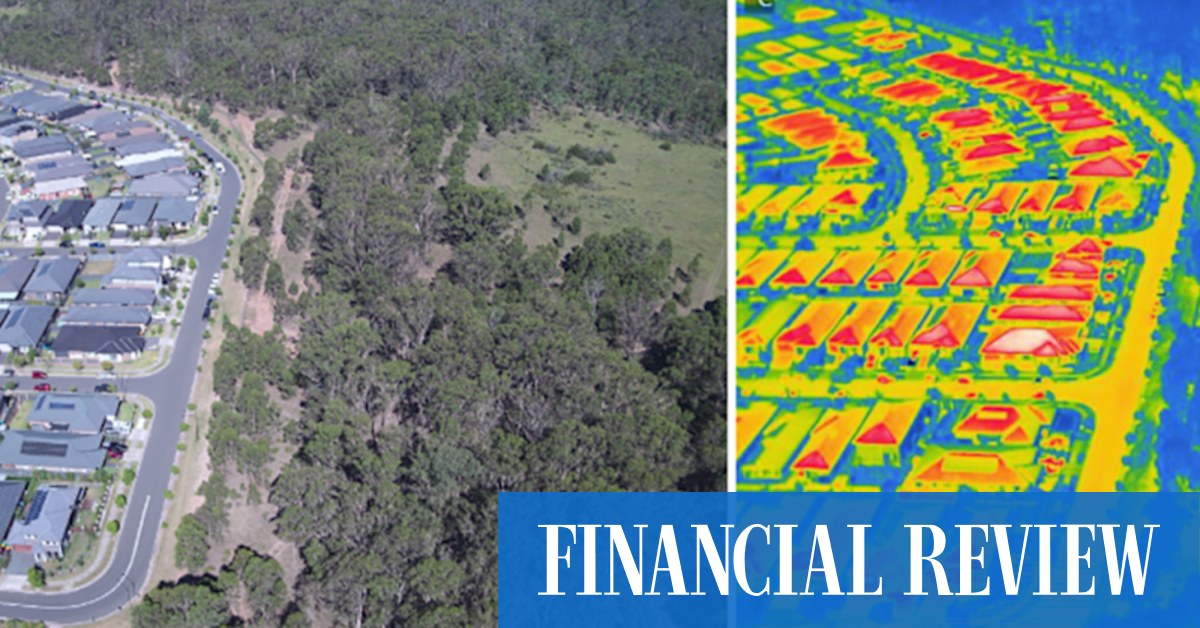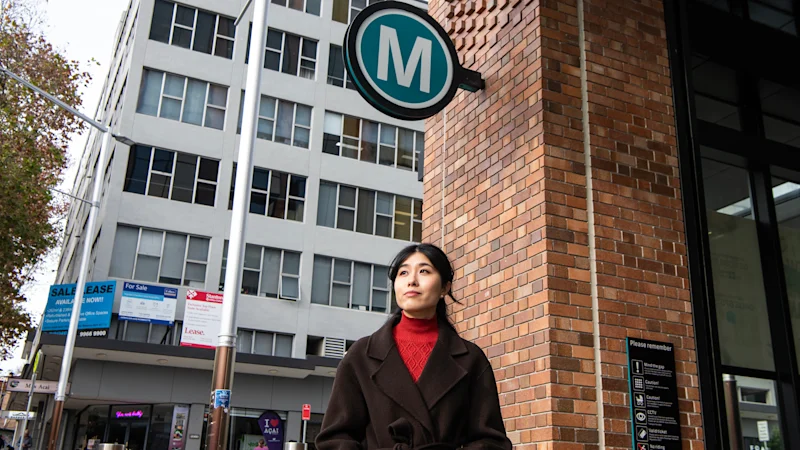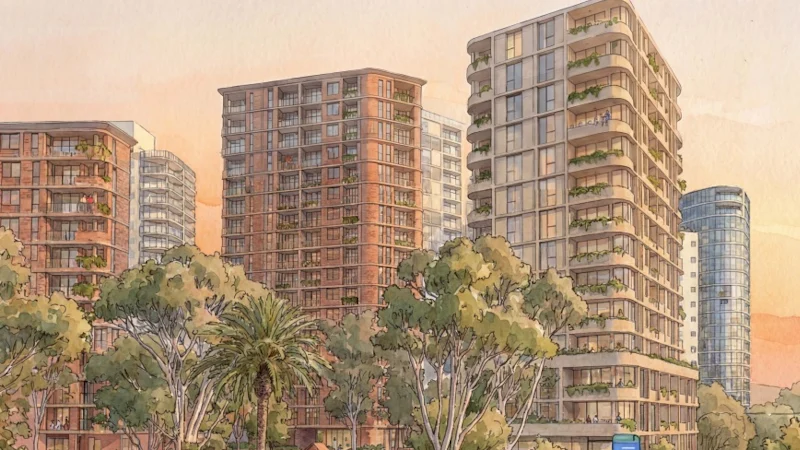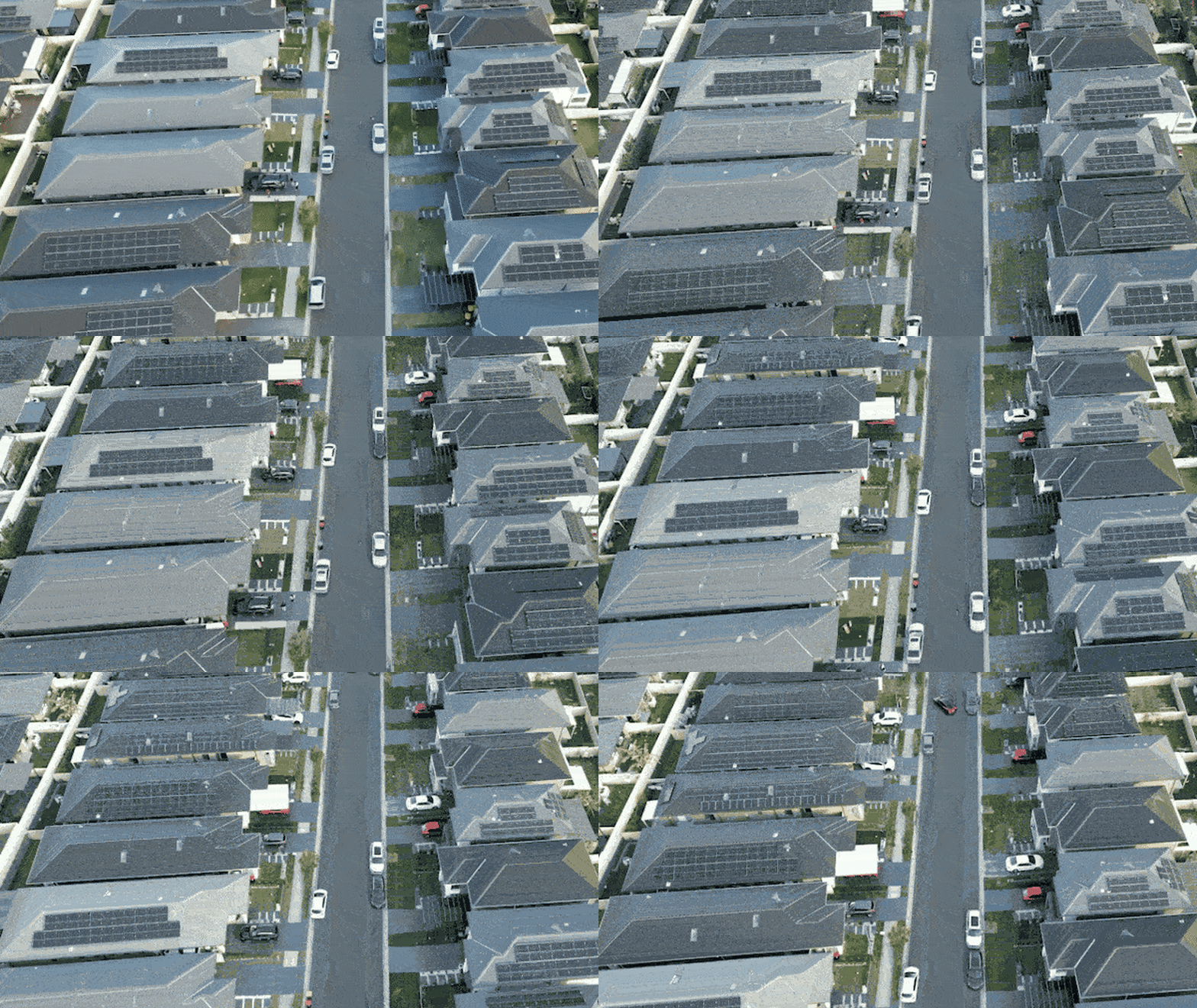
If you set out to design a suburb that is least suited to the climate conditions of the 21st century, you might end up with something a bit like the western Sydney neighbourhood of Marsden Park.During several summer heatwaves, western Sydney has had the dubious honour of being the hottest place on earth, a problem that is expected to intensify because of baked-in climate change even if emissions fall tomorrow.Emissions reduction remains enormously important because every fraction of a degree in avoiding global warming matters, but the parallel task of climate adaptation is growing ever more pressing and NSW is falling behind.Yet almost every design choice in Marsden Park, a formerly rural suburb developed since 2013, seems calculated to make the problem of extreme heat worse – and the same mistakes in urban planning have been replicated statewide.Row upon row of giant houses are built almost to the boundary with dark roofs that absorb sunlight and make the house and suburb hotter, in what is known as the urban heat islands effect. The roads are painted an intense black, thanks to a treatment to restore asphalt that Blacktown Council says is cheaper than lighter-coloured alternatives. Even the driveways are black.Without effective eaves to protect windows from the harsh sun, the houses are heat boxes, reliant on air-conditioning that spews hot air at the neighbouring house just centimetres away. The bright spot is that there is plenty of roof space for solar panels.Trees and greenery cool an area down, but the backyards are tiny, and the footpaths only have room for small trees that will never provide much shade. The suburb, which had a population of 15,000 at the 2021 census and is growing rapidly, is also in a low-lying part of the Eastern Creek catchment at high risk of flooding.Sanaa Shah, who lives a few kilometres away in The Ponds, says Marsden Park is an example of what happens when governments focus on the housing crisis without also tackling the climate crisis – the cure to one problem can make the other worse.“Marsden Park does not have a permanent library, it does not have a pool, it struggled to get a public school for a long time – but it is getting a massive AI data centre,” says Shah, a community campaigner for climate adaptation advocacy group Sweltering Cities. “It’s a given that we have a housing crisis right now, but it’s unfair for our communities to be placed in housing developments in suburbs that just aren’t built to withstand the climate future that we’ll be living in.”The world is set to sail past the Paris Agreement goal of limiting global warming to 1.5 degrees above pre-industrial levels within a few years, and 2 degrees also looks increasingly unlikely.“We’ve got to deal with the problems that have been created by the fact that the climate has changed and is changing,” says NSW Planning Minister Paul Scully in a lengthy interview with the Herald. “And even if we were to hit net zero tomorrow, the science says that there will continue to be changes in the environment.”At 2 degrees of global warming, NSW Treasury estimates that economic costs from disasters triggered by extreme weather events will jump from an annual average of $5.1 billion in 2020-21 to $15.8 billion by 2060-61, while the NSW Net Zero Commission says the state’s economy will be $700 billion smaller in 2070.The NSW government has been taking the problem seriously, updating planning controls for new builds despite pushback from developers and some councils, and producing substantive reports on multi-hazard disaster mitigation that will eventually cover every region of the state.Sanaa Shah, a community campaigner for climate adaptation advocacy group Sweltering Cities, says Marsden Park is a good example of what happens when the government’s focus is on the housing crisis without also tackling the climate crisis.Janie BarrettDark roofs, minimal trees, black roads and driveways are all features of this Marsden Park development.Janie BarrettYet so far, the funding piece has been largely missing, with the government yet to take up the Reconstruction Authority’s proposal for a NSW mitigation fund to provide a consistent source of funding for risk reduction. Minister for Recovery Janelle Saffin says the government is still considering the proposal for a fund, while investing in regional disaster mitigation plans.Light roofsSuccessive state governments have tried to grapple with the flaws in the planning system, making rules to improve the resilience of housing to climate perils from heat to bushfires and floods. The greenfield developments occurring today are better than Marsden Park – but far from perfect.The challenge is that the climate crisis is occurring at the same time as the housing crisis, amplifying the voices of developers. It can be hard to get even the simple things done. The light-roofs saga is emblematic of this.Changing roofs to a lighter, more reflective colour seems like an obvious fix as NSW prepares for a hotter climate. Former planning minister Rob Stokes certainly thought so.In November 2021, Stokes mandated that new builds had to have lighter, reflective roofs to save the home owner money on cooling costs, and the public purse from underwriting additional electricity capacity, and to reduce the heat island effect.“I was gobsmacked by the reaction,” says Stokes. “It was explained to me by developers that there was a consumer preference for dark roofs, that dark roofs were somehow equated with quality.”When fellow Liberal MP Anthony Roberts became planning minister in a reshuffle, he dropped the requirement. Reflecting on it now, Roberts says the idea was right, but the approach was wrong, “especially at a time when housing affordability and supply were already under pressure”.Former planning minister Rob Stokes, who has now left politics, said “sometimes you’ve got to put out a big bold plan and get knocked back on it because if you step in the right direction, history will catch up with it eventually”.Dominic LorrimerThe better way to deal with it, he says, was through BASIX, the NSW standard that governs energy and water efficiency requirements for new builds, which he updated in April 2022 to introduce consideration of roof colour.The Minns Labor government also strengthened BASIX in October 2023, and it now has the practical effect of requiring lighter roofs in most circumstances. Scully says there was “fierce resistance”, including from the other states.“In most circumstances, and most climate zones, you can’t get a BASIX certificate to be able to do your build with a dark roof right now,” Scully says. “If you wanted to do a dark roof, and that is a choice for some people, you have to do a whole series of other mitigation effects, so it becomes more expensive.”Scully says dark roofs still work in some climate zones, such as the Northern Tablelands and the alpine regions. In the large rezonings in western Sydney, the government has set a maximum solar index, which measures the solar absorption rate rather than the colour itself.Planning Minister Paul Scully (left) with Premier Chris Minns.Dion GeorgopoulosStokes, who has since left politics, feels vindicated. “Sometimes you’ve got to put out a big, bold plan and get knocked back on it because if you step in the right direction, history will catch up with it eventually,” he says.Scully says natural disaster resilience is now an object of the Planning Act, making it an unavoidable consideration from the beginning of a project. The government has been pushing a housing development policy that prioritises density around transport hubs, and none of the selected locations are in a high-risk flood zone, he says.Even the designs in the NSW government’s Housing Pattern Book – a project to provide high-quality housing in the “missing middle” suburbs near railway stations and shopping centres – incorporate climate concerns. Scully says the patterns are all done to a 7-star Home Energy Rating (formerly NatHERS), which indicates a high level of energy efficiency.The NSW government is spending more than $60 million through the Greening our City program to help councils in Greater Sydney, the Illawarra-Shoalhaven and the Hunter-Central Coast plant trees. The government aims to boost tree canopy from 21.9 per cent now to 40 per cent within 10 years, though experts say many suburbs in western Sydney will struggle to get past single digits because there are no trees on private properties and not enough room for large street trees.Professor Sebastian Pfautsch, an expert in urban heat at Western Sydney University, took the Herald on a tour to highlight both good and bad examples of urban development. The planning flaws on display in Marsden Park are repeated in multiple suburbs and also regional cities such as Bathurst.Yet, there are also examples of good urban design, such as Norwest on the edge of Baulkham Hills. In the 1980s, the urban planners used a natural creek to create a series of ponds that cool the area and provide a hub for recreation. The main road has a double layer of trees planted down the median strip, providing shade and reducing the urban heat island effect, though some were removed for the construction of the Metro station.In Fairwater, near Blacktown, which opened in 2016, there is plenty of green space, waterways and trees. The houses not only have light roofs, but they also have geothermal climate control – where a pipe goes into the ground and back into the house to keep a constant temperature inside the home, making air-conditioning unnecessary.Professor Sebastian Pfautsch from Western Sydney University walks down the middle of the trees on the median strip on Norwest Boulevard in Norwest, an example of good urban design that can help to combat climate change and heat stress in western Sydney.Janie BarrettPfautsch says new developments now might have greater energy efficiency, thanks to government reforms, but they are still making fundamental mistakes in building huge homes on small lots, with little green space.“It seems that we have forgotten how we can actually build more climate-resilient urban spaces,” Pfautsch says. “And we are not getting these kind of outcomes any more for the community.“Developers have really worked out the plan because now we have a housing crisis, now everyone wants more homes, they don’t need to change that model.”Stokes laments that Australians tend to only consider the transaction costs rather than the recurring costs, such as having high heating bills because of insufficient insulation. This is compounded by the fact that the person developing the property is usually not responsible for the future recurring costs.Stokes recalls as planning minister speaking to a large national developer and sharing a business case that demonstrated how the benefits of a resilient building outweighed the costs.“He just smiled and said to me, ‘Yes, but those benefits go to the person who bought it, not to the person who sold it and, given we’re the ones selling it, we don’t get those benefits,’ ” Stokes says. “When private interest doesn’t appropriately meet long-term public benefit, that’s when the state has to step in.”With an impending El Nino summer this year, bushfires are looming as a threat once again. From a planning point of view, the building codes for bushfires are already pretty robust, although Stokes warns incremental steps can undermine that work.“An architect friend of mine developed a house in the Shoalhaven that met all the bushfire standards, but then the owner tacked on a verandah that they didn’t need to get council consent [for] because it was under a complying development certificate,” Stokes says. “The verandah caught fire and burnt the house down.”Before the Black Summer fires, locals in the Eurobodalla area were arguing for development in spots that became casualties in the fires.Kate GeraghtyThe housing crisis makes bushfire-prone areas tempting for development, as well as floodplains. Before the 2019-’20 Black Summer fires, Stokes came under “huge pressure” from Eurobodalla Shire Council to approve its rural land rezonings against the advice of the Rural Fire Service.He remembers a local politician “screaming” at him at a public meeting: “You’re blocking housing supply!”“But if we had let that go ahead, these were the very areas that the bushfires raced through,” Stokes says.FloodsThe tension between the need to provide more housing and climate change is particularly clear when it comes to flood planning. Everywhere you turn, there’s a push to open up more land for development.Historically, we have built on flood-plains because the land was flat with rich soil and the rivers provided drinking water and transport. Early colonists were often told by the Indigenous people about the risks, but chose to ignore them, records suggest.Sam Magnusson, 55, lives on a property by the river in the Richmond Lowlands. Flooding is a given, but it’s becoming more intense. Since 2020, Magnusson has experienced six big floods.Magnusson describes staying up all night watching the data – how much rain in the catchment, how much locally, the status of Warragamba Dam – and factoring in whether the soil is already sodden and the fact that sometimes the information from the authorities is wrong or out of date. She is cautious and will usually evacuate her 14 horses, four dogs, three cats and three chickens to higher ground early, but will often return home to sleep.Since 2020, Sam Magnusson has experienced six big floods.Steven SiewertShe knows it is only a matter of time until her house is inundated.Steven SiewertWhat Magnusson has experienced so far has been slow-moving water moving from inland because of a breach in the riverbank elsewhere. In every big flood so far, Magnusson has been able to hop in her tinny and steer a course over the top of her neighbour’s fences to have dinner in the pub in Richmond. But she fears for the day when the riverbank breaches near her home, and floods it. She has “absolutely no doubt” that it will happen, given climate change and the fact that two of the floods were only half a metre below her riverbank.“Once that riverbank breaches, that is an entirely different flood because that’s got velocity and force,” she says. “It’s scary, but we’d all be out, we wouldn’t be here, and the horses and all the animals would be out, so then it’s a property damage question.”So far, water has only lapped at the back steps of her old cottage. Magnusson knows it’s only a matter of time before it goes under, but she is no longer insured since her premium jumped from $1400 to $14,000 in a single year almost a decade ago.The Hawkesbury-Nepean flood-plain is particularly dangerous because it is populous, hard to evacuate and the geography means floods rise quickly and drain slowly. In what is called the “bathtub effect”, the Hawkesbury-Nepean Valley has five “taps”, or tributaries, flowing in, and only one “drain”, constricted by steep sandstone gorges and river bends to let the water out.But it would be virtually impossible to declare the entire flood-plain off limits – by the measure of “probable maximum flood” it spans about 500 square kilometres. In this scenario, which the State Emergency Services rates at a 0.1 per cent chance in an 80-year lifetime, 234,000 people who live and work in western Sydney would need to evacuate.The long-established standard for planning across NSW has been to allow building above an annual exceedance probability (AEP) of 1 per cent plus an additional safety buffer. This is commonly referred to as the one-in-100-year flood, but actually means the risk in any given year is 1 per cent. Some flood experts believe planning controls should be reduced to a 0.2 per cent AEP – or a one-in-500-year chance.Associate Professor Fiona Johnson, an engineering expert and director of the UNSW Water Research Centre, says it should be tailored to the catchment and updated to reflect the changed conditions. “I have no problem with 1 per cent being the threshold, but you shouldn’t be using today’s 1 per cent, you should be using a climate change 1 per cent,” she says.Short-duration extreme rainfalls will increase under climate change because a hotter atmosphere can hold more water in the air as humidity, which translates into more intense rain, Johnson explains. The Minns government came to power in March 2023 promising to end construction on “dangerous flood-plains”. Scully believes he has done just that.In April, he approved the rezoning of the Riverstone Town Centre, unlocking up to 2850 new homes and 1200 jobs. The buffer for climate change was three metres, taking the flood planning level to about the one-in-500-year mark.Across the city, the government has pushed ahead with major housing developments, centred on transport, none of which is located in a high-risk flood zone.But in other areas, the government has partially back-tracked. In 2023, Scully ruled out the original rezonings that planned for 6200 homes at Marsden Park North and 4500 homes at West Schofields, on flood prone land near the Hawkesbury-Nepean River. But earlier this year he decided Marsden Park North would instead get 960 new homes and West Schofields would have 2900 with “strict conditions”. The decision sparked an outcry from former emergency service commissioners, not just because of the flood risk itself but because of the capacity of the roads in the event of an evacuation.Scully says the development has been reduced to a “reasonable safe number”, and the worst of the flood-affected land could be used for employment and recreation or nature restoration rather than homes. “Just because land is flood affected doesn’t mean that it can’t be used for no purpose, it’s just making sure that’s the right purpose,” Scully says.The Richmond and Windsor areas were settled a long time ago, but their fate is linked to these new developments. Eastern Creek and South Creek flow through new and future suburbs such as Marsden Park, Marsden Park North and West Schofields before joining the Hawkesbury at Windsor.“They bring in [millions] of tonnes of fill, put concrete down, houses right next to each other and there’s no vegetation, and so there’s nowhere for that water to go, it just rushes down South Creek,” Magnusson says. “We have definitely noticed, even with the smaller floods, that the velocity and the amount of water coming down South Creek is much greater than it was.”Johnson, from UNSW, explains that, in an urban catchment, water runs along hard surfaces into stormwater drains rather than being absorbed into the ground. This increases the chances of flash flooding locally, as well as the volume of water being sent downstream.These master-planned new developments are a state-run process, but usually local councils are responsible for managing flood risk and preparing flood maps. They must follow the process in the Flood Risk Management Manual 2023, but in theory councils can determine whether the one-in-100-year or one-in-500-year level is most appropriate.In practice, councils that are cautious about floods may find that the courts will side with developers. In April, the NSW Land and Environment Court upheld a developer’s appeal against Clarence Valley Council refusing a proposed major residential subdivision in Yamba. The court found flood and stormwater risks could be managed.Updates to state planning controls, including a 2023 flood evacuation modelling tool and a 2026 planning circular, aim to hold councils to a higher standard when assessing the risk of rare floods and the ability to evacuate.The biggest change will come in the Climate Change and Natural Hazards State Environmental Planning Policy (SEPP). The policy as drafted would create more consistency in flood planning controls across the state, introduce the notion of “tolerable risk” to guide decision-making, and force councils to consider forward-looking climate change models rather than relying on historical flood mapping. These changes have had a mixed response. Penrith City Council is eager to use the upcoming Western Sydney Airport to grow its region, but complains that the state government’s multiple updates to flood planning policies are creating uncertainty that is constraining development.And on the other side, Insurance Council chief executive Andrew Hall says bluntly that “we are still building on flood-plains” despite national cabinet agreeing in 2022 this should end. As insurers price in the risk, insurance coverage is retreating in areas precisely where flooding is most likely to occur, leaving home owners trapped with high mortgages in uninsurable properties.“In places like western Sydney, you particularly get migrant families, who have got no idea about the history of the region, buying homes for a million dollars in areas that we know will go under a metre of water,” Hall says. “Western Sydney has the greatest flood-exposed population in the southern hemisphere … if a known event like the flood of 1867 repeats, there will be 5000-plus people made homeless in Sydney.”Hall says the banks of the river at Richmond and Windsor can be 19 metres higher during a flood, and raising Warragamba Dam would not fix it, just as raising Wivenhoe Dam did not stop floods in Brisbane.Magnusson wants Warragamba Dam to release water ahead of time, with the desalination plant as the back-up plan for water security.The Reconstruction Authority’s Hawkesbury-Nepean Disaster Adaptation Plan is nearing completion, and will guide future development on Sydney’s flood-plain. The agency is also partway through a multi-hazard disaster adaptation plan for the Northern Rivers, and has started preparing for one for the Central West.But this work is behind schedule – in February 2024, the goal was that councils would do the work and all areas in the state would have their own disaster adaptation plan within five years.Retrofitting“Whatever we do, we’re not starting with a blank piece of paper,” Scully says. “In terms of NSW, we start with 200-odd years of history of decision-making, for good and for bad, so we’ve got to accept there’s that part of it, as well as what we do in the future.”That means climate adaptation is not just about planning, it’s about retrofitting. In extreme cases, that might mean relocating communities out of harm’s way – but attempts to do that on flood-prone lands in the Northern Rivers have been beset by problems.After the 2022 floods, the Reconstruction Authority was established by the former government, and allocated $880 million to deliver 1345 buybacks – later revised to 1000 – as well as flood resilience improvements under the Resilient Homes program. As of the end of June, 826 buybacks had been completed.The related $100 million Resilient Lands program was also meant to fast-track flood-safe land for residential development, providing 4382 homes or lots. So far, it is yet to deliver any land for housing.A scathing report by the NSW auditor-general in May this year branded both programs as not effectively planned, which led to significant delays and increased the risk of failure. Scully acknowledges it wasn’t as quick as it could have been, but says things have improved immensely with Saffin, the recovery minister, at the helm.UTS Professor Elizabeth Mossop has experience in urban resilience from her time in New Orleans after Hurricane Katrina and now as academic director of Living Lab Northern Rivers, an academic think tank focused on post-disaster recovery.Many people say that Lismore, which has been devastated by floods multiple times, shouldn’t be there. “But they also say that New Orleans shouldn’t be there and, in fact, if you look at the maps, really New York shouldn’t be there either,” Mossop says. “There are enormous numbers of cities that are located in places for strategic reasons … Lismore is a location that has always flooded, but it’s also a location where lots of people live.”The problem with buybacks, she says, is “we keep treating it as a real estate transaction” rather than about making communities whole. The focus should be finding land for people to move to, rather than how much the government pays for the flood-prone land, she says.Tweed Shire Mayor Chris Cherry says after several big floods “we need to just face up to that and accept that we need to adapt”.Paul HarrisBuilding back better: Bridge works at Byrrill Creek to make it more flood resilient. In the foreground are the footings from the old bridge.Paul HarrisFurther north in Tweed Shire, Mayor Chris Cherry says the community was devastated by the 2017 floods, which were meant to be a one-in-100-year event, but they got through it and rebuilt. Then the flooding happened again in 2022.“It really forced the realisation on our community that this was not going to be an isolated experience, and we need to just face up to that and accept that we need to adapt,” Cherry says.Under the federal and state “build back better” policies, the council has rebuilt bridges to withstand floods. It has also moved its visitor information centre and council works depot to higher ground, and organised an industrial land swap for about eight of its largest businesses to move along with the depot.The Insurance Council has been calling for the federal and state governments on the east coast to provide $30.15 billion over 10 years for a flood defence fund to fund infrastructure such as levees and dams in high-density areas, property-level solutions like house raising in lower-density areas, and managed relocation and buy-backs in extreme-risk areas.Hall applauds the idea of the federal Disaster Ready Fund, which has $200 million a year to spend on climate adaptation projects across the country, but says it has not fulfilled its promise. It could have funded hard infrastructure to reduce the risk to assets – such as a flood levee in Taree, which the town’s council scoped out, but did not build before the terrible flood in 2025, Hall says. Instead, the fund has mostly paid for disaster readiness such as teaching people about bushfire preparation and building cyclone shelters.Residents clear up the debris after flooding in Taree last year.Kate GeraghtyCommittee for Sydney chief executive Eamon Waterford says Sydney and Australia more generally are dealing with two intergenerational challenges at the same time. “One is the housing affordability crisis,” Waterford says. “The other is the climate crisis.“We should be treating them with the same level of existentialism.”Get to the heart of what’s happening with climate change and the environment. Sign up for our fortnightly Environment newsletter.
Dark roofs, no trees and black roads: The Sydney suburbs designed to get even hotter
New developments in western Sydney show what happens when governments focus on the housing crisis without also tackling the climate crisis – the cure to one problem can make the other worse.
4,328 words~20 min read