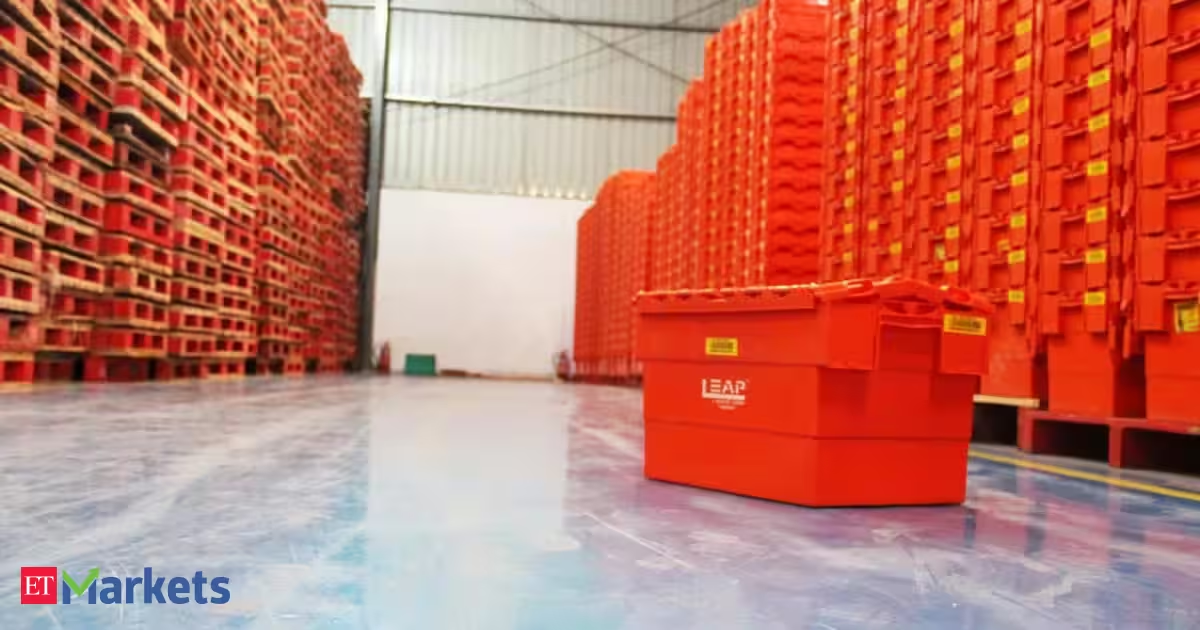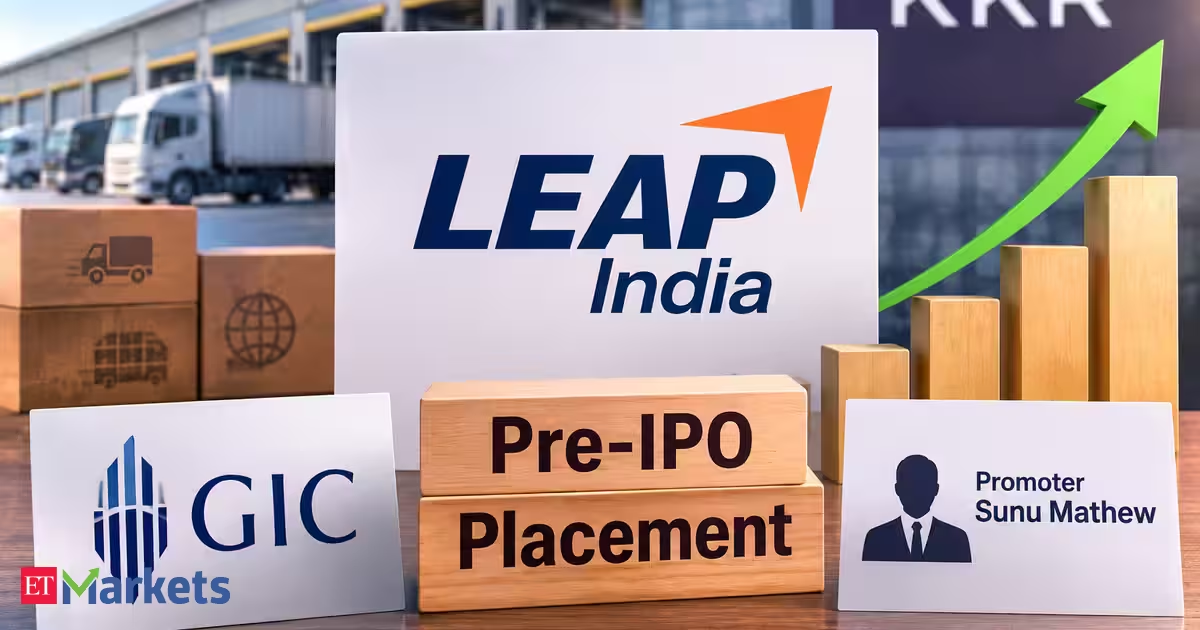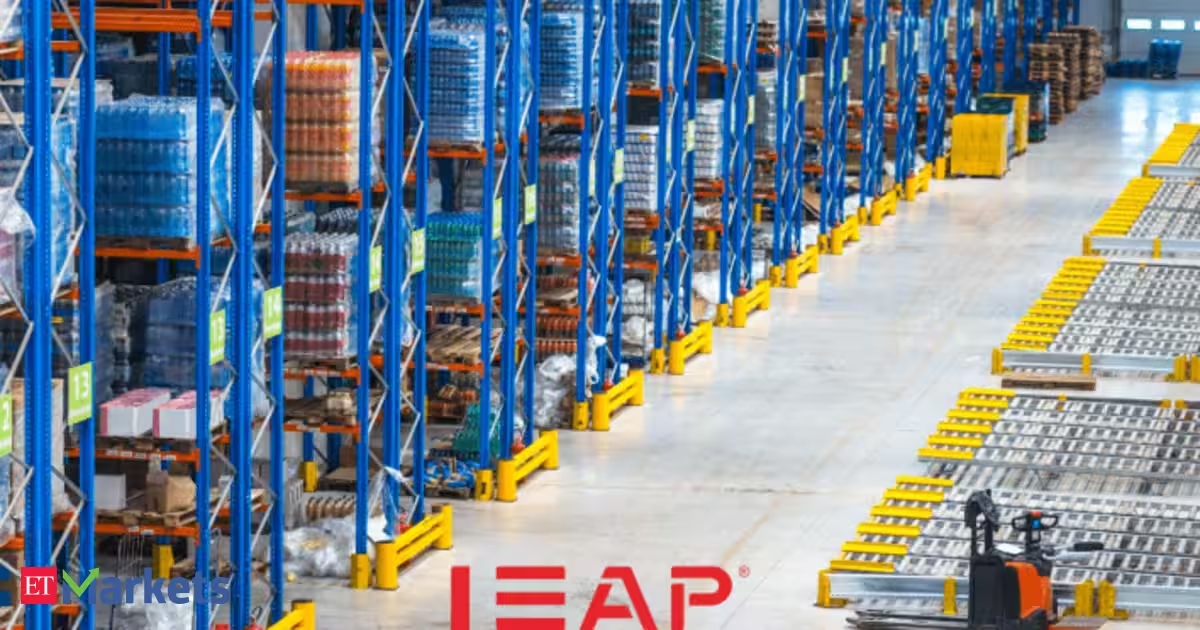
On-demand asset-pooling provider LEAP India, backed by private equity giant KKR, has come to the IPO market with a ₹2,480-crore IPO at a price band of ₹151-159 per share. The public issue opened on August 7 and closes August 11.Thirteen-year-old LEAP India owns pallets (flat wooden platforms used to move heavy loads), reusable containers and material-handling equipment, and rents them to companies. The physical product is simple, but the network around it is not. LEAP has built scale through acquisitions, particularly Skan Marine and CHEP India, high utilisation, technology-led asset tracking and a dominant position (90 per cent market share) in India’s organised pallet-pooling market. The January 2025 acquisition of CHEP India, then its largest organised competitor, strengthened this position further.After accounting for the fresh issue and proposed debt repayment, the enterprise value works out to about ₹7,700-7,800 crore, or around 20-20.5 times FY26 EBITDA. This is demanding for a company whose recent growth is substantially acquisition-led, FY26 return on equity was only 6.48 per cent and business requires continuous capital expenditure. LEAP is available for 112x trailing P/E and about nearly 7x price to book.The IPO is heavily tilted towards promoter monetisation, with a ₹2,000-crore OFS against a fresh issue of only ₹480 crore. KKR-controlled Vertical Holdings II accounts for nearly the entire OFS. The gross OFS proceeds are equivalent to about 93 per cent of KKR entities’ estimated aggregate investment in LEAP, even as KKR retains a sizeable holding. KKR entities took a controlling stake less than 3 years ago. The promoter and promoter group’s combined holding will decline from 90 per cent pre-IPO to about 55.4 per cent post-IPO.Just before the IPO opened, corporate promoter KKR (Vertical Holdings II) sold a 5.67 per cent stake for ₹371.3 crore at ₹159 per share to public institutional buyers like Singapore’s sovereign wealth fund GIC (Gamnat) and individual promoter Sunu Mathew’s entity.Of the fresh proceeds from IPO, ₹360 crore will repay debt. This could reduce annual interest costs for LEAP by ₹28-34 crore and boost profit. Yet, after allowing for a full year of interest savings and post-issue dilution, the stock would still trade at roughly 80-84 times earnings and about 20 times EV/EBITDA at ₹159/share.Selected global pallet and asset-handling companies such as Cabka, AJ Networks, UFPI and Brambles trade at about 5-15 times trailing EV/EBITDA (20-25x P/E), though none is a perfect comparable. LEAP’s faster growth may warrant a premium, but its acquisition-led expansion, negative free cash flow and modest return ratios make the present valuation difficult to justify.LEAP India offers a unique play on the formalisation of India’s supply-chain infrastructure, backed by a dominant pallet-pooling franchise and strong growth. But declining margins, sensitivity to utilisation and asset recovery, and the lack of listed peers limit valuation comfort. With the business model still new to public markets and industry dynamics yet to be tested through cycles, investors can wait and watch for now.BusinessA pallet is the platform on which cartons or industrial goods are stacked so that forklifts can move them. Large manufacturers may need thousands across factories, warehouses, distributors and retailers. Owning them involves upfront expenditure, seasonal idle capacity and recovery after delivery.LEAP addresses this through pooling. It owns the assets and allows multiple customers to use the same pool repeatedly. A food company, for example, can order pallets, load goods and send them to a retailer’s warehouse. LEAP earns rent while the pallets remain deployed and may also earn movement-related charges. After unloading, the pallets are collected, inspected, repaired where necessary and redeployed.Rental rates are negotiated separately and are not disclosed. Pallets contributed 62.2 per cent of operating revenue. On the whole, leasing and rental services together contributed 93.4 per cent. The company also rents reusable containers and material-handling equipment such as forklifts.Its 1,000+ customers span food and beverages, consumer goods, automotive, industrials, third-party logistics and e-commerce. Customer concentration has also improved, with the top 10 clients’ share of revenue declining from about 39 per cent in FY24 to 27 per cent in FY26.For customers, LEAP’s offerings are asset-light. For LEAP, it is capital-intensive. The company owns 1.47 crore revenue-generating assets and must keep purchasing, tracking, transporting, repairing and replacing them. Profitability, therefore, depends heavily on utilisation. FY26 pallet utilisation was 89.34 per cent, while container and material-handling equipment utilisation stood at 71.68 per cent and 79.79 per cent, respectively.Its 29 fulfilment centres, 10,100-plus customer touchpoints and recovery network are genuine competitive advantages. A denser network makes it easier to serve national customers and recover empty assets economically. So, recreating this scale would require substantial capital and time.LEAP also shows some pricing power. The RHP attributes pallet-revenue growth in FY25 and FY26 partly to higher prices. Its one-to-five-year contracts permit periodic escalation and recovery of certain cost increases, while customers compensate it for specified asset losses and damage. High retention and the difficulty of switching providers strengthen its position. But large customers can bargain hard, while owned or cheaper unorganised pallets remain alternatives.FinancialsRevenue from operations rose from about ₹365 crore in FY24 to about ₹730 crore in FY26, while EBITDA increased from about ₹210 crore to about ₹379 crore. PAT rose from about ₹37 crore to ₹62 crore, and the asset pool expanded from 79.2 lakh to 1.47 crore units.The industry opportunity is meaningful. According to a Frost & Sullivan (India) report, only about 17 per cent of goods movement in India was palletised in 2025, compared with nearly 90 per cent in North America and the European Union. The Indian pallet-pooling market is projected to grow from one crore pallets in FY26 to two crore by FY31.However, headline growth overstates organic momentum. LEAP acquired CHEP India for about ₹1,004 crore in January 2025. FY26 included a full year of acquired operations. The 56 per cent jump in FY26 revenue therefore reflects consolidation as well as underlying growth and should not be extrapolated mechanically.The acquisition transformed the balance sheet. Total borrowings rose from ₹513 crore in FY24 to ₹1,018 crore in FY26, while annual finance costs reached about ₹94 crore. Borrowings stood at roughly ₹1,023 crore by June 2026; the proposed ₹360-crore repayment should reduce them to about ₹663 crore.The larger concern is capital intensity. LEAP generated operating cash flow of ₹268 crore in FY26, but capital expenditure was about ₹390 crore, leaving free cash flow after capex negative. Cash conversion also needs watching. Average receivable days remained high at 131 in FY26, though they improved from 156 days in FY25.Depreciation, amortisation and impairment amounted to about ₹204 crore in FY26. LEAP assumes a 15-year economic useful life for pallets. AJ Networks, a listed South Korean asset-rental company with a pallet-rental division, uses lives of three to ten years. If LEAP’s pallets last closer to 10 years, normalised depreciation and replacement requirements would be higher, reducing profit and free cash flow.Margins have softened. EBITDA margin declined from 56.4 per cent in FY24 to 50.7 per cent in FY26, while PAT margin slipped a bit from 10 per cent to 8.3 per cent. Despite the high EBITDA margin, depreciation and interest absorb much of operating profit, leaving reported ROE modest.LEAP may compound well over the long term. But the IPO price captures much of tomorrow’s promise upfront. Investors should wait for evidence of organic growth, post-acquisition free-cash-flow generation and a credible maintenance-capex record. Thus, they can wait and watch for now.Published on August 8, 2026
LEAP India IPO Review: Expensive Valuation, Dominant Market Share
LEAP India dominates India’s organised pallet-pooling market, but high valuation, acquisition-led growth, negative free cash flow and modest returns warrant caution.
1,227 words~6 min read