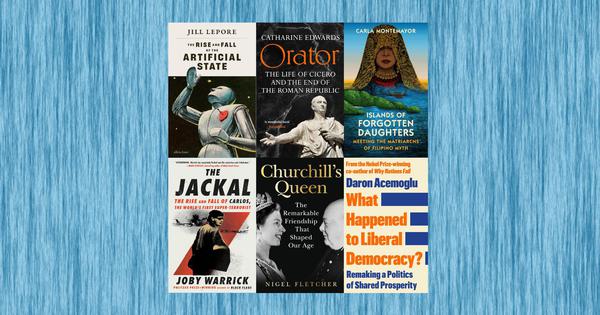
All information sourced from publishers.Islands of Forgotten Daughters: Meeting the Matriarchs of Filipino Myth, Carla MontemayorWhen Carla Montemayor discovers that her great-great-grandmother was a binukot – a girl sequestered from her family and community, trained to memorise and sing the myths of her people – this sets her on her own epic journey to uncover her ancestry. Why was she raised on European fairytales and Greek myths when the stories of her own people are so rich? And why did no one in her family speak of their illustrious binukot foremother anymore?Travelling to the Philippines to trace the lives of her female relatives, Montemayor discovers that, officially, her people have no history. Like many indigenous groups, their stories have been erased by colonists. It becomes her work to reconstruct and reimagine them.Weaving together the tales of her family members, who survived war, oppression, violence, displacement and more, with the myths of her people, Montemayor finds similarities: women with courage, resourcefulness and ambition, who fight and love with equal ferocity.Islands of Forgotten Daughters celebrates these women and tells their tales, offering a fresh perspective on Filipino history and culture. What Happened to Liberal Democracy?: Remaking a Politics of Shared Prosperity, Daron AcemogluFrom its inception, liberalism offered a glittering promise of shared prosperity, equality, democratic values and the free pursuit of knowledge. At first, it flourished. And then it faltered. Once a tantalising beacon of hope, it began to erode and decay at the hands of elitism, intolerance and rising autocracy.One could say that liberalism is broken. So what comes next?Daron Acemoglu charts the rise and fall of liberal democracy, and offers hope for a way forward: a new theory that lays the groundwork for how we can – and must – remake liberalism before it’s too late.The Rise and Fall of the Artificial State, Jill LeporeWe live in the age of data. Over the past century, rapidly evolving technologies have transformed every aspect of our society, in troubling and seemingly unstoppable ways. Political campaigns have been reduced to attention-mining algorithms, multinational corporations control public discourse, and the era of the liberal nation-state seems to be coming to an end, replaced by the rule of artificial intelligence. Today, power is maintained through mystification: machines, we are told, know what humans cannot. Yet nothing about any of this was, or is, inevitable.In this astounding account of how technology has corroded democracy around the world, historian Jill Lepore traces the rise and fall of what she calls the “Artificial State”. Examining everything from robot rights and Elon Musk’s origins to what data centres cost wildlife, Lepore offers a history – and a perspective – wholly missing from the debate.History, Lepore demonstrates, is driven not by machines but by individuals, societies, cultures and ideas. The architects of the Artificial State had no theory of governance, nor did they have any interest in the rule of law, or any capacity for restraint. They drew their ideas not from science, but from science fiction. Yet everything destructive that they have done can be undone. By illuminating the origins of the Artificial State, Lepore reveals how we can escape it – helping us to imagine, and fight for, a different future.The Jackal: The Rise and Fall of Carlos, the World’s First Super-terrorist, Joby WarrickA black-bereted, gun-slinging avatar of one of the most turbulent eras in global politics, Carlos the Jackal burst onto the world stage in 1975 as the first true celebrity terrorist and the TV-ready face of a violent Palestinian resistance movement that was then just beginning to gain traction. In a bloody career that would ultimately span three decades, Carlos innovated a new kind of spectacular terrorism, one that embraced hijackings, hostage crises, airport bombings, and international assassinations. And he personally masterminded one of the most shocking operations of the era: the kidnapping of an entire conference of world oil ministers for ransom in Vienna. The polar opposite of today’s most infamous terrorists, Carlos was a hard-drinking libertine and self-styled romantic who entranced dozens of beautiful women and murdered his victims with callous disregard, often with his own hand.But Carlos was not all that he seemed to be.Through newly declassified archives, secret witness accounts, and a rare interview with the Jackal himself, journalist Joby Warrick reveals a previously hidden side of the man born Ilich Ramírez Sánchez – an ideologically driven figure whose myth was as carefully constructed as his attacks were deadly.Orator: The Life of Cicero and the End of the Roman Republic, Catharine EdwardsWhen the Roman statesman Cicero was murdered in 43 BCE, his head was cut off and his tongue pierced with pins – a final, brutal act of revenge against a man whose words had shaped a generation and made him many enemies. Rising from provincial obscurity to the highest elected office in Rome, Cicero became the greatest orator of his age, a figure who believed that speech itself could defend a republic.Yet Cicero was far more than a master of rhetoric. His long and turbulent life unfolded alongside the collapse of the Roman Republic, and often at its very centre. He moved among Julius Caesar and Pompey the Great, crushed a conspiracy that threatened the foundations of Rome and cast himself as the republic’s last hope. His writings on politics, philosophy and society would prove enormously influential, while his uneasy response to the rise of autocratic power continues to provoke admiration and debate.In this new biography, classicist Catharine Edwards brings Cicero vividly to life, revealing both the brilliance and the contradictions of a man caught between principle and ambition. Churchill’s Queen: The Remarkable Friendship That Shaped Our Age, Nigel FletcherIn February 1952, when the young Elizabeth returned to London after her sudden accession to the throne, Churchill was first to greet her as she stepped off the aircraft. The image was a striking one – an elderly statesman in the twilight of his career paying homage to a young sovereign just embarking on what would become the longest reign in the history of the British monarchy. He already had a lifetime of experience to share, while she had a lifetime of service still to come.Winston Churchill and Queen Elizabeth II rank alongside the most iconic historical figures of all time. They defined the ages in which they lived, and exerted enormous influence on the lives of millions around the globe. But even more extraordinary than their individual achievements is the unique friendship that developed between them, with Churchill helping the fledgling queen to shape the start of her reign, and Elizabeth in turn helping him to retire with dignity and grace, cementing his legacy at the end of his career.Using previously unpublished material from government files and private archives, Churchill’s Queen sheds new light on this historic partnership, revealing how it grew despite challenges and setbacks – and ultimately shaped the monarchy and the nation.
August global nonfiction: Six new titles of world histories that deserve a place on your bookshelf
An examination of the ‘Artificial State’, an account of Queen Elizabeth II and Winston Churchill’s friendship, a remembered history of the Philippines and more.
1,154 words~5 min read