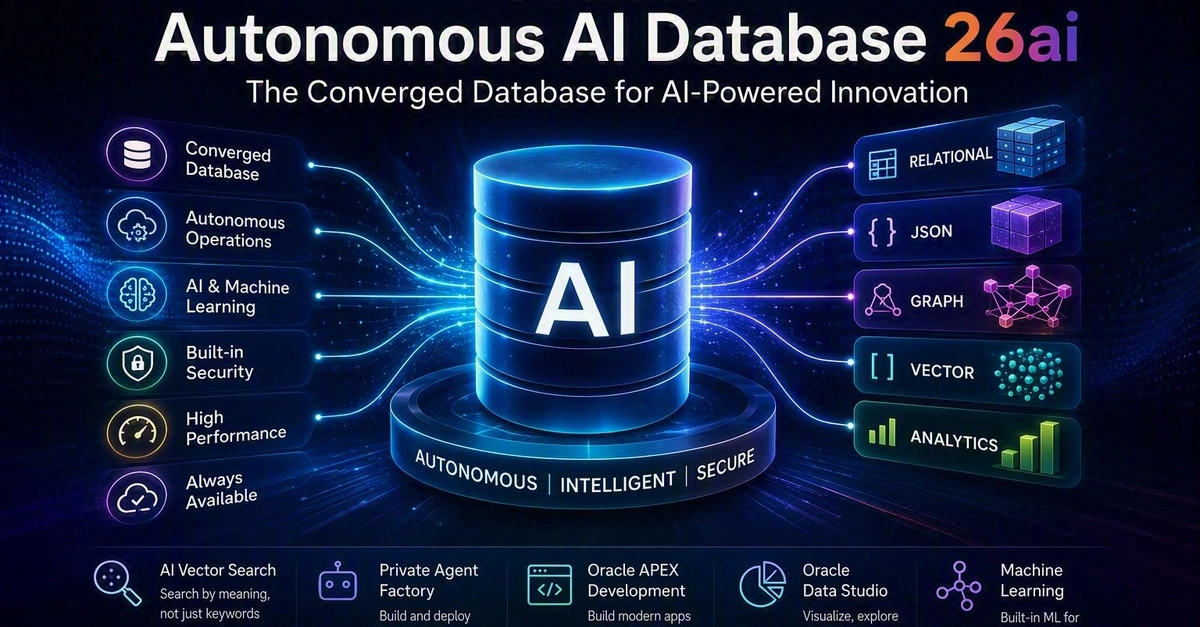
Autonomous databases are quietly rewriting what it means to work in database administration, and the change has almost nothing to do with robots taking over server rooms. It has to do with time. A platform like Oracle Autonomous Database or a managed service such as Amazon RDS now performs the patching, backups, tuning, and scaling that used to consume most of a database administrator's week, and that shift is forcing IT departments to decide what a DBA is actually for once the maintenance work disappears.
The term "autonomous" gets thrown around loosely, so it helps to be precise about what these systems actually do on their own. An autonomous database applies security patches without downtime, monitors query performance and adjusts indexing or memory allocation in response, scales compute and storage up or down based on live workload, and runs automated backups with point-in-time recovery built in. None of this requires a human to log in at 2 a.m. because a batch job is choking on disk space. That single change, removing the pager duty that defined DBA life for two decades, is the real disruption, not some abstract AI takeover narrative.
What the automation actually replaces
The tasks disappearing first are the ones that were always the most repetitive: routine patching, manual backup verification, disk space monitoring, and first-pass performance tuning. These are precisely the responsibilities that showed up in every DBA job description for the last twenty years, and they are also the ones most easily codified into rules a machine can execute. A McKinsey estimate cited by Research.com projects that up to 45% of database-related tasks could be automated by 2030, which lines up with what practitioners are already reporting on the ground.