Story audio is generated using AI
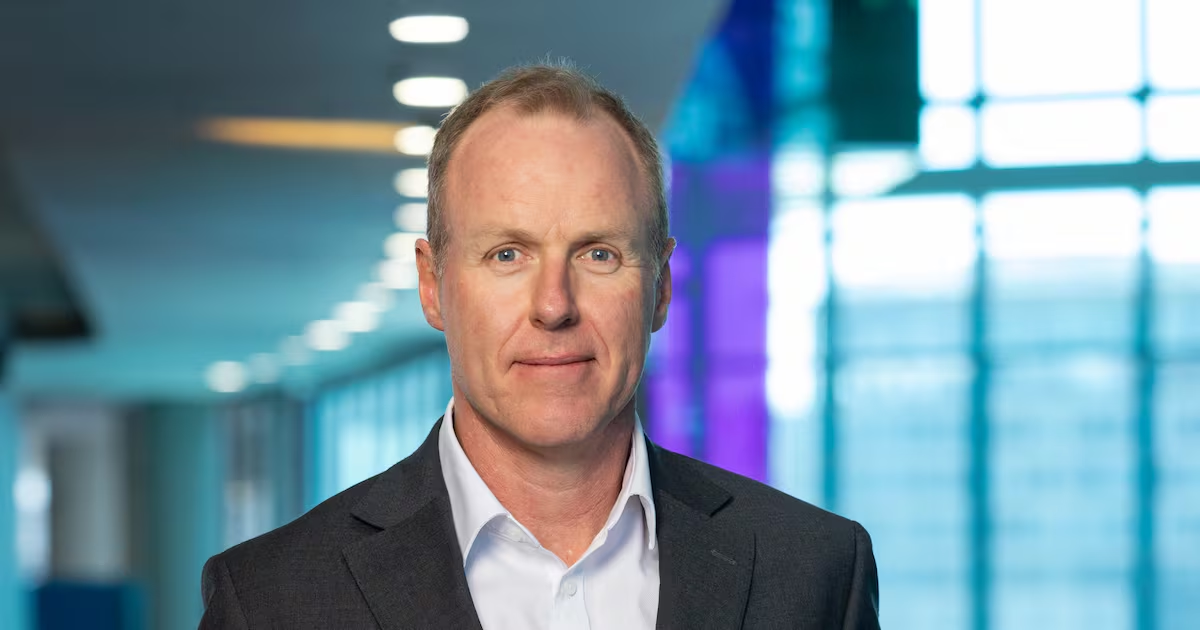
Medshield is stepping up its push into South Africa’s corporate health-care market after recording its strongest membership growth in years. The medical aid scheme wants to lift employer-sponsored members from 40% of its principal membership to around 60% over time. The company says an increasing number of employers are moving from a single medical scheme and are offering workers more choice and affordable medical cover options, adding that this will fuel its next phase of expansion.“Three or four years ago, the corporate market was almost impenetrable. I mean, there was only really one medical scheme that dominated in the corporates. But now most employer groups are allowing more than one medical scheme, and that’s because employees want more choice. When we get into a corporate, we find that a large part of the employee base will choose Medshield because of value for money,” said Medshield chief principal officer Kevin Aron. He said affordability had overtaken lifestyle rewards as the main consideration for employees choosing medical cover. “Five or 10 years ago, loyalty programmes and gym benefits were major selling points. Today employees are far more focused on getting genuine health-care value rather than paying for benefits they don’t necessarily use.”To strengthen its position, Medshield recently entered into a strategic partnership with Sanlam to help the scheme acquire new corporate clients. As part of the partnership, Medshield members will get access to Sanlam’s rewards programme and discounted gap cover.Aron said Sanlam’s extensive corporate client base would provide significant opportunities for growth.Medshield had recorded 11 consecutive months of positive membership growth during 2025, with principal members increasing by 4.5% and total beneficiaries rising 5.3%. Aron attributed membership growth to a combination of competitive pricing, improved customer service and stronger brand awarenessThe momentum continued into 2026, with principal membership growing 8.3% by the end of July and beneficiaries climbing 9.4%. The scheme now covers 80,899 principal members and, including beneficiaries, it had about 160,000 members at the end of July, up from 145,587 in December last year. Corporate members currently account for about 40% of the scheme’s principal membership, while individual members contribute 49% and government employees make up the remaining 11%. Aron attributed membership growth to a combination of competitive pricing, improved customer service and stronger brand awareness. “The value proposition is resonating with consumers. People are looking at what they pay versus what they receive and they see Medshield as offering rich benefits at affordable rates,” he said. The strongest growth is being driven by young people between the ages of 20 and 37, who account for about 70% of new members joining each month. Aron said affordability remained the defining factor behind purchasing decisions.More than 90% of new members select the scheme’s lower-cost options, typically priced between R3,000 and R3,500 a month. “Above that level, we see very little growth. Young professionals simply cannot afford significantly higher contributions,” Aron said.The scheme is also reviewing its product offering ahead of 2027, with affordability taking priority over major benefit expansions.Despite the membership gains, Aron warned that economic conditions remain the biggest threat facing medical schemes. About 90% of members who leave Medshield do so because they can no longer afford their monthly contributions rather than through voluntary resignations.“People still want private medical cover because they know the alternative is often an overstretched public health-care system. The challenge is affordability,” he said.Health-care inflation continues to outpace consumer inflation and wage growth, driven by rising hospital costs, expensive new medicines and growing rates of chronic lifestyle diseases such as hypertension, diabetes and high cholesterol.Mental health claims are also increasing as economic uncertainty contributes to higher levels of stress, anxiety and depression.Medshield paid R2.6bn for hospital claims and more than R4bn in the 2025 financial year. It approved nearly 36,000 hospital admissions. Medshield’s accumulated funds attributable to members for future benefits reached R2.62bn in the 2025 financial year. Its solvency ratio was 53%, more than double the required statutory minimum of 25%. This reserve offers protection against health-care inflation, economic uncertainty and industry challenges, Aron said.Looking ahead, Aron called on regulators to accelerate approval of low-cost benefit options.He said current regulations require medical schemes to provide comprehensive prescribed minimum benefits and maintain minimum solvency levels, making entry-level products significantly more expensive than health insurance alternatives.“If low-cost benefit options were approved, medical schemes could offer products in the R400-a-month range, opening access to millions of younger South Africans who currently cannot afford traditional medical scheme cover,” Aron said. Business Times