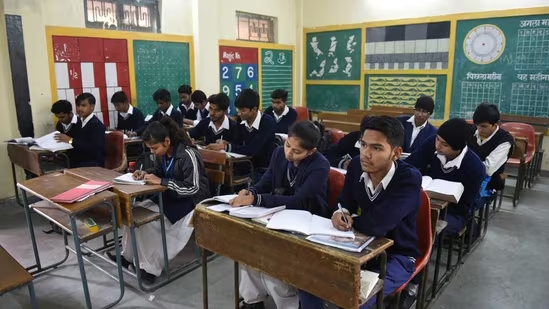
Six years after the National Education Policy (NEP) 2020 was introduced, India has made significant progress in reimagining education. Across the country, schools are embracing competency-based learning, experiential teaching, multilingual education, digital literacy, and holistic assessment practices. Together, these reforms reflect NEP 2020’s vision of creating an education system that is more learner-centric, inclusive, future-ready, and focused on developing real-world skills.(Sign up for THEdge, The Hindu’s weekly education newsletter.)This vision is both ambitious and necessary. Yet, despite widespread acceptance of the policy, one important question remains: Why do classroom outcomes continue to vary so widely?The answer is not that the policy is flawed, nor that schools or teachers are unwilling to change. The missing link lies between intent and everyday classroom execution.Join THEdge LinkedIn groupRecent policy assessments present a nuanced picture. UDISE+ 2025–26 reports total school enrolment at 24.7 crore students, down marginally from 24.8 crore in 2023–24, reflecting a decline of around 8.3 lakh students. At the same time, the report highlights improvements in key indicators, including teacher availability, lower dropout rates, and stronger school infrastructure. The latest Performance Grading Index (PGI) 2.0 also shows that states have made measurable progress in governance and institutional capacity. However, these gains have not been matched by comparable improvements in learning outcomes. Findings from the NITI Aayog’s recent policy report on school education system in India reinforce that systemic improvements alone do not automatically translate into better learning. The challenge today is no longer understanding what the NEP expects schools to do. It is enabling every school to implement those expectations consistently, every single day.From curriculum reform to classroom practiceThe National Education Policy 2020 introduces an innovative approach towards teaching and learning. Students are encouraged to work, participate and engage in the task of problem-solving instead of simply remembering facts. Implementing this shift in thinking requires changes in teaching methods and practices. Many schools have begun this transition. The use of interactive content, virtual laboratories, AI assisted lesson planning, project based learning modules, and competency based assessments is increasing across educational institutions. However, these innovations are often introduced in isolation rather than as part of an integrated teaching model. Technology alone cannot improve learning. It becomes meaningful only when it supports pedagogy rather than replaces it.The teacher remains the centre of every reformDiscussions about the transformation of education often revolve around infrastructure or technology. However, the most valuable resource is the expertise and commitment of every teacher. At the heart of this transformation is the shift from traditional lecture-based instruction to facilitative teaching, where teachers guide students to think critically, solve problems, and apply knowledge in real-world contexts. Today, teachers are expected to adopt competency-based teaching and assessment practices aligned with the National Education Policy (NEP) 2020 and the National Curriculum Framework (NCF), integrate digital tools into classroom instruction, interpret assessment data to identify learning gaps, support mixed-ability classrooms, and prepare students with the skills needed for both academic success and future careers. This expanding role calls for continuous professional development rather than one-time training programmes.Empowering teachers is perhaps the most sustainable way of improving classroom outcomes because every educational reform is ultimately realised in the classroom.Assessment must become a learning toolOne of NEP’s most important reforms is the transition towards competency-based assessment. The objective is not simply to test students differently but to help teachers understand how students think, reason, and apply concepts. To achieve this vision, evaluation methods cannot remain fragmented. They should become continuous feedback mechanisms that inform teaching and individualise learning.Educational institutions that have adopted formative assessment, digital skill tracking, and competency mapping are better able to tailor instruction to individual student needs instead of treating all learners alike. This shift is reinforced by PARAKH, India’s national assessment regulator, which has been established to standardise assessment practices across school education. By promoting the evaluation of conceptual understanding, application of knowledge, and higher-order thinking skills, PARAKH seeks to transform assessment into a tool for improving learning rather than merely measuring performance. Such an approach enables teachers to identify learning gaps early and adapt instruction to meet the needs of individual learnersSchool leadership is the overlooked catalystEducational transformation is often viewed through the lens of teachers and students, but school leadership deserves equal attention. Principals today are expected to oversee curriculum implementation, teacher development, digital integration, compliance requirements, parent engagement, and institutional quality simultaneously.Effective leaders develop schools in such a way that innovation is entrenched in the school system rather than an isolated practice. They foster communication and cooperation between teachers, support evidence-based reasoning, create opportunities for vocational and skill-based learning, and make sure that the integration of technology into the school is an addition to the teaching process rather than an additional burden for the administration.Building ecosystems, not isolated initiativesThe success of NEP implementation is likely to depend less on introducing new reforms and more on how effectively existing reforms are connected and implemented together. Teacher training must be aligned with classroom resources, assessments should help teachers identify learning gaps and improve instruction rather than merely assign marks, and digital learning should nurture inquiry, creativity, problem-solving, and critical thinking instead of learning without participation.Ultimately, schools need an integrated education ecosystem where curriculum, pedagogy, assessment, technology, and teacher support reinforce one another to improve student learning. While NEP 2020 has laid a transformative framework for education in India, its true impact will depend on how consistently these principles are translated into everyday classroom practice. When reforms are implemented in an integrated and sustained manner, classroom outcomes are far more likely to reflect the policy’s vision.(By Monica Malhotra Kandhari, MD of AASOKA, by MBD Group)
The missing link between NEP 2020 and classroom outcomes
Explore the crucial connection between NEP 2020 and classroom outcomes, emphasizing integrated reforms for effective education in India.
934 words~4 min read