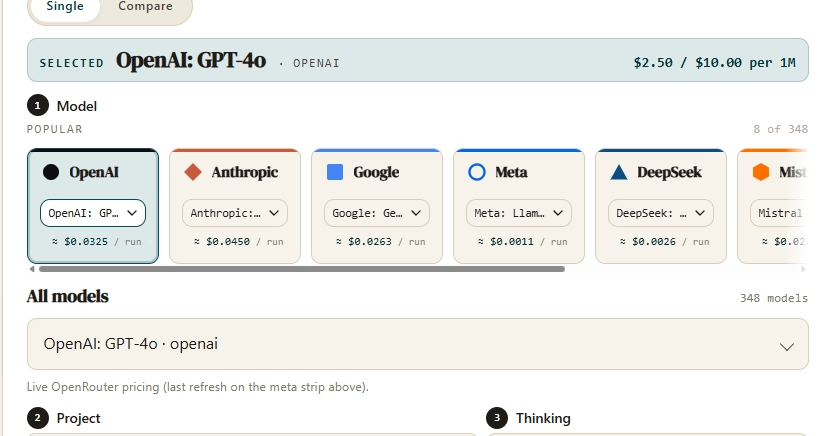
Short answer: don't choose an LLM API for a SaaS app from a public token-price table alone; replay a representative eval set through direct OpenAI, direct Claude API, and an OpenRouter-style routing path, then choose the smallest integration whose measured quality, billed usage, retry behavior, and recovery policy meet your release constraint.
The cheapest path is workload-dependent. A low input rate can hide engineering overhead, while a chatty agent can turn one user action into several model calls. A fallback can rescue an answer and still charge for an earlier attempt. A unified key can reduce credential sprawl, but it also changes the control plane you depend on. Those effects belong in the same experiment.
This is the notebook-to-prod move that matters: keep the comparison as a replayable ledger tied to an eval suite, not as a screenshot of three price pages. Prices and model catalogs can change after publication; the ledger remains useful because fresh quotes and fresh run records can be inserted without changing the decision method.
How should a Node.js SaaS compare token cost and fallback behavior?
Start with user-visible tasks, not providers. Sample the production shapes that drive spend: a short classification, a retrieval-augmented answer with a long context, a tool-using turn, and a regeneration after invalid structured output. Remove sensitive data, freeze the inputs, and attach an acceptance check to every case. If two paths don't clear the same quality bar, their token costs aren't comparable.