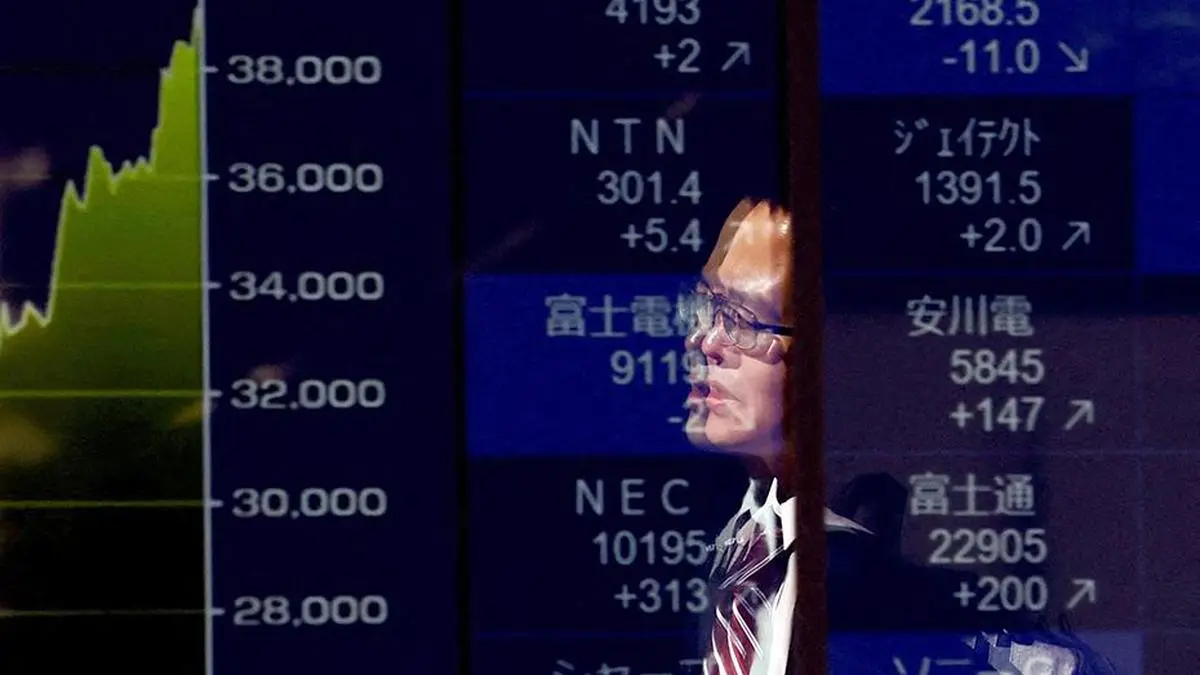
LONDON, Aug 7 : Global stocks headed for their strongest weekly gain since May after a weaker-than-expected U.S. jobs report eased fears of an imminent Federal Reserve rate hike, while strong earnings and AI enthusiasm outweighed concerns about the Iran war.U.S. stocks opened higher on Friday and Treasury yields fell, reflecting ebbing expectations that the Fed will raise rates at next month's meeting. The Nasdaq rose 0.7 per cent in early trading and the dollar fell, giving the Japanese yen a reprieve. The yen strengthened to 157.20 per dollar after earlier nearing 159, a level widely seen as a potential trigger for policy intervention. MSCI's All-World index has risen 2.4 per cent this week, the most in three months, and was steady on Friday. Europe's STOXX 600 was up 0.6 per cent on the day and 2 per cent for the week, led by gains in healthcare and technology shares.
The U.S. payroll report showed employment fell by 23,000 jobs, confounding expectations in a Reuters poll for an increase of 80,000. Analysts said the data gave the Fed more room to keep rates unchanged next month while assessing upcoming economic indicators, including next week's U.S. inflation report."History doesn't repeat, but sometimes it rhymes," said Lindsay Rosner, head of multi-sector fixed-income investing at Goldman Sachs Asset Management in New York. "For the third time in as many years, July jobs data saw a mid-summer loss of momentum. While incoming inflation data will be the ultimate arbiter, slowing jobs growth helps support a September hold."TRADERS SPLIT ON FED RATE RISEMoney markets had been evenly divided on the prospects of a Fed rate increase next month before the payrolls report. After the data, the implied probability of a hike fell to about 40 per cent from roughly 55 per cent earlier."With yields and inflation still the key risks for stocks, we expect Friday's NFP to trade as a 'good news is bad news' print," said Michael Feroli, chief U.S. economist at JPMorgan.Conflict in the Middle East flared up again after Yemen's Iran-aligned Houthis attacked Saudi Arabia, a major oil exporter. Riyadh warned that coordinated attacks by the Houthis and Iran-backed Iraqi militias were imminent.Brent crude futures reversed course on Friday to fall 0.7 per cent to around $82 a barrel, as investors largely shrugged off Saudi Arabia's warnings.Iran, meanwhile, is reviewing a preliminary bill that would bar U.S., Israeli and other "hostile" vessels from transiting the Strait of Hormuz, Iran's semi-official Fars news agency reported on Thursday, citing a lawmaker. The draft bill would impose fines of up to 20 per cent of a ship's cargo value for violations.Treasury yields fell after the soft jobs report. The 2-year note yield fell 7 basis points to 4.176 per cent, while the 10-year yield dropped 5 basis points to 4.61 per cent.The U.S. currency slipped alongside rate expectations, pushing the dollar index down 0.5 per cent to 99.43 and lifting the yen. Gold moved inversely to the dollar, rising to its highest in around six weeks this week while the U.S. currency hovered near six-week lows. Bullion has gained nearly 7 per cent this week, its strongest weekly performance since mid-January, when it hit a record $5,594. It was last up 2 per cent at $4,322 an ounce. (Additional reporting by Stella Qiu in Sydney. Editing by Alex Richardson, Colin Barr and Mark Potter)