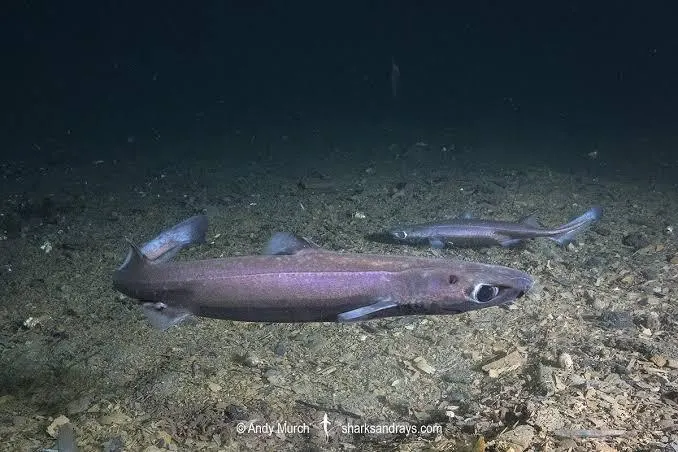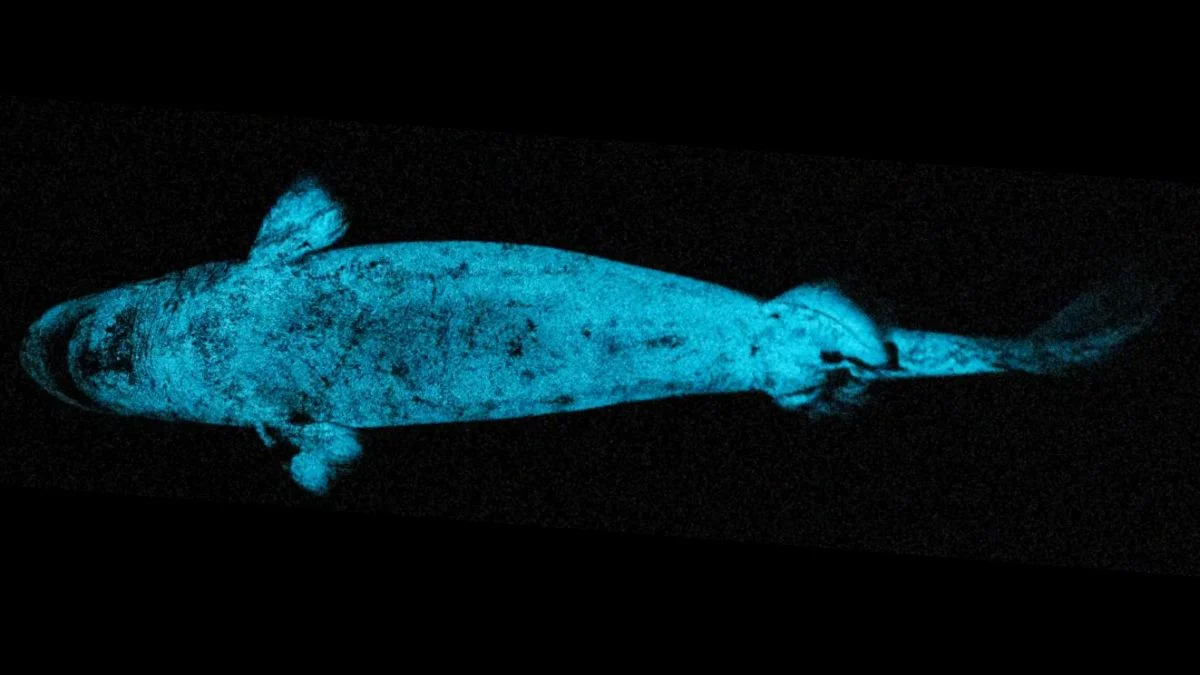
In the deep, dim ocean, a world of eat-or-be-eaten, lighting up may seem like a counterintuitive survival strategy.Nevertheless, it helps many animals hide from predators that might strike from below – a shine that conceals the shadow they cast against the faint light filtering down from above.Now, however, scientists have found evidence that one of the most stunning bioluminescent animals in the ocean may have been using its light in another way all along.The kitefin shark (Dalatias licha) is the world's largest glowing vertebrate and has no known natural predators.And instead of simply hiding, it may also use its glow like a searchlight to find prey, reports a team led by marine biologist Julien Claes of Université catholique de Louvain in Belgium."What differs is the selective context: the identity of the visual observer whose detection the organism is evolving to avoid," the team writes in a paper published in iScience.The kitefin shark in its habitat deep under the sea. (jgrimshaw/iNaturalist, CC BY-NC 4.0)Counterillumination is a surprisingly common form of camouflage in the open ocean.The deeper into the ocean you dive, the less light penetrates. It's scattered and absorbed by water molecules until, eventually, the sea is completely dark. At the top of the water column, conditions are well-lit; by a few hundred meters down, everything becomes murky and dim.The animals that live in this part of the ocean can have vision exceptionally sensitive to the little light that filters down.An animal swimming overhead can stand out starkly as a dark silhouette against the faint glow from above. Bioluminescent counterillumination lights up that silhouette just enough so that it blends in with the dim light.Since the kitefin shark – in which bioluminescence was only confirmed a few years ago – has no known natural predators, that suggests its glow has less to do with evasion and more to do with concealment.But concealment from what?A diagram showing how counterillumination works to conceal the firefly squid. (Ian Alexander/Wikimedia Commons, CC BY-SA 4.0)Usually, counterillumination needs to be incredibly precise. It's not enough for an animal simply to glow; its light needs to resemble the ambient light it is trying to disappear against.One other curious characteristic of kitefin sharks sharpened the mystery.Unlike other animals that use counterillumination, kitefin shark bioluminescence covers almost their whole body, including the dorsal fin. If camouflage was the only purpose, why would the shark's fin need to glow?To investigate, the researchers examined eight live sharks caught as bycatch during a survey of Chatham Rise, to the east of New Zealand, They asked three questions: How bright is the glow? What color is it? And – crucially – in which direction does it shine?The measurements revealed that the glow on the underside of the shark has the color and brightness that would be expected for counterillumination – a bluish-green light peaking at a wavelength of 491 nanometers.That color closely matches the residual daylight found at these depths, while the brightness of the glow matched the daylight predicted at depths of around 480 to 540 meters (1,575 to 1,770 feet) – smack-bang in the shark's habitat range.The glowing shark as seen from the side. (Claes et al., iScience, 2026)But then it got weird.When the researchers looked at the direction of the shine, they found that instead of closely matching the pattern of downwelling daylight, the kitefin's glow spreads sideways, significantly more broadly than any of the other counterilluminating animals they used for comparison.The effect was strongest towards the front of the shark – the nose, the jaw, and the pectoral fins."One parsimonious explanation," the researchers write, "is that this excess lateral emission functions as a biological searchlight, illuminating the seafloor to the sides of the shark and potentially enhancing prey detection in the otherwise dark benthic environment."It's not as weird as it sounds. Other sea creatures, such as the splitfin flashlightfish (Anomalops katoptron) and stoplight loosejaws (Malacosteus), use bioluminescence to find prey.
'Biological Searchlight': World's Largest Glowing Vertebrate May Use Its Light to Hunt Prey
In the deep, dim ocean, a world of eat-or-be-eaten, lighting up may seem like a counterintuitive survival strategy.
954 words~4 min read